
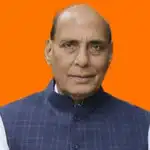
Rajnath Singh
Defence Minister, Government of IndiaBirth DetailsJuly 10, 1951 | Bhabhuara, Chandauli, UP
NationalityIndian
LeaguePolitician
EducationMSc Physics, Gorakhpur University
Rajnath Singh's Journey so far ...
Before you go ...
- Rajnath Singh went to a local school in his village in Uttar Pradesh's Chandauli district. He then joined Gorakhpur University from where he completed his MSc in Physics. His first job was that of a lecturer of Physics at Mirzapur's K.B. Post-Graduate College
- He joined the Akhil Bharatiya Vidyarthi Parishad (ABVP) and was its secretary for the Gorakhpur division from 1969 to 1972. He joined the RSS and became its general secretary of Mirzapur division in 1972
- Singh began his political career at the age of 24 with the Jan Sangh in 1975, and was first elected to the UP Assembly in 1977 from Mirzapur
- He was appointed as State Secretary of UP BJP in 1983 and in the following year became the State President of the BJP's youth wing (BJYM). In 1988 he became the National President of the BJYM
- In 1988, he was elected to the Upper House of the UP Legislative Council and became the Education minister of the state in 1991. During his tenure, he introduced the Anti-Copying Act and Vedic Mathematics in the syllabus
- He was elected to the Rajya Sabha in 1994 and also became the party's chief whip in the Upper House. In 1997, Singh became the president of UP BJP and played a crucial role in saving the state government during political crises
- In November 1999, he became the Union Minister for Surface Transport and initiated the National Highway Development Programme (NHDP), a dream project of Prime Minister Atal Bihari Vajpayee
- In October 2000, Rajnath took oath as the Chief Minister of Uttar Pradesh and remained in the post till 2002. In May 2003, he was given the charge of the Union Agriculture Ministry by PM Vajpayee. He introduced projects like Kisan Call Centre and Farm Income Insurance Scheme
- In 2004, he was appointed as National General Secretary of the BJP and in the following year became the party's president. Rajnath Singh served as BJP president from 2005 to 2009, and briefly again from 2013 to 2014 following the resignation of Nitin Gadkari. After he took charge as Union minister, Amit Shah took his place
- As the party president, he toured the country highlighting the failures of the UPA government. During his presidentship, Narendra Modi was anointed as the BJP's PM candidate for the 2014 Lok Sabha polls
- In 2014, Singh contested the Lok Sabha polls from the Lucknow constituency and won comprehensively. He was sworn-in as the home minister in the Modi cabinet and played an effective role as number 2 to PM
- As home minister, he led the effort on Jammu & Kashmir, first managing a difficult alliance and then changing course after the alliance broke. During his stint, Singh was able to contain Maoist violence and squeeze their operational areas. He also took certain administrative decisions which allowed paramilitary forces to enjoy greater autonomy in financial matters and liberalised visa regimes. Apart from that, he was also tasked by Modi to help him fight political problems, including those related to farmers
- He again contested from Lucknow in the 2019 Lok Sabha polls and won from there. He was sworn-in as the Defence Minister in Modi Cabinet 2.0 in 2019
- As Raksha Mantri, he initiated various reforms particularly involving women. Some of them include induction of women in the corps of military police and increasing the tenure of women officers in SSC from 10 to 14 years
- After the Galwan clash in 2020, Singh personally conveyed his appreciation and compliments to the Army personnel from the Bihar Regiment for displaying exemplary grit and courage in valiantly fighting the Chinese troops
Before you go ...
- Rajnath Singh is sought after as a leader who understands farmers’ issues
- Even after several decades in politics, the teacher in him is alive and he loves interacting with students and youth of India
- The veteran politician has also written a book on Unemployment - Its Reasons and Remedies
Last Updated: 27/09/2021
Rajnath Singh News
- "Strengthen aspirations of 140 crore Indians": Rajnath Singh hails India's 7.7% GDP growth in FY 2025-26India's economy achieved a strong 7.7 percent growth in financial year 2025-26. This performance accelerated to 7.8 percent in the fourth quarter. Defence Minister Rajnath Singh highlighted this resilience, attributing it to the 'Reform, Perform, Transform' mantra. India continues to lead as the world's fastest-growing major economy amidst global uncertainty. This growth strengthens aspirations for Viksit Bharat.

- India no longer weak, has become powerful: Defence Minister Rajnath SinghDefence Minister Rajnath Singh states India's global standing has improved significantly under Prime Minister Narendra Modi. He highlights the nation's economic achievements and success in controlling inflation amidst global uncertainties. Singh also emphasized the importance of tree plantation for environmental conservation and prosperity. He participated in the 'Ek Ped Maa Ke Naam' (A Tree in the Name of Mother) campaign in Lucknow.
- Defence ministry doubles financial powers of field commandersDefence ministry has doubled financial powers for field commanders. This move aims for faster procurement and efficient operations. Army commanders can now approve up to 100 crore rupees. Service chiefs have a limit of 125 crore rupees. These enhanced powers will support procurements worth 1.25 lakh crore rupees this financial year. This reform will also boost indigenisation and joint procurements.
- Rajnath approves over 2-fold increase in financial ceiling for field commanders to boost operational efficiencyDefence Minister Rajnath Singh has approved a significant increase in financial powers for field commanders, more than doubling them to Rs 100 crore per project. This move aims to enhance operational efficiency, expedite contract conclusion, and boost indigenous defence capabilities. The revision also includes provisions for joint service procurement and decentralizes decision-making for goods and services.
- India, Australia to develop MoU on defence articles, services after second defence ministers' dialogueIndia and Australia will develop a defence cooperation agreement. This follows their second Defence Ministers' Dialogue. The countries aim to boost maritime security and expand military exercises. Defence industry collaboration and science technology exchanges are also planned. Training cooperation will see an Indian instructor at an Australian college. Both nations support Indo-Pacific maritime surveillance initiatives.
- India, Australia to hold second defence ministers' dialogue in New Delhi on June 1India and Australia are set to enhance their defense ties. Defence Minister Rajnath Singh and his Australian counterpart Richard Marles will co-chair a dialogue in New Delhi. The meeting aims to strengthen strategic and military cooperation in the Indo-Pacific region. Discussions will focus on interoperability, industry partnerships, and co-development. This engagement underscores the growing maturity of the bilateral defense relationship.
- Pakistan Navy remained confined to ports during Operation Sindoor: Rajnath SinghDefence Minister Rajnath Singh inaugurated the Nausena Shaurya Vatika in Lucknow. He stated the Indian Navy confined Pakistan's navy to ports during Operation Sindoor. The museum showcases naval achievements and inspires citizens. India's defence manufacturing and exports have significantly increased. Uttar Pradesh has transformed under Chief Minister Yogi Adityanath.
- Rajnath Singh releases volume on Operation Sindoor with accounts of officers, aviators, other combatantsDefence Minister Rajnath Singh has officially launched the book 'Operation Sindoor', a documented chronicle of extraordinary heroism featuring accounts from 100 dedicated participants. This pivotal operation not only marked a significant achievement but also led to an expedited ceasefire with Pakistan.
- No power can stop India from being biggest exporter of weapons in 25-30 years: Rajnath SinghDefence Minister Rajnath Singh stated India will be the world's largest weapons exporter within 25 to 30 years. He inaugurated an ammunition manufacturing unit in Shirdi. The government aims for the private sector to contribute 50 percent to defence production. Singh emphasized the private sector's role in producing advanced weapon systems.
- India, South Korea sign pact in key areas of defence cooperationIndia and South Korea have strengthened their defence ties. MoUs were signed in key areas like defence cyber, training, and UN peacekeeping cooperation. Defence Ministers Rajnath Singh and Ahn Gyu-back held extensive discussions in Seoul. They reviewed existing cooperation and explored expansion in industry, maritime security, and emerging technologies. Both nations reaffirmed their commitment to a free and open Indo-Pacific.
- India tests ULPGM-V3 fire and forget missile that can be launched from drones; Check its featuresDRDO ULPGM-V3 has successfully completed development trials in both air-to-ground and air-to-air modes, marking a major boost to India’s indigenous defence capabilities. The UAV-launched precision-guided missile can engage tanks, drones and airborne targets at ranges of up to 10 km. Equipped with advanced seeker technology and modular warheads, the missile is seen as a key step towards defence self-reliance.
- India to back Vietnam's defence modernisationDefence Minister Rajnath Singh affirmed India's dedication to Vietnam's defence modernization. Discussions with Vietnam's Deputy PM and Defence Minister General Phan Van Giang focused on strengthening cooperation. Key areas included maritime security, defence industry, and military training. Both nations also exchanged views on regional and global security matters. This visit underscores a deepening bilateral defence partnership.
- 'Our discussion today will further strengthen defence cooperation': Rajnath Singh during bilateral talks in VietnamIndia's Defence Minister Rajnath Singh met his Vietnamese counterpart Phan Van Giang in Hanoi. They reviewed defence ties and regional security. The meeting marked ten years of their Comprehensive Strategic Partnership. Both nations agreed to expand cooperation in maritime security and defence industry.
- Defence Minister Rajnath Singh pays homage to Ho Chi Minh in HanoiDefence Minister Rajnath Singh visited Hanoi, Vietnam. He paid tribute to Ho Chi Minh on his birth anniversary. Singh held important discussions to boost defence cooperation and strategic ties between India and Vietnam. The visit also included talks on potential BrahMos missile system supply. This trip is part of a larger tour to enhance India's Indo-Pacific partnerships.
- Rajnath Singh embarks on 4-day trip to Vietnam and South KoreaDefence Minister Rajnath Singh is on a four-day visit to Vietnam and South Korea to bolster strategic defence cooperation, including joint production of military hardware. The trip aims to strengthen defence industrial partnerships, enhance maritime collaboration, and promote peace in the Indo-Pacific region. Discussions will also cover the South China Sea situation and explore new initiatives for bilateral engagements.
- Rajnath Singh, N Chandrababu Naidu launch Combat Aircraft infrastructure facility in Andhra PradeshIndia has officially launched its ambitious Advanced Medium Combat Aircraft project. Defence Minister Rajnath Singh and Andhra Pradesh Chief Minister N Chandrababu Naidu attended the groundbreaking ceremony. The manufacturing unit for these next-generation stealth fighter jets will be established in Puttaparthi.
- Rajnath Singh, Chandrababu Naidu launch Rs 15,803 crore AMCA project in Andhra PradeshDefence Minister Rajnath Singh and Chief Minister N. Chandrababu Naidu initiated a significant defence project in Andhra Pradesh. The Rs 15,803-crore Advanced Medium Combat Aircraft infrastructure project was launched. This initiative is set to create thousands of jobs and boost India's defence manufacturing capabilities. The leaders also inaugurated other defence and drone initiatives, positioning the state as a technology hub.
- Rajnath Singh, Chandrababu Naidu launch Rs 15,803 crore AMCA project in Andhra PradeshDefence Minister Rajnath Singh and Chief Minister N. Chandrababu Naidu initiated a significant defence project in Andhra Pradesh. The Rs 15,803-crore Advanced Medium Combat Aircraft infrastructure project was launched. This initiative is set to create thousands of jobs and boost India's defence manufacturing capabilities. The leaders also inaugurated other defence and drone initiatives, positioning the state as a technology hub.
- Modern warfare respects no silos, success to rely on forces' integration across domains: Rajnath SinghIn a video message played at the defence conclave 'Kalam & Kavach' at Manekshaw Centre here, Singh said, "A nation's strength will increasingly depend on how quickly its defence forces, laboratories and industries think and act as one."
- India has 60 days of crude oil, 60 days of Natural Gas & 45 days of LPG rolling stock: CentreIndia is launching a national mission to conserve fuel amid global energy market turmoil. The government assures citizens of robust energy security and ample reserves. This collective effort aims to ease the nation's financial burden from high international crude prices. Prime Minister Modi urges public participation to reduce consumption and protect foreign exchange reserves.
- India tests 'Divyastra': How the new multiple-entry nuke missile will boost India's capability to reach any city in China or PakistanIndia successfully flight-tested an advanced Agni-5 missile with MIRV technology, capable of striking multiple targets simultaneously. This demonstration, dubbed 'Mission Divyastra', significantly enhances India's strategic deterrence and defence preparedness. The development positions India among nations with advanced intercontinental strike capabilities, bolstering its long-term security posture.
- Defence Minister Rajnath Singh chairs high-level West Asia review as PM Modi calls for ‘economic self-defence’Defence Minister Rajnath Singh chaired a meeting on West Asia's evolving situation. Prime Minister Narendra Modi called for nationwide economic resilience. Citizens are urged to conserve fuel, reduce imports, and minimize foreign exchange outflows. The government is assessing the impact on India's economy and energy security. Collective behavioral change is emphasized for national responsibility.
- Rajnath Singh to chair meeting of Informal Group of Ministers over West Asia conflict at 10:30 amDefence Minister Rajnath Singh chairs a meeting on the West Asia situation. Prime Minister Narendra Modi calls for collective economic resilience. Citizens are urged to reduce fuel consumption, opt for public transport, and support local products. The Prime Minister also encourages domestic tourism and mindful foreign exchange spending.
- India successfully tests Agni missile with MIRV systemIndia successfully tested an Advanced Agni missile with a MIRV system on May 8, 2026. The missile carried multiple payloads, hitting different targets across the Indian Ocean Region. This trial demonstrated India's capability to strike multiple strategic locations with a single missile. The Defence Minister congratulated DRDO and the Indian Army on this significant achievement for national defence preparedness.
- Operation Sindoor reflected Indian military's joint prowess: Rajnath SinghDefence Minister Rajnath Singh praised Operation Sindoor for showcasing India's military prowess. He urged commanders to stay prepared for evolving security threats. The minister stressed the need for advanced technologies like AI and secure networks. Future conflicts will involve hybrid warfare across multiple domains. Singh highlighted the importance of jointness and innovative thinking for military success.
- DRDO tests India’s first indigenous glide weapon system 'TARA'India's indigenous glide weapon system, TARA, successfully completed its first flight trial off the coast of Odisha. Developed by DRDO, TARA converts unguided warheads into precision-guided weapons. This advancement enhances the accuracy and lethality of low-cost weapons for ground target neutralization. The successful trial marks a significant step in bolstering India's self-reliance in defence technology.
- Rajnath Singh releases film on Operation Sindoor in JaipurDefence Minister Rajnath Singh released a film on Operation Sindoor in Jaipur. The movie marked the first anniversary of the military operation. Singh was received by Rajasthan Chief Minister Bhajanlal Sharma. The film honors the armed forces' courage and spirit. It reflects India's resolve to safeguard its sovereignty.
- Rajnath Singh, Amit Shah, other ministers change social media profile photos to 'Op Sindoor' logoIndian ministers marked the first anniversary of Operation Sindoor by changing their social media profile pictures. Prime Minister Narendra Modi urged citizens to do the same to honor the armed forces. Operation Sindoor was a decisive response to the Pahalgam terror attack. Indian forces conducted precision strikes in Pakistan and Pakistan-Occupied-Kashmir. The operation demonstrated India's resolve and military capability.
- Powerful symbol of national resolve, preparedness: Rajnath Singh on anniversary of Operation SindoorDefence Minister Rajnath Singh commemorated Operation Sindoor. This operation was a strong military response to a terror attack. Indian forces targeted terror launchpads in Pakistan and Pakistan-occupied Jammu and Kashmir. Over 100 terrorists were eliminated. Pakistan responded with attacks, leading to a conflict. India conducted retaliatory strikes. A ceasefire was agreed upon, ending the hostilities.
- Operation Sindoor anniversary: Rajnath Singh to lead national security review in JaipurUnder the operation, India launched a series of precision missile strikes on nine terror camps in Pakistan and Pakistan-occupied Kashmir in the early hours of May 7 last year eliminating at least 100 terrorists, in response to the horrific Pahalgam terror attack that killed 26 innocent civilians.
- Rajnath Singh: Operation Sindoor showed world Indian military's capabilitiesDefence Minister Rajnath Singh hailed Operation Sindoor as a unique example of the Indian military's technological prowess in striking terror groups and their patrons. He highlighted the operation's decisive nature, achieved through advanced missile systems and latest equipment, serving as a global reminder of India's capabilities.
- What is NASM SR? Indian Navy, DRDO conduct maiden salvo launch of naval anti ship missile off Odisha coastIndia's Defence Research and Development Organisation and the Navy achieved a significant milestone with the first-ever salvo launch of a Naval Anti-ship Missile Short Range from a helicopter off Odisha's coast. This advanced, indigenously developed missile system demonstrated impressive capabilities, including hitting its target at waterline. The successful test bolsters India's naval defence prowess.
- India known for IT, Pakistan for international terrorism, says defence minister Rajnath SinghDefence Minister Rajnath Singh highlighted India's strength. He stated Pakistan is known for international terrorism, while India excels in information technology. The nation is prepared for prolonged conflict and has enhanced its surge capacity.
- Stopped Op Sindoor voluntarily, were ready for long war: Rajnath Singh calls Pakistan "epicentre of international terrorism"Defence Minister Rajnath Singh highlighted India's decisive action in Operation Sindoor. He affirmed India voluntarily halted the operation and was ready for a prolonged conflict with Pakistan. Singh identified Pakistan as the epicentre of international terrorism. He stressed the need to uproot terrorism's ideological and political foundations. India's military capabilities have expanded significantly.
- Congress accuses Rajnath Singh of giving 'clean chit to Pakistan', dubs his remarks at SCO 'anti-national'Congress criticizes Defence Minister Rajnath Singh's remarks on terrorism at an SCO meeting. The party claims Singh provided a 'clean chit' to Pakistan, labeling his statements 'anti-national'. Congress alleges this stance aligns with Prime Minister Narendra Modi's policies towards the US and China. The Defence Minister's comments in Bishkek are under scrutiny.
- No immunity for terror hubs: Rajnath Singh at SCO meetIndia's Defence Minister Rajnath Singh declared at a Shanghai Cooperation Organisation summit that terrorism hubs will face consequences. He stressed a unified global stance against terror, separatism, and extremism. Singh highlighted India's resolve to respond to terror threats. He called for a world order prioritizing co-existence over conflict. Nations must act collectively against terrorism without double standards.
- There must not be any double standards in combating terrorism: Defence minister Rajnath Singh at SCO meetIndia's Defence Minister Rajnath Singh addressed the Shanghai Cooperation Organisation. He stressed the need to fight state-sponsored terrorism. Singh stated there should be no double standards in this fight. He also highlighted the growing threats of extremism and radicalism. The minister called for global efforts to tackle these challenges. He noted current geopolitical upheavals and conflicts.
- West Asia in focus as SCO Defence Ministers assemble in BishkekDefence minister Rajnath Singh will attend the Shanghai Cooperation Organisation Defence Ministers' meeting in Bishkek. Geopolitical developments and the West Asia situation will be key discussion points. India will emphasize its commitment to global peace and zero tolerance for terrorism. The meeting will also explore ways to mitigate the impact of ongoing conflicts. Bilateral talks with counterparts are also scheduled.
- Rajnath Singh to attend SCO Defence Ministers' Meet in Kyrgyzstan; to pitch for 'zero tolerance' for terrorismDefence Minister Rajnath Singh is in Bishkek, Kyrgyzstan for the SCO Defence Ministers' Meeting. He will highlight India's commitment to global peace and its zero-tolerance stance on terrorism. The visit includes bilateral meetings with counterparts and engagement with the Indian community. Discussions will focus on counter-terrorism, joint military exercises, and intelligence sharing.
- Arunachal CM Pema Khandu meets with Rajnath Singh, seeks support for critical infraArunachal Pradesh Chief Minister Pema Khandu met Defence Minister Rajnath Singh in New Delhi. He requested ongoing assistance for crucial infrastructure in the border state. The Chief Minister highlighted development in border districts, enhancing security and local lives. Discussions focused on the Akajan-Likabali-Bame corridor and a key bridge.
- Rajnath Singh invites German industry to co-develop, co-produce modern defence systems with IndiaDefence Minister Rajnath Singh urged German companies to partner with India for co-development and co-production. He highlighted India's growing market and skilled workforce. This collaboration aims to build resilient supply chains and foster mutual growth. India offers stability and a commitment to the rule of law for long-term investments. The partnership focuses on niche technologies and strategic cooperation.
- India to get German submarines soon: Check key features and capabilities of TKMS Type 214 submarines to be acquired under $8 billionIndia is set to acquire advanced Type 214 submarines from Germany. Defence ministers from both nations visited a submarine facility, highlighting cooperation. The deal, valued between eight and ten billion dollars, includes technology transfer and local manufacturing. Six submarines will be built in India, with the first expected in seven years.
- 'It is possible': Rajnath Singh says India may 'play its role' in bringing peace in Middle EastIndia has signalled a possible diplomatic role in the ongoing West Asia crisis, with Defence Minister Rajnath Singh saying New Delhi could step in to help initiate peace efforts. He added that Prime Minister Narendra Modi has urged both sides to end the conflict and is taking a balanced approach.
- India will never forget, terror will be met with strength: Rajnath Singh pays tribute to victims of Pahalgam terror attackRemembering the victims of the April 22, 2025, terror attack, Singh said, "Remembering and paying my heartfelt tributes to the innocent people who lost their lives in the cowardly terror attack at Pahalgam in Jammu and Kashmir on 22 April 2025. We share the enduring pain of their loved ones and families. We will never forget those wounds inflicted on our nation. India has endured decades of cross-border terror, but today our response is firm, decisive and unwavering. Through determined action, we have demonstrated that any attempt to harm our people or disrupt our unity will be met with strength and clarity."
- Iran-US war: Strait of Hormuz disruptions have implications for India, says Rajnath SinghDefence Minister Rajnath Singh warned that disruptions in the Strait of Hormuz directly threaten India’s energy security and economic stability, calling West Asia instability a global concern. In Germany, he urged stronger India–Germany defence ties, expanded industrial cooperation, and coordinated responses to emerging security challenges including cyber, AI and drone warfare.
- We don't disturb anyone, but don't spare those who attack us: Defence Minister Rajnath on Operation SindoorDefence Minister Rajnath Singh declared India's stance on security. He stated the nation does not initiate conflict but will not hesitate to respond to attacks. These remarks were made in reference to Operation Sindoor. The comments come ahead of the anniversary of a terror attack in Jammu and Kashmir.
- India successfully carving out distinct identity in major sporting events: Rajnath SinghDefence Minister Rajnath Singh highlighted India's growing global presence in sports beyond cricket and hockey. Investments in infrastructure and programs like Khelo India are empowering athletes and promoting traditional sports, he said.
- India will soon become self-reliant in defence sector, find itself among leading nations of the world: Rajnath SinghIndia's defence production has reached a record 1.51 lakh crore rupees for 2024-25. Defence exports also hit an all-time high of 38,424 crore rupees in 2025-26. Defence Minister Rajnath Singh is confident India will soon be self-reliant and a global leader. Lucknow is now a Defence Node, manufacturing BrahMos missiles.
- Rajnath Singh to visit Germany, defence investor summit in focusDefence Minister Rajnath Singh will visit Germany this month for high-level talks. The visit includes a special defence investor summit in Munich. Top military manufacturers from both India and Germany will attend. This summit aims to explore collaboration and strategic partnerships. India is also set to sign a significant submarine deal with German firm TKMS.
- Rajnath Singh hits out at Mamata over 'appeasement', says TMC means 'Total Misrule and Corruption'Defence Minister Rajnath Singh launched a strong attack on West Bengal Chief Minister Mamata Banerjee. He accused her government of appeasement politics and encouraging infiltration for votes. Singh also alleged misrule and corruption in the state. He stated the central government aims to bring industry and jobs to West Bengal.
- "Only God knows how many parts Pakistan will be divided into if they cast an eye on Bengal”: Rajnath SinghIndia's Defence Minister Rajnath Singh issued a strong warning to Pakistan. This followed a provocative statement by Pakistan's Defence Minister threatening to strike Kolkata. Singh reminded Pakistan of its past division and cautioned against eyeing Bengal. He stated only God knows the consequences if Pakistan attempts such an action.
- Must explore how AFMS can make meaningful contribution in domain of clinical trials: Rajnath SinghDefence Minister Rajnath Singh highlighted the need for clinical trial reforms in India. He suggested the Armed Forces Medical Services can play a key role in advancing medical knowledge. Singh also emphasized health security as vital for national progress. He spoke at an event marking the Army Medical Corps' Raising Day, where new facilities were inaugurated.
- Pakistan would hit Kolkata in 'future' conflict: Defence Minister Khawaja AsifPakistan's Defence Minister Khawaja Asif has issued a stern warning to India. He stated that any future misadventures by India will be met with a strike in Kolkata. Asif claimed intelligence reports suggest India is planning a false flag operation. He made these remarks while speaking to reporters in Sialkot.
- India commissions third nuclear-powered submarine INS AridamanIndia has commissioned INS Aridaman, its third nuclear-powered submarine. This indigenously built vessel is the nation's largest submarine. It is armed with nuclear-tipped missiles, significantly boosting India's nuclear triad. The submarine can stay submerged for extended periods and launch long-range nuclear missiles.
- Navy ensures security of Indian commercial ships, oil tankers: Defence Minister Rajnath SinghDefence Minister Rajnath Singh highlighted the Indian Navy's crucial role in protecting trade routes and energy supplies. The Navy maintains a constant presence in the Indian Ocean, ensuring the safe passage of commercial ships and oil tankers. A strong navy is deemed a necessity for India's security and its vision for a developed nation by 2047.
- Defence minister Rajnath Singh says 'No dearth of fuel or gas in country'Defence Minister Rajnath Singh stated India has ample fuel and gas to face any energy crisis from the West Asia conflict. Indian Navy ships are escorting tankers safely. He emphasized India's zero tolerance for terrorism and its decisive response to any misadventure. National security has been strengthened.
- India’s defence exports hit record Rs 38,424 crore in FY26, up over 62%India's defence exports have achieved a record Rs 38,424 crore in the financial year 2025-26. This represents a significant 62.66 per cent increase from the previous fiscal. The substantial growth highlights growing global confidence in India's indigenous defence manufacturing capabilities. Both defence public sector undertakings and the private sector contributed to this milestone, showcasing a strong collaborative ecosystem.
- 'God not secure in Kerala', LDF betrayed Lord Ayyappa for few pieces of gold: Rajnath SinghDefence Minister Rajnath Singh alleged that "God was not secure in Kerala," accusing the ruling LDF of betraying Lord Ayyappa over gold loss cases. He also criticized both LDF and UDF for corruption, dividing society, and economic mismanagement, citing alleged gold smuggling and money laundering links to the CM's family.
- Trump’s NATO threat could be India’s biggest defence breakUS President Donald Trump's remarks on NATO create a significant opportunity for India. Europe is seeking new defence partners as it rethinks its reliance on the US. India's recent defence pact with the European Union positions it perfectly. This collaboration focuses on co-development and co-production.
- PM Modi to chair key CCS meet at 7 pm in Delhi to review West Asia situationPrime Minister Narendra Modi will lead a crucial meeting of the Cabinet Committee on Security. The focus will be on the West Asia situation and its potential effects on India's energy security and economy. This follows a previous assessment of essential commodities. The government is preparing a coordinated response to manage any disruptions.
- Defence stocks to fire up? Brokerages bullish after DAC clears Rs 2.38 lakh cr proposals; check top picksBrokerages are bullish on Indian defense stocks following the Defense Acquisition Council's approval of proposals worth Rs 2.38 lakh crore, enhancing India's combat and surveillance capabilities. These approvals, including S-400 missile systems and Su-30 engine overhauls, signal strong order inflows and indigenization opportunities for domestic players like Bharat Electronics, which remains a top pick.
- Rajnath Singh chairs first IGoM meet on West Asia situation, calls for proactive and coordinated responseDefence Minister Rajnath Singh led a key meeting of ministers to address the West Asia situation. The group discussed impacts on India and planned proactive steps. Ministers emphasized vigilance and coordinated action. Presentations highlighted sectoral issues and policy measures. The government is committed to protecting citizens from conflict effects. Information sharing and public advisories are prioritized.
- West Asia crisis: Govt sets up informal group of ministers led by Rajnath SinghThe Indian government has formed an informal group of ministers, led by Defence Minister Rajnath Singh, to address the West Asia conflict's repercussions. This move follows Prime Minister Modi's review of state preparedness and his emphasis on national unity amidst the ongoing crisis impacting global economies and citizens.
- Rajnath Singh to head Inter-Ministerial Group on Middle East conflictAn Inter-Ministerial Group, led by Defence Minister Rajnath Singh, has been formed to address Middle East conflict concerns. The government has reduced excise duties on petrol and diesel. Windfall tax on diesel exports and taxes on Aviation Turbine Fuel have also been revised. These measures aim to stabilize fuel prices amid global energy crisis.
- Pakistan mediated between the United States and Iran in past tooIndia conveyed to US President Donald Trump that the West Asia war must end soon. The country faces shipping disruptions and potential delays in energy supplies. Pakistan's historical role in mediating between the US and Iran was noted. India maintains strategic autonomy and constructive relations with Iran. The government also addressed the sinking of an Iranian ship.
- Rajnath Singh to top military brass: Study West Asia conflict to bolster India's preparednessDefence Minister Rajnath Singh has instructed military leaders to thoroughly study the West Asia conflict. This study aims to enhance India's military readiness and safeguard crucial supply chains. The focus is on lessons learned from the conflict for defence equipment procurement and production. A comprehensive roadmap for the next decade is planned, emphasizing self-reliance and operational readiness across all fronts.
- Rajnath Singh reviews defence preparedness in high-level meeting on West Asia conflictDefence Minister Rajnath Singh chaired a high-level meeting on the ongoing West Asia conflict. Top defence officials reviewed India's preparedness. Prime Minister Narendra Modi briefed Parliament on the worrisome situation. The conflict impacts global trade and India's energy needs. India advocates for a diplomatic solution through dialogue. The situation poses economic and humanitarian challenges.
- Defense Minister Rajnath Singh sets target for drone self-reliance by 2030India is boosting its drone manufacturing capabilities. The defence ministry plans to reduce reliance on foreign drones and components. A 2030 target is set to make India a global hub for indigenous drone production. This initiative focuses on developing critical components domestically. The goal is to ensure rapid scaling of output and secure supply chains amid global uncertainties.
- West Asia crisis must be resolved through dialogue and diplomacy: Defence Minister Rajnath SinghDefence Minister Rajnath Singh emphasized that the West Asian conflict is a global concern requiring dialogue and diplomacy for resolution. He highlighted that while India is also affected by global conflicts, Prime Minister Modi's leadership has so far protected the nation from difficult situations. Singh also stressed the importance of prepared citizens alongside a robust military in modern warfare.
- "He should be called Dhurandhar Dhami": Defence Minister Rajnath Singh on 4 years of Uttarakhand govtDefence Minister Rajnath Singh lauded Uttarakhand Chief Minister Pushkar Singh Dhami's leadership. He stated Dhami is 'Dhurandhar Dhami' and credited him for the state's growth. Singh also spoke about global crises, emphasizing Prime Minister Narendra Modi's approach of dialogue and diplomacy for resolution. India has avoided potential energy and fertilizer crises due to the PM's foresight.
- Indian Navy to commission stealth frigate Taragiri on April 3, bolstering ‘Make in India’ pushThe Indian Navy will soon welcome its new stealth frigate, INS Taragiri. This advanced warship will be commissioned on April 3, 2026. Built by Mazagon Dock Shipbuilders Limited, it boasts indigenous technology and enhanced stealth capabilities. INS Taragiri is equipped with modern weaponry and can also support disaster relief missions. This marks a significant addition to India's naval strength.
- Drones are critical for future warfare: Rajnath SinghIndia is set to become a global drone manufacturing hub by 2030. Defence Minister Rajnath Singh emphasized the need for complete self-reliance in drone technology. This includes all components like engines and software. Future warfare will heavily involve drones and counter-drone systems. India plans to integrate these advanced systems into its armed forces, boosting national security and strategic independence.
- Rajnath Singh cites global conflicts to urge self-reliance in drone manufacturingDefence Minister Rajnath Singh emphasized India's need for a strong drone manufacturing ecosystem. He highlighted the crucial role of drones and counter-drone technologies in modern warfare, drawing lessons from ongoing global conflicts. Singh stressed the importance of complete self-reliance, from components like software and engines to the final product, for India's defence preparedness and strategic autonomy.
- Rajnath Singh unveils ‘Defence Forces Vision 2047’ roadmapIn a historic address, Defence Minister Rajnath Singh has launched 'Defence Forces Vision 2047', a bold new strategy designed to elevate the Indian military into a cohesive force capable of swift multi-domain operations. This vision prioritizes collaboration and efficiency among all branches of the armed services, aiming for seamless integration in planning and execution.
- Rajnath Singh flags West Asia risks, calls for India’s maritime leadershipDefence Minister Rajnath Singh stated India must lead with confidence and capability. Oceans are now central to global power balance. The West Asian conflict is unusual and impacts the global economy. Disruptions affect energy security and supply chains. This situation highlights the importance of maritime nations like India.
- What BJP’s 'Paribartan Yatra' means for the battle for West BengalWest Bengal Assembly elections 2026: The Bharatiya Janata Party is launching a 'Poribortan Yatra' across West Bengal. Senior leaders Amit Shah and Rajnath Singh will flag off separate legs of this campaign. The yatra aims to hold the Trinamool Congress government accountable. It will traverse thousands of kilometers, culminating in a rally led by Prime Minister Narendra Modi.
- Defence Minister Rajnath Singh assures full support to Manipur governmentDefence Minister Rajnath Singh assured Manipur Chief Minister Yumnam Khemchand Singh of full assistance from his ministry for state government initiatives. The Chief Minister also met BJP leaders, discussing party strengthening and expediting resettlement efforts for Internally Displaced Persons affected by ethnic violence.
- Army unveils AI-powered tech; Rajnath Singh tours pavilionThe Indian Army is showcasing advanced artificial intelligence applications at the AI Impact Summit. These innovations include a system for predicting natural disasters and a device to detect driver fatigue, aiming to prevent accidents. Defence Minister Rajnath Singh visited the Army pavilion, highlighting India's growing leadership in AI and advanced technologies.
- Rajnath Singh pushes For higher 'Make in India' content in Rafale dealIndia's Defence Minister Rajnath Singh met with France's Catherine Vautrin. Discussions focused on increasing local manufacturing for Rafale fighter jets. India also wants French support for setting up engine maintenance facilities. A renewed 10-year defense pact will boost training and technology cooperation between the nations.
- Rajnath Singh pushes faster next-gen aero engine developmentDefence Minister Rajnath Singh has called for accelerated development of advanced aero engines. He stressed the nation's strategic needs demand faster progress. India must aim for self-reliance in critical technologies. The focus is on developing sixth-generation engines and advanced technologies. Collaborations with France and the UK are underway to gain expertise.
- India, France to hold key dialogue to boost defence cooperation on February 17A defence cooperation agreement is expected to be renewed for another 10 years, with an MoU on joint venture for "manufacturing of Hammer missiles" likely to be signed at the meeting in the presence of both the ministers, the defence ministry here said on Sunday.
- Nod to expansion of definition of 'family' for allotment of govt accommodation to service officersDefence Minister Rajnath Singh has approved an expanded definition of 'family' for government accommodation for service officers. This revision now includes parents and dependent siblings. Legally adopted children are also covered. The move aims to support all service officers, especially single women officers living with their parents.
- Greek Defence Minister visits Bengaluru Military Station, hails Indian Army's operational, technical capabilitiesIndia and Greece signed a Joint Declaration of Intent on strengthening bilateral defence industrial cooperation, which will serve as a starting point for developing a five-year roadmap.
- India, Greece sign Joint Declaration of Intent to boost defence industrial cooperationIndia and Greece are strengthening their defence ties. A new five-year roadmap aims to boost their defense industries. Military cooperation plans for 2026 were exchanged. Greece will place an officer at India's Information Fusion Center. This partnership builds on shared values and maritime interests. The visit included tours of defense establishments.
- PM Modi did not come to Lok Sabha fearing Naravane book issue, not because of threat from MPs: Rahul GandhiRahul Gandhi claimed Prime Minister Modi avoided the Lok Sabha due to fear of discussing former army chief Naravane's book and a US deal's impact on farmers. He challenged the government to file an FIR against anyone threatening the PM, asserting the opposition seeks genuine debate.
- India-US trade deal to boost exports, jobs; farmers’ interests safeguarded: Rajnath SinghIndia and the United States have reached an interim trade agreement framework. This deal will boost exports and create jobs. Farmers' interests are protected. The US will reduce tariffs on Indian goods. India will lower tariffs on US industrial and agricultural products. India also plans to buy significant US energy and aircraft products over five years.
- Greek defence minister Nikos Dendias arrives in India for official visitGreek Defence Minister Nikos Dendias is in India to boost defence ties and explore industry partnerships. This visit aligns with the landmark India-EU Free Trade Agreement. The FTA opens vast economic opportunities for both India and the European Union. It promises preferential market access and deeper integration. This agreement marks a significant step in bilateral relations.
- Decisive leap forward for India-US economic ties: Rajnath Singh on trade dealIndia and the United States have reached a trade agreement. Washington will lower reciprocal tariffs on Indian goods to 18 percent. Defence Minister Rajnath Singh called the deal a decisive leap for economic ties. He stated the historic agreement will foster stronger growth, jobs, and strategic collaboration. Prime Minister Narendra Modi and US President Donald Trump discussed the deal.
- Opposition, govt spar over Rahul Gandhi's China remarkLok Sabha witnessed a heated exchange as Rahul Gandhi insisted on quoting from an unpublished book regarding the India-China border. Despite objections from Defence Minister Rajnath Singh and Speaker Om Birla's rulings, Gandhi persisted, leading to multiple adjournments. Gandhi later claimed he was being prevented from raising national security concerns.
- Rajnath Singh urges faster deployment of indigenous weaponsDefence Minister Rajnath Singh lauded the innovative contributions of DRDO in developing homegrown technologies. He noted the urgency for expediting the rollout of new weapon systems, as the pace of technological evolution necessitates swift governmental action.
- Must move forward keeping in mind 'survival of the fastest' in tech, not just 'fittest': Rajnath SinghDefence Minister Rajnath Singh praised Operation Sindoor for showcasing India's indigenous defence strength. He urged faster technology adoption, emphasizing 'survival of the fastest'. Singh called for reducing research-to-deployment time and encouraged DRDO to take risks in new sectors. He highlighted the growth in defence exports and the goal of an 'Aatmanirbhar Bharat'.
- Rajnath Singh underscores India-EU defence cooperation amid trade pactDefence Minister Rajnath Singh met with EU's Kaja Kallas. Both leaders emphasized strengthening India-EU defence ties. They agreed to integrate supply chains and boost joint efforts in the Indian Ocean Region. This collaboration aims for global stability and resilient defence capabilities. India's defence industry can support EU's 'ReArm initiative'.
- India exports Pinaka rockets to Armenia: Check the guided missile system’s capabilities that even France is interested inIndia has begun exporting its advanced guided Pinaka rocket systems to Armenia, marking a significant milestone for the nation's burgeoning defence industry. This move underscores India's transition from a defence importer to a prominent global exporter, with defence exports reaching a record Rs 24,000 crore. The Pinaka system boasts enhanced precision strike capabilities.
- Wars now complex due to new dimensions, says Rajnath Singh; hails private sector defence production roleDefence Minister Rajnath Singh highlighted the evolving nature of warfare, now encompassing energy, trade, and technology. He praised the private sector's increasing contribution to India's defence manufacturing and research. India is rapidly becoming a major arms exporter, with ambitious targets set for the coming years. The government aims for significant private sector involvement in defence production.
- Chief of Defence Staff, Army Chief attend Army Day celebrations in JaipurDefence Minister Rajnath Singh, Chief Minister Bhajanlal Sharma, Army Chief General Upendra Trivedi, Rajasthan Governor Haribhau Bagde, BJP Rajasthan President Madan Rathore, along with a large number of other dignitaries will also be present for the occasion.
- IPKF decision open to debate, but sacrifices must be respected: Defence minister Rajnath SinghDefence Minister Rajnath Singh reflected on the complex history surrounding the deployment of Indian forces for Operation Pawan in Sri Lanka almost four decades ago, suggesting that opinions may vary on the decision. Nonetheless, he staunchly defended the valor of the IPKF troops, calling for widespread recognition of their sacrifices and the heroism they demonstrated during difficult times.
- Operation Pawan sacrifices must be honoured, says Rajnath SinghDefence Minister Rajnath Singh called for honouring Indian soldiers' sacrifices during Operation Pawan in Sri Lanka. He noted the Modi government is recognizing the IPKF's contributions at all levels. India deployed the IPKF in Sri Lanka in 1987 following a peace accord. The operation saw significant sacrifices from Indian soldiers. The government is now ensuring their valor is acknowledged.
- Defence Minister Rajnath Singh lauds successful test of indigenous MPATGM, calls it boost to Aatmanirbhar BharatIn a post on X, RMO India said, "Third Generation Fire & Forget Man Portable Anti-Tank Guided Missile (MPATGM) with top attack capability was flight tested successfully against moving target by the Defence Research and Development Laboratory (DRDL), Hyderabad. Raksha Mantri Shri @rajnathsingh has complimented DRDO, DCPP Partners and Industry for the successful test of Fire & Forget Man Portable Anti-Tank Guided Missile with top attack capability and termed it an important step towards AatmanirbharBharat."
- 100% hike in financial assistance under schemes of Dept of Ex-Servicemen Welfare via Kendriya Sainik Board implemented: MoDThe Ministry of Defence has fully implemented a 100 percent increase in financial aid for ex-servicemen and their families. This enhancement applies to schemes managed by the Department of Ex-Servicemen Welfare. The Penury Grant has doubled, and the Education and Marriage Grants have also seen significant increases. These measures reaffirm the government's dedication to veterans' service and sacrifice.
- Yogi Adityanath, Rajnath Singh inaugurate Ashok Leyland EV plant in UPChief Minister Yogi Adityanath and Defence Minister Rajnath Singh inaugurated Ashok Leyland's new electric vehicle manufacturing plant in Uttar Pradesh. This significant investment highlights the state's growing industrial confidence. The plant aims to boost employment and contribute to environmental protection. Uttar Pradesh is transforming into a hub for industrial growth and development.
Panache People 101

Trending In Profiles
Mukesh AmbaniRatan TataAnand MahindraSundar PichaiGautam AdaniElon MuskAnil AmbaniYogi AdityanathRakesh JhunjhunwalaRadhakishan DamaniNarendra ModiByju RaveendranNitin GadkariSmriti IraniKiran Mazumdar ShawJeff BezosNandan NilekaniJack DorseyWarren BuffettBill Gates








DisclaimerThe content of this page has been aggregated from multiple websites. Some information can change over the passage of time.