
No EPF, no pension: How Indian freelancers can build a retirement corpus in 2026-27; NPS, PPF, ELSS and the regime choice

1/10
No EPF, No pension: Your retirement is 100% your job
A salaried person’s provident fund grows quietly in the background. A freelancer does not exist unless you create it. No employer sets aside money for you, and your income may swing from heavy months to thin ones, so a fixed monthly investment can break in a slow quarter. Start by separating two goals: saving tax and building wealth. Tax saving lowers your bill this year, while a retirement corpus supports you when you are at your weakest. When the two conflict, the corpus should win.
2/10
Old vs new tax regime: The choice that decides everything
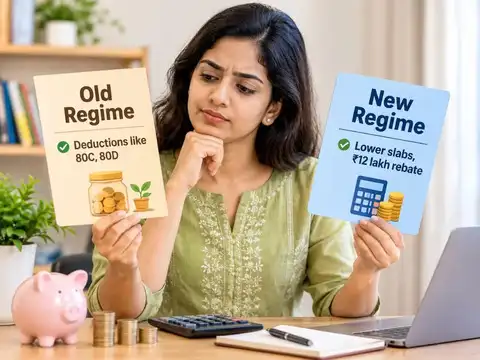
Get the regime right first, because it decides whether your retirement investments come with a tax deduction. The new regime has lower slabs, and its Section 87A rebate covers incomes up to ₹12 lakh, which makes it simpler and better for most freelancers. The old regime lets you claim deductions such as Section 80C up to ₹1.5 lakh and Section 80D, but you would need roughly ₹8 lakh in deductions for it to beat the new regime. For Tax Year 2026-27, the old regime rarely makes sense for freelancers.

3/10
The one-way door: You can’t keep switching regimes
Freelancers with business or professional income cannot move between regimes every year the way salaried people can. To choose the old regime, you must file Form 10-IEA before your return is due. Once you switch back to the new regime, you cannot return to the old one. That makes the decision worth a proper calculation using your real income and deductions, not a guess.

4/10
Pay tax on half your income with Section 44ADA
If your gross receipts are under ₹50 lakh (or up to ₹75 lakh if cash transactions are under 5%), presumptive taxation lets you declare just 50% of your gross turnover as taxable profit. You do not need detailed books of accounts or a tax audit. If your actual business expenses are higher than 50% of your earnings, the traditional route may work out cheaper. There you maintain profit-and-loss statements and a balance sheet, and file ITR-3.

5/10
Cut your taxable income with legit business expenses
Writing off genuine work costs reduces your taxable income. These include office rent, high-speed internet, mobile bills, software subscriptions, travel, and depreciation on hardware such as laptops or cameras. If you are registered for GST, you can also claim input tax credit on GST paid for business equipment and travel. For international clients, register for GST and obtain a Letter of Undertaking (LUT) so you can export services with zero-rated GST. Keep a separate current or business account for client receipts and expenses so personal spending never mixes in.

6/10
Build your safety net before you invest
Because no TDS or employer tax is deducted from your payments, move 20% to 30% of every client payment into a separate high-interest savings account meant only for advance tax and ITR payments. Next, build a liquid emergency fund covering 6 to 12 months of expenses, since freelance income fluctuates. Then buy personal term insurance and a comprehensive health policy, which can be claimed under Section 80D. Keep this emergency fund separate from your retirement money, so a slow patch never forces you to raid your long-term corpus.

7/10
NPS: The pension you can’t touch early
The National Pension System is built for people with no workplace pension. You open an account in your own name, contribute when cash allows, and choose your own equity and debt mix. Under the old regime it carries an extra ₹50,000 deduction under Section 124(3). The rules are strict. You largely stay invested until age 60, and partial withdrawals are allowed only after three years, capped at 25% of your own contributions, for needs such as a house, a child’s education or marriage, or serious medical treatment. At 60 you can take up to 60% as a tax-free lump sum, and at least 40% must buy an annuity, which is taxed as income. If your corpus is ₹5 lakh or less, you can withdraw all of it.

8/10
PPF vs ELSS: Safe anchor or growth engine?
PPF is the slow, safe core of a retirement plan. It runs for 15 years, accepts up to ₹1.5 lakh a year, and pays government-fixed interest that was 7.1% for July to September 2026 (check the latest quarterly rate). The interest and the maturity amount are tax-free. ELSS funds are equity mutual funds with the shortest lock-in of the tax-saving options, just three years from each purchase. They offer more growth over a long horizon but carry market risk, and long-term gains above ₹1.25 lakh a year are taxed at 12.5%. Both qualify for deduction under Section 123 only in the old regime.

9/10
New regime? Invest for returns, not receipts
Under the new regime, there is no deduction for PPF, ELSS or your own NPS contributions. That does not make them pointless. It means you choose them for returns and retirement, not for a lower tax bill in March. A monthly SIP into a diversified equity or index fund has no lock-in and no dependence on your tax regime. A simple test helps: if an investment would still earn its place with no deduction attached, it belongs in your plan. If the tax break is the only reason to buy it, skip it. Also note that self-employed freelancers cannot open an EPF account or contribute to VPF, though any old EPF balance from a salaried job remains yours.

10/10
Your 5-step freelancer retirement plan
Work through these steps in order. First, build an emergency fund of 6 to 12 months of expenses. Second, compare the old and new tax regimes using your real numbers. Third, decide how much to invest, set as a percentage of income rather than a fixed sum. That way a ₹3 lakh invoice and a ₹40,000 month both contribute fairly. Fourth, choose a mix across NPS, PPF, ELSS and plain mutual funds that fits your risk appetite and lock-in tolerance. Fifth, review the plan at least once a year and after any big change in income. Base your target on your own expenses, retirement age and inflation, not a headline corpus figure from the internet.
This is general guidance, not personalized tax or investment advice. Tax rules can change and market-linked returns are not guaranteed. Consult a qualified tax professional or registered advisor before choosing a regime or retirement investment.
This is general guidance, not personalized tax or investment advice. Tax rules can change and market-linked returns are not guaranteed. Consult a qualified tax professional or registered advisor before choosing a regime or retirement investment.