
 Daily Top 5 Daily Top 5 |
WhatsApp usernames face heat; Byju’s inventory in limbo
Want this newsletter delivered to your inbox?
I agree to receive newsletters and marketing communications via e-mail

Thank you for subscribing to Daily Top 5
We'll soon meet in your inbox.
India is weighing legal guardrails for WhatsApp usernames amid fresh fraud fears. This and more in today’s ETtech Top 5.
Also in the letter:
■ Anthropic models back online
■ India’s IT stocks crumble
■ UPI’s slight dip

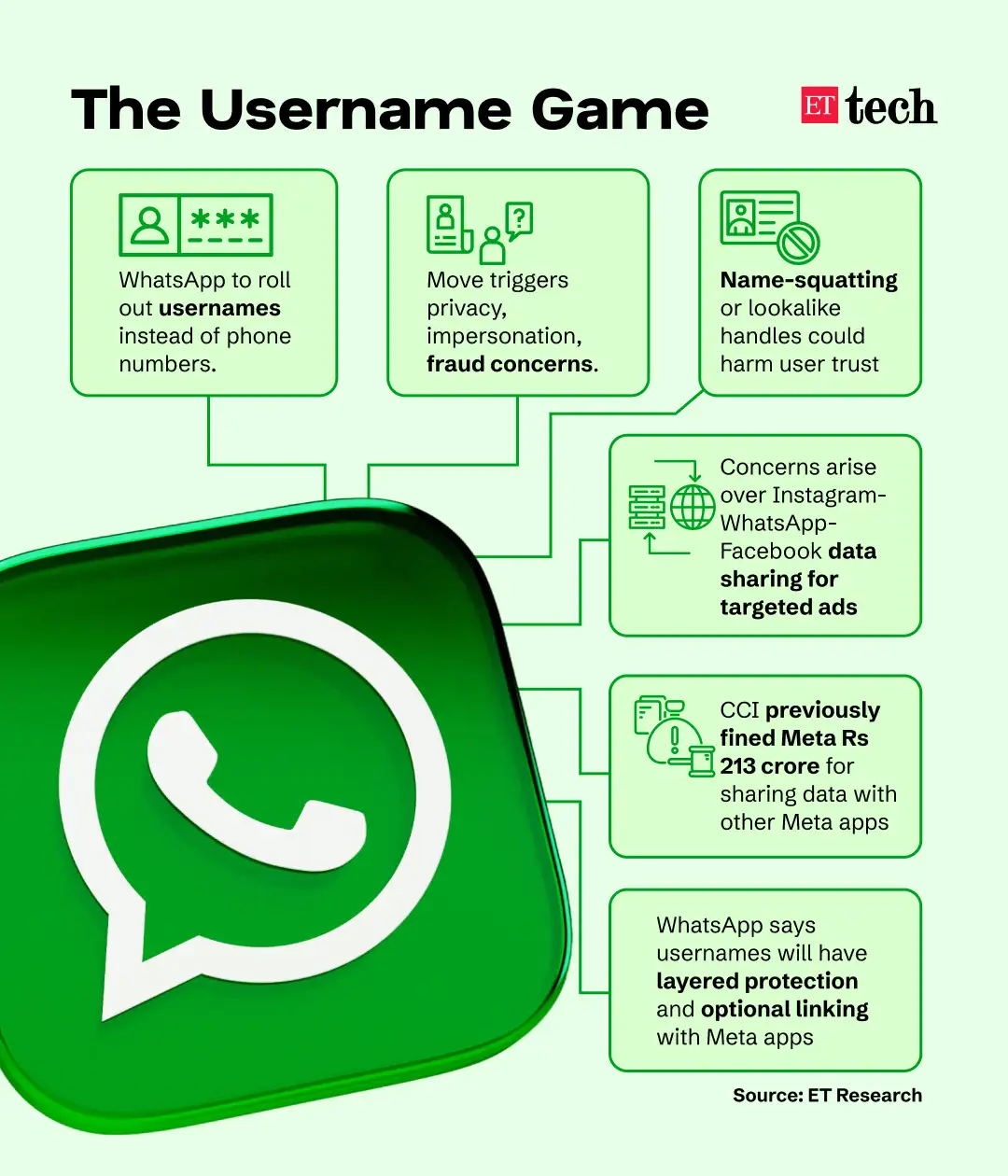
The Centre is weighing legal options to regulate WhatsApp's proposed username feature before it goes live in India, sources told us.
What’s happening? Officials are reviewing existing laws to determine whether WhatsApp can be compelled to implement safeguards before rolling out the feature. As it stands, they fear, the proposal could make it easier for fraudsters to impersonate individuals, businesses and public figures using near-identical usernames.
"Open to making new law if needed to prevent cybercrime and digital impersonations," one person said.
ET reported on Wednesday that the feature – expected to launch later this year – has triggered privacy worries, even though it is marketed as a privacy upgrade. It will let users find and message each other by username instead of sharing phone numbers, a feature that rival messaging app Telegram launched in 2014.
Also Read: WhatsApp opens username reservations: All you need to know
Expert take: Experts say usernames can indeed improve privacy by reducing the need to share phone numbers, and by lowering risks such as SIM swapping and contact scraping.
But they warn that the feature introduces fresh headaches around identity verification, data sharing and how usernames work across platforms. Lookalike usernames, they argue, could become a powerful tool for scammers posing as brands, banks, government agencies, and celebrities.
Also Read: All you need to know about Meta’s Instagram, Whatsapp and Facebook subscription plans in India
 Byju Raveendran, founder, Byju's
Byju’s insolvency proceedings involving its parent company, Think & Learn, are moving slowly, and the drag is now visible on the ground: hardware worth about Rs 7-10 crore is lying idle in warehouses.
Driving the news: Sources told us that around two lakh tablets and thousands of laptops, headphones, routers, keyboards, printers, and webcams belonging to Byju’s are stuck in storage on the outskirts of Bengaluru. The pile also includes stationery and learning material accumulated during the company’s high-growth years.
The inventory was put up for sale in March by resolution professional Shailendra Ajmera of EY. But despite interest from bidders, no deal has closed yet, these people said.
What’s the hold-up: The process is taking time because the hardware is being categorised and audited before sale. The plan is to break up the inventory into lots based on condition and use case, instead of offloading the entire stock to a single buyer at a deep discount, sources said.
Yes, and: The impasse highlights the wider tension in Byju’s insolvency. Lenders want to squeeze the maximum recovery from assets built in the boom years, while bidders are treating them as old, depreciating stock and pricing them accordingly.
Also Read: NCLT posts Byjus-Aakash hearing for July 16 as parties seek time for settlement
 Dario Amodei, CEO, Anthropic
Anthropic will soon restore global access to its flagship AI models, Fable 5 and Mythos 5, after the US government lifted curbs, the company said on Tuesday.
Driving the news:
Also Read: SoftBank completes second $10 billion tranche of its $30 billion OpenAI investment
In other news: A new UN report warns that countries relying heavily on foreign AI models, cloud infrastructure and data pipelines risk losing control over AI standards, safeguards and their ability to adapt the technology to local needs.
The warning comes after US restrictions on Anthropic's models reignited calls for India to accelerate its sovereign AI ambitions.
Also Read: Living on borrowed AI won’t end well for India, warn experts

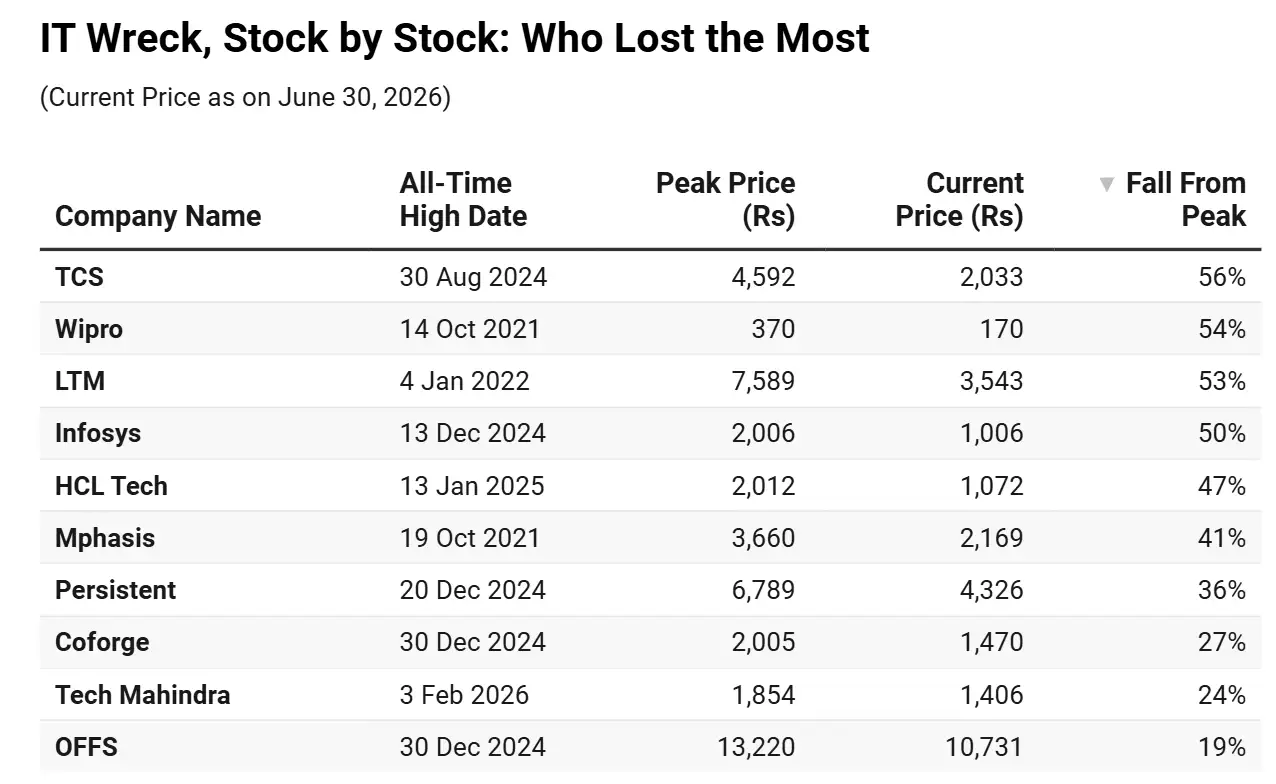
India's IT stocks are deep in correction territory, with TCS, Infosys, Wipro and LTIMindtree now trading at least 50% below their record highs.
Driving the news: The slide has wiped out nearly Rs 19.28 lakh crore in combined market value across 10 major IT firms.
 Source: ACE Equity, Ritesh Presswala
Why is this happening?
Also Read: AI will amplify IT services demand, not replace it: Infosys chairman Nandan Nilekani

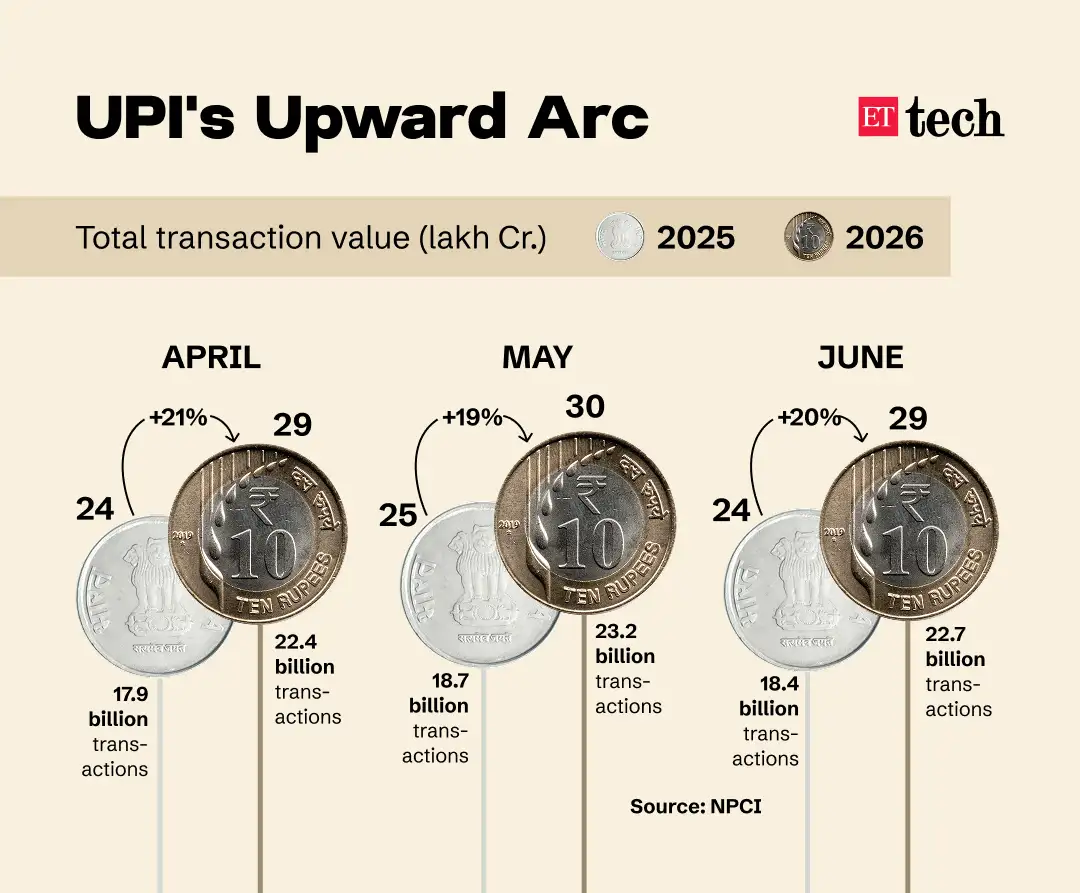
India's Unified Payments Interface (UPI) processed 22.72 billion transactions worth Rs 28.92 lakh crore in June, easing slightly from May's record.
By the numbers:
Also Read: NPCI plans to enable unified e-mandate tracking for all UPI apps
Tell me more: June had 30 days, compared with 31 days in May, which largely explains the decline in monthly transaction volumes and value.
On a yearly basis, UPI is still powering ahead. Transaction volumes rose 23% year-on-year, while the total value of transactions increased 20% compared with June last year.
Also Read: PB Fintech to inject Rs 20 crore into payments arm, expand Dubai presence
Also in the letter:
■ Anthropic models back online
■ India’s IT stocks crumble
■ UPI’s slight dip
India weighs legal curbs on WhatsApp usernames over impersonation risks: Sources
The Centre is weighing legal options to regulate WhatsApp's proposed username feature before it goes live in India, sources told us.
What’s happening? Officials are reviewing existing laws to determine whether WhatsApp can be compelled to implement safeguards before rolling out the feature. As it stands, they fear, the proposal could make it easier for fraudsters to impersonate individuals, businesses and public figures using near-identical usernames.
"Open to making new law if needed to prevent cybercrime and digital impersonations," one person said.
ET reported on Wednesday that the feature – expected to launch later this year – has triggered privacy worries, even though it is marketed as a privacy upgrade. It will let users find and message each other by username instead of sharing phone numbers, a feature that rival messaging app Telegram launched in 2014.
Also Read: WhatsApp opens username reservations: All you need to know
Expert take: Experts say usernames can indeed improve privacy by reducing the need to share phone numbers, and by lowering risks such as SIM swapping and contact scraping.
But they warn that the feature introduces fresh headaches around identity verification, data sharing and how usernames work across platforms. Lookalike usernames, they argue, could become a powerful tool for scammers posing as brands, banks, government agencies, and celebrities.
Also Read: All you need to know about Meta’s Instagram, Whatsapp and Facebook subscription plans in India
Byju’s tablets, laptops gather dust in warehouse as insolvency drags on
Byju’s insolvency proceedings involving its parent company, Think & Learn, are moving slowly, and the drag is now visible on the ground: hardware worth about Rs 7-10 crore is lying idle in warehouses.
Driving the news: Sources told us that around two lakh tablets and thousands of laptops, headphones, routers, keyboards, printers, and webcams belonging to Byju’s are stuck in storage on the outskirts of Bengaluru. The pile also includes stationery and learning material accumulated during the company’s high-growth years.
The inventory was put up for sale in March by resolution professional Shailendra Ajmera of EY. But despite interest from bidders, no deal has closed yet, these people said.
What’s the hold-up: The process is taking time because the hardware is being categorised and audited before sale. The plan is to break up the inventory into lots based on condition and use case, instead of offloading the entire stock to a single buyer at a deep discount, sources said.
Yes, and: The impasse highlights the wider tension in Byju’s insolvency. Lenders want to squeeze the maximum recovery from assets built in the boom years, while bidders are treating them as old, depreciating stock and pricing them accordingly.
Also Read: NCLT posts Byjus-Aakash hearing for July 16 as parties seek time for settlement
US govt lifts restrictions on powerful AI models: Anthropic
Anthropic will soon restore global access to its flagship AI models, Fable 5 and Mythos 5, after the US government lifted curbs, the company said on Tuesday.
Driving the news:
- The US had blocked the models on June 12, citing national security concerns after spotting gaps in safeguards designed to prevent misuse.
- Rival OpenAI also limited access to its latest model, GPT-5.6, to a limited group of approved partners.
- According to Politico, US Commerce Secretary Howard Lutnick said in a June 26 letter that Anthropic had addressed the government's concerns over the covered models.
- Then, on June 28, Anthropic was cleared to provide Mythos 5 to a small group of US cybersecurity firms.
Also Read: SoftBank completes second $10 billion tranche of its $30 billion OpenAI investment
In other news: A new UN report warns that countries relying heavily on foreign AI models, cloud infrastructure and data pipelines risk losing control over AI standards, safeguards and their ability to adapt the technology to local needs.
The warning comes after US restrictions on Anthropic's models reignited calls for India to accelerate its sovereign AI ambitions.
Also Read: Living on borrowed AI won’t end well for India, warn experts
TCS, Infosys and other IT giants crash 50% from peak
India's IT stocks are deep in correction territory, with TCS, Infosys, Wipro and LTIMindtree now trading at least 50% below their record highs.
Driving the news: The slide has wiped out nearly Rs 19.28 lakh crore in combined market value across 10 major IT firms.
- TCS: down 56% from Rs 4,592.25 (August 30, 2024) to Rs 2,033, erasing over Rs 9.12 lakh crore in market value.
- Wipro: down 54% from Rs 369.93 (October 14, 2021)
- LTIMindtree: down 53% from Rs 7,588.80 (January 4, 2022)
- Infosys: down nearly 50% from Rs 2,006.45 (December 13, 2024) to Rs 1,006.
Why is this happening?
- Weak enterprise tech spending in North America – the biggest market for Indian IT – continues to weigh on the sector.
- High inflation and elevated US interest rates are keeping technology budgets tight.
- At the same time, generative AI is clouding the industry's long-term outlook by automating coding, customer support and back-office functions, challenging the traditional labour-arbitrage model.
Also Read: AI will amplify IT services demand, not replace it: Infosys chairman Nandan Nilekani
UPI volume eases 2.1% in June to 22.72 billion from May peak
India's Unified Payments Interface (UPI) processed 22.72 billion transactions worth Rs 28.92 lakh crore in June, easing slightly from May's record.
By the numbers:
- National Payments Corporation of India (NPCI) data shows transaction volumes fell 2.1% month-on-month from 23.2 billion in May.
- The total value of transactions declined 3.3% from Rs 29.9 lakh crore in May.
- Even so, June's volume remained above April's 22.35 billion transactions.
Also Read: NPCI plans to enable unified e-mandate tracking for all UPI apps
Tell me more: June had 30 days, compared with 31 days in May, which largely explains the decline in monthly transaction volumes and value.
On a yearly basis, UPI is still powering ahead. Transaction volumes rose 23% year-on-year, while the total value of transactions increased 20% compared with June last year.
Also Read: PB Fintech to inject Rs 20 crore into payments arm, expand Dubai presence
Want this newsletter delivered to your inbox?
I agree to receive newsletters and marketing communications via e-mail