
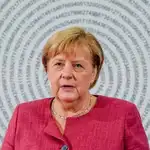
Angela Merkel
Chancellor, Federal Republic of GermanyBirth DetailsJuly 17, 1954 | Hamburg, West Germany
NationalityGerman
LeaguePolitician
EducationMaster of Science, University of Leipzig; PhD in Physical Chemistry, University of Leipzig
Angela Merkel’s Journey so far ...
Before you go ...
- Angela Merkel started her professional career as a member of the academic faculty in the Central Institute of Physical Chemistry of the Academy of Sciences in East Berlin in 1978
- In 1989, Merkel joined the political party Democratic Awakening after the fall of the Berlin Wall
- The following year, she became the spokesperson of the party
- After Lothar de Maizière won East Germany’s first free election and became the Prime Minister, Merkel became the deputy spokesperson of the government
- She joined the political party Christian Democratic Union (CDU) in 1990 and won a seat in the Lower House of the parliament in the post-reunification elections of Germany held later that year
- In 1991, she was appointed as minister for women and youth
- Merkel became the minister of environment, conservation and reactor safety after the 1994 elections
- She became the head of CDU in 2000
- In November 2005, at the age of 51, Merkel became the first woman and the youngest Chancellor of Germany
- She took office for the second term as the country’s Chancellor in September 2009
- She became the Chancellor for the third time in December 2013
- In 2017, she was re-elected for her fourth term as the Chancellor of Germany
- In 2018, Merkel announced that she would not re-contest after the end of her fourth term in 2021
- Her biography, Angela Merkel: A Chancellorship Forged in Crisis, was released in 2013
Before you go ...
- While growing up, Merkel was involved with several youth organisations such as Young Pioneers and Free German Youth
- She was honoured with the US Presidential Medal of Freedom in 2011
Last Updated: 25/08/2021
Angela Merkel News
- Ex-German chancellor set to deliver first Manmohan Singh Memorial LectureFormer German Chancellor Angela Merkel will deliver the inaugural Dr Manmohan Singh Memorial Lecture in New Delhi on February 26. The lecture, organized by the Dr Manmohan Singh Trust, will focus on 'Germany and India in times of global change'. This event honors the late former Prime Minister, a key figure in India's economic reforms.
- Even Germany is Gaullist now. Well done, TrumpGerman indecision over European defense is shifting as Friedrich Merz's incoming coalition in Berlin calls for deeper Euro integration. Merz's €200 billion defense spending proposals signal a potential Franco-German grand bargain, crucial amid US diplomatic uncertainties. This could reset associations with key border countries, promoting a cohesive European defense strategy and confronting modern geopolitical challenges.
- Friedrich Merz and his long march to the German chancelleryFriedrich Merz's conservative party won Germany's national election, positioning him to form a coalition government amidst economic and diplomatic crises. Despite past failures and criticism, Merz's leadership style promises a shift from Merkel's centrism. His win signals potential changes in German governance and international relations, with possible months of negotiations ahead.
- German conservatives win election but far-right AfD surges, exit polls showGermany's opposition conservatives won Sunday's national election, with Friedrich Merz poised to become chancellor. The far-right AfD scored its best result, finishing second. Coalition talks are expected to be challenging, potentially leaving Olaf Scholz as caretaker and delaying crucial policies. The AfD's rise indicates growing complexities in German politics.
- Next likely Chancellor Friedrich Merz promises a tougher GermanyFriedrich Merz, expected to become Germany's next chancellor, promises a more assertive foreign policy aligned with a strong trans-Atlantic relationship, and a firm stance against Russia and China. He aims for increased military spending and clearer support for Ukraine, emphasizing European responsibility in defense matters.
- Who is Friedrich Merz, and can he fix Germany?Friedrich Merz, likely Germany's next chancellor, faces the challenge of revitalizing the economy and addressing immigration concerns amidst rising far-right support. With his CDU/CSU party leading the polls, Merz's success hinges on projecting effective leadership and convincing voters of his ability to achieve meaningful reforms and positive change for Germany.
- Why our politicians don't write memoirsMemoirs transform politicians into statesmen by offering their personal viewpoint on their legacy. Unlike biographies, which are often overly flattering, memoirs provide a more nuanced self-portrayal. The recent releases of Bill Clinton's and Angela Merkel's memoirs highlight that retired politicians are more likely to share their stories faithfully.
- Donald Trump fascinated by Vladimir Putin and captivated by 'dictators': Angela Merkel in memoirIn her forthcoming memoir, "Freedom," former German Chancellor Angela Merkel reveals her unease following her initial encounter with then-President-elect Donald Trump in 2017. Merkel recounts Trump's fascination with autocratic leaders, particularly Russian President Vladimir Putin, and his critical stance towards Germany's refugee policies, defense spending, and trade practices.
- German government averts crisis with budget agreement for Europe's largest economyThe German government, led by Chancellor Olaf Scholz, reached an agreement on Friday regarding the 2025 budget and a stimulus package for the country's economy. This resolution concluded a prolonged dispute within Scholz's center-left coalition involving the Social Democrats, Free Democrats, and Greens. The budget plan, finalized after extensive negotiations, involves repurposing 60 billion euros in unused COVID-19 emergency funds, despite earlier legal challenges against such actions.
- Rich and retired: The boom beneficiaries who finance Germany's far rightWith the AfD high in opinion polls ahead of regional and European elections later this year, the party is facing legal and political scrutiny as never before, which could lead to it being cut off from all state financing. That would make backers like Issmer, who gave 250,000 euros last year, even more important. Wealthy, elderly products of Germany's post-war rise, they have cash to spare and views they are unafraid to air.
- Wolfgang Schaeuble, veteran of German politics, dies at 81Schaeuble, who spent much of his career devoted to re-unifying his country and later served as former chancellor Angela Merkel's frugal finance minister during the eurozone debt crisis, died peacefully late Tuesday, said a spokesperson for the centre-right Christian Democrats (CDU) on Wednesday.
- The derisking dilemma: how German companies are tackling China riskGerman medium-sized companies, including fan and motor maker ebm-papst, are reducing their reliance on China due to concerns about possible Western sanctions or a conflict over Taiwan. Some companies are pursuing a localization strategy by becoming self-sustainable in sourcing and production. Others are diversifying their markets, with India, Vietnam, South Korea, and Indonesia being targeted as alternative markets.
- Angela Merkel decorated with highest German honorPresident Frank-Walter Steinmeier bestowed the Grand Cross of the Order of Merit for special achievement on the four-term chancellor, who became only the third ex-leader to receive that level of distinction. The other two were Konrad Adenauer, West Germany's first leader, and Helmut Kohl, who led Germany to reunification.
- Germany's defense minister Christine Lambrecht resigns amid Ukraine criticismChristine Lambrecht said in a statement that she had submitted her resignation request to Chancellor Olaf Scholz, adding that "months of media focus on my person" had stood in the way of a factual debate about the military and Germany's security policy.
- Has Boris Johnson broken Acoba rule with his Colorado speech? Details hereFormer UK PM Boris Johnson delivered a speech to the Council of Insurance Agents and Brokers in Colorado Springs for which he reportedly received £135,000.
- Merkel bats Russia's inclusion for sustainable peace in EuropeSpeaking during the 77th anniversary of the German newspaper ‘Suddeutsche Zeitung,’ Merkel explained that while the West has been adamant in its support for Ukraine as the nation remains locked in conflict with Russia, it should also keep its mind open about what might seem as “unthinkable” now – Moscow’s future role in Europe’s affairs.
- Former German chancellor Angela Merkel wins UN refugee prizeFormer German chancellor Angela Merkel on Tuesday won the United Nations refugee agency's prestigious Nansen Award, receiving praise for her determination to protect asylum seekers while in office.
- Who is Edward Snowden, the whistleblower granted Russian citizenship through decree? Read to knowWhistleblower Edward Snowden has recently got Russian Citizenship but he looks to get dual citizenship of Russia and the US to reunite with mom, dad. Some people on social media also wondered if he would join the war against Ukraine.
- The very bearable lightness of being PMThe 36-year-old has been steering her nation for the last two-and-a-half years. She is in the news for videos of her dancing and partying - one at her official residence, the other at Helsinki club. Unlike the nearby country of a PM who had hosted parties at his office during the pandemic, Marin is good at her job, with her country's economy and politics not in a total mess.
- Angela Merkel admired talking to Prime Minister Modi, says German envoyThe German envoy further claimed that the 'present geopolitical situation has pushed EU- India agreement towards FTA and alignment with international bodies.'
- 'Be kind to yourself, stay focused & fearless.' Suhasini Sampath, co-founder of Yogabar, shares her success mantraHere are some more pearls of wisdom by Sampath, in her own words.
- German president admits mistakes with RussiaThe president conceded that "there were different assessments" of Russia among European countries.
- Bayern enters Indo-Pacific leagueSlow to pick up since the signing of the Indo-German defence cooperation agreement in 2006, the bilateral security relationship has gained momentum in recent months. It has also survived a change of government in Berlin with Chancellor Olaf Scholz walking a path set by his predecessor Angela Merkel.
- Germany to close nuclear reactors despite energy crisisWith energy prices already on the rise and tensions higher than ever between Europe and key gas supplier Russia, the closure of the plants in Brokdorf, Grohnde and Gundremmingen could well tighten the squeeze.
- Angela Merkel wants to be an author, plans to write a political autobiographyThe book is envisioned as a two- to three-year project.
- PM Narendra Modi congratulates Olaf Scholz on being elected Germany's Chancellor"I look forward to working closely to further strengthen the Strategic Partnership between India and Germany" said Prime Minister Narendra Modi.
- Olaf Scholz succeeds Angela Merkel as German chancellorOlaf Scholz has been sworn in as Germany's new chancellor, bringing to an end Angela Merkel's historic 16 years as leader.
- Olaf Scholz replaces Angela Merkel as German chancellor, opening new eraLawmakers voted by 395-303 with six abstentions to elect Scholz - a comfortable majority, though short of the 416 seats his three-party coalition holds in the 736-seat lower house of parliament. That's not unusual when chancellors are elected, and some lawmakers were out sick or in quarantine.
- German parliament elects Social Democrat Olaf Scholz as chancellorIn the afternoon, Merkel will hand over the chancellery to the new leader of Europe's largest economy which is facing a brutal fourth wave of coronavirus infections. With his down-to-earth and no-nonsense manner, Scholz has positioned himself as Merkel's natural successor and a safe pair of hands to steer Germany through challenges ranging from tackling the climate crisis to dealing with a more confrontational Russia and a more assertive China.
- A day in the life of Angela Merkel post-retirement: Vegetable gardening, quality time with hubby & 'a little nap'The veteran chancellor is set to receive a monthly pension of $16,900 in her retirement.
- Pomp, punk and pandemic see Angela Merkel out of officeGerman daily taz reported that Merkel has requested three songs, two of which the Staff Band of the Bundeswehr had to scramble to arrange. One is the 18th century Christian hymn "Holy God, we Praise thy Name," perhaps a natural choice for the daughter of a Protestant pastor.
- Expanding Indo-German partnership: ‘India’ a part of the new coalition Treaty in GermanyThe coalition agreement includes an extensive section about the Indo-Pacific and why it’s important for German foreign policy. Furthermore the agreement clearly mentions the importance of an intensive dialogue on peace and security in the Indo-Pacific region. India is also mentioned in the context of the EU-India Connectivity Partnership as well as the Free Trade Agreement (FTA).
- World Health Organization calls for treaty to shield against next pandemicWHO member states reached a consensus Sunday on kick-starting the process towards a pandemic treaty. The draft decision was secured after countries agreed to compromise -- notably the United States, which is luke-warm on whether the outcome needs to be a legally-binding treaty. The decision should be formalised on Wednesday.
- German parties set to announce coalition deal, Merkel bids farewellSocial Democrat Olaf Scholz has moved closer to becoming German chancellor after agreeing on a coalition deal that aims to modernise Europe's largest economy, accelerate its green transition and bring the curtain down on the Angela Merkel era.
- Germany can't rule out lockdown, even for the vaccinated, minister saysGermany will limit large parts of public life in areas where hospitals are becoming dangerously full of COVID-19 patients to those who have either been vaccinated or have recovered from the illness.
- View: German election results indicate change with continuityThough results look fragmented, it may produce a Centre left government which will prefer continuation of Angela Merkel's domestic and foreign policy with more ambitious climate action and social policies.
- Openings in post-Merkel GermanyAs Europe is forced, after the US pivot to Asia, to find its own geopolitical identity, it is useful for India to engage with Germany, along with France, and with the EU, on political and strategic affairs, and not just on trade and investment. And it would be useful to be proactive.
- Germany in political limbo after Social Democrats' narrow winFinance Minister Olaf Scholz, who led the Social Democrats' (SPD) campaign, said Europe's biggest power would not be thrown off by the power struggle, stressing that Germany would remain "stable" even as parties scramble for coalition partners.
- Germany polls: SPD beats Angela Merkel's party, rivals scramble to lead next govtMerkel is still Germany's most popular politician, whose voluntary departure marks a watershed moment for the country of 83 million people. Her legacy risks being tarnished however by the CDU-CSU's poor showing in Sunday's election, which saw the bloc fall below 30 percent for the first time in its history.
- Conservatives, social democrats tied in vote to decide Angela Merkel successorMerkel has been in power since 2005 but plans to step down after the election, making the vote an era-changing event to set the future course of Europe's largest economy.
- Angela Merkel's bloc sees worst result since 1949; Social Democrats riseLeaders of Alternative for Germany (AfD) put on a brave face after projected election results showed support for the far-right party dropping and said they rejoiced in seeing Chancellor Angela Merkel's conservatives slump to their worst-ever result.
- Race wide open as Germany votes in post-Merkel electionOpinion polls show the race for the chancellery headed for a photo finish, with Merkel's CDU-CSU conservative alliance on around 23 percent, just behind the centre-left Social Democrats on 25 percent -- well within the margin of error.
- View: German elections tinged with uncertaintyPoll projections do not give a clear majority to any one party or a perceived coalition. When no lead party has over 30% of the vote, it becomes more difficult to cajole allies.
- Angela Merkel makes final push for successor in Germany's knife-edge pollsLaschet, 60, has been trailing his Social Democrat challenger Olaf Scholz in the race for the chancellery, although final polls put the gap between them within the margin of error, making the vote one of the most unpredictable in recent years.
- Floods, books & kids: Highlights of German election campaignWhoever wins Sunday's election, experts say Germany's next parliament will likely be bigger than ever. Election rules mean the current 709-seat Bundestag could grow to 800 seats or more.
- Will Angela Merkel finally laugh?Sixteen years as chancellor, Angela Merkel has been the diametric opposite of the flashy leader.
- As Angela Merkel bids farewell, German women wish for more equalityWhen it comes to the situation of women in Germany, Angela Merkel - who said in 2018 that she wouldn't seek reelection in this Sunday's general election - has been criticized for not using her position enough to push for more gender equality.
- Angela Merkel makes farewell visit to PolandAs Merkel’s time as Chancellor draws to a close, the issue of the pipeline from Russia has soured relations with central and eastern European nations, some of them EU members, who say it will increase the bloc’s dependence on Russian gas and could be used by Moscow to exert pressure.
- Germany wants to talk with Taliban about further evacuations from Afghanistan: Angela MerkelThe European Union's foreign policy chief has said the bloc is ready to engage with the new Taliban government in Kabul but the Islamist group must respect human rights, including those of women, and not let Afghanistan become a base for terrorism.
- European stocks on track for seventh straight month of gainsThe pan-European STOXX 600 index rose 0.1% by 0710 GMT, with Asian stocks reversing earlier losses as fresh signs of a slowdown in China's economy spurred hopes of more stimulus.
- Germany sending 600 troops for Kabul evacuationGermany's Bundestag Parliament will have to vote on the military mission as well which is likely going to happen next week.
- EU ministers to weigh Afghan security, migrant challengesAfghans are among the biggest group of nationalities seeking sanctuary in Europe, after Syrians. According to some EU estimates, around 570,000 Afghans have applied for asylum in Europe since 2015.
- Germany recommends combination of AstraZeneca, mRNA shotsThe committee, known by its German acronym STIKO, didn't detail what studies its conclusion was based on. Germany's disease control center noted that it was a draft, and that a final recommendation with more detail and sourcing will follow. Researchers have said that mixing vaccines is likely safe and effective, but are still gathering data to be sure.
- EU members bordering Russia reject plan to meet with PutinThe European Union is deeply divided in its approach to Moscow. Russia is the EU's biggest natural gas supplier, and plays a key role in a series of international conflicts and issues linked to Europe's strategic interests, including the Iran nuclear deal, and conflicts in Syria and Libya.
- Double vaccine will re-open foreign travel: British PM JohnsonTransport Secretary Grant Shapps is due to set out the latest rules on which countries are safe to visit and those that should be avoided on Thursday. Ending quarantine rules for fully vaccinated travellers isn't expected to come into force until August.
- German Chancellor Angela Merkel gets Moderna as second jab after AstraZeneca first doseThe 66-year-old took her first dose of AstraZeneca's vaccine in April, more than two weeks after German authorities recommended use of the jab only for people aged 60 and over.
- PM Modi addresses G7 outreach session, gives mantra of 'One Earth, One Health'The Prime Minister is taking part in part in G7 outreach sessions in a virtual format. He will also take part in an outreach session on June 13.
- Macron offers UK's Johnson: 'Le reset' if he keeps his Brexit wordSince Britain completed its exit from the EU late last year, relations with the bloc and particularly France have soured, with Macron becoming the most vocal critic of London's refusal to honour the terms of part of its Brexit deal.
- G7 leaders agreed to keep the money taps open: SourceThe backing for more stimulus was shared by all leaders including Angela Merkel of Germany which has traditionally opposed heavy borrowing to spur growth, a position it has relaxed in the face of the COVID-19 crisis.
- Angela Merkel welcomes better COVID-19 situation but Delta variant a worryChancellor Angela Merkel said on Thursday that a recent improvement in the number of coronavirus cases in Germany was pleasing but warned that the pandemic was not over and the risk from the Delta variant in Britain was worrying.
- World needs a ‘Global Health Threat Council’German Chancellor Angela Merkel threw her backing behind a 'global health threat council'.
- Europe demands answers after US-Danish spying claimsThe NSA was able to access text messages, telephone calls and internet traffic including searches, chats and messaging services -- including those of Germany's Chancellor Angela Merkel, then-foreign minister Frank-Walter Steinmeier and then-opposition leader Peer Steinbruck, DR said.
- United States spied on Angela Merkel and other Europeans through Danish cables: State broadcasterAccording to the investigation, which covered the period from 2012 to 2014, the NSA used Danish information cables to spy on senior officials in Sweden, Norway, France and Germany, including former German Foreign Minister Frank-Walter Steinmeier and former German opposition leader Peer Steinbrück.
- German Chancellor Angela Merkel stresses 'solidarity' with Israel in call with Benjamin Netanyahu"The chancellor again sharply condemned the continued rocket attacks from Gaza on Israel and assured the prime minister of the German government's solidarity," Merkel's spokesman Steffen Seibert said in a statement after the call. "She reaffirmed Israel's right to defend itself against the attacks."
- Turkey says mercenaries should leave Libya, but it has military pact with governmentTurkey deployed troops to Libya under an accord on military cooperation signed with the Tripoli-based Government of National Accord (GNA), helping it repel an assault by forces from eastern Libya. It also sent thousands of Syrian fighters to Libya.
- Germany, WHO announce creation of new data hub to fight pandemicsSpeaking at a virtual news conference attended also by German Chancellor Angela Merkel and the head of the WHO, Spahn said the world was still insufficiently prepared for pandemics.
- Leading contender to succeed Angela Merkel wants tougher stance on China, RussiaShe backed Ukraine's right to apply for membership in NATO and the EU, but said “the most important thing right now is to increase the pressure on Russia so that the Minsk accord is adhered to."
- Germany faces lockdown until June as curbs fail to push down casesGermany's coronavirus infection rate rose at the weekend despite stricter restrictions as Finance Minister Olaf Scholz cautioned he did not expect moves to ease curbs before the end of May.
- EU says will 'respond rapidly' to assist Covid-hit IndiaThe EU is preparing rapid assistance for India as it copes with a growing Covid-19 crisis that has seen infections and deaths hit record highs, European Commission chief Ursula von der Leyen said Sunday.
- Germany preparing 'urgent support' for Covid-hit India: Merkel"To the people of India I want to express my sympathy on the terrible suffering that Covid-19 has again brought over your communities," Merkel said in a message shared on Twitter by her spokesman Steffen Seibert.
- French President Emmanuel Macron says nations must 'define red lines' with RussiaReferring to a recent buildup of Russian troops on Ukraine's border, Macron said in an interview with American broadcaster CBS News, ``We will never accept new military operations on Ukrainian soil.'' The West must demonstrate diplomacy and credibility in making that point, he said.
- Ukraine, France and Germany hold security talksThe talks come as Ukraine and the West have sounded alarms in recent weeks about the concentration of troops along Russia's border, a buildup that the US and NATO have described as the largest since 2014.
- Merkel paralysis: Why Germany's conservatives can't decide on a successorPressure is mounting on the conservatives to agree a candidate to succeed Merkel, who has led them to four victories, as its ratings wallow near a one-year low, hurt by the government's chaotic handling of the coronavirus pandemic.
- Angela Merkel says lockdowns, curfews vital to break Germany's third wave"The third wave of the pandemic has our country firmly in its grip," said Merkel, whose speech was interrupted by heckles from lawmakers of the far-right Alternative for Germany party opposed to lockdowns.
- Meet the two men in tug-of-war for Merkel mantleAs head of the CDU, affable Merkel loyalist Armin Laschet would normally be the obvious choice to lead the party and the CSU. But with support for the parties plumbing new depths amid anger over Germany's pandemic management, Laschet has faced calls to step aside in favour of the better-liked Bavarian premier Markus Soeder.
- Kremlin says it fears Ukraine could restart conflict in war-torn eastThe comments came a day after Ukraine's commander-in-chief accused Russia of a military buildup near their shared border and said that the pro-Moscow separatists were systematically violating a ceasefire in eastern Ukraine.
- Germany says ready to use Russian vaccine if approved by European Medicines AgencyLast week, Merkel herself directly referred to Sputnik jabs and said Germany "should use any vaccine that has been approved" by the EMA.
- Germany to list France as Covid-19 high-risk zoneThe decision will come into force on Friday and be announced by the national health institute, the Robert Koch Institute, according to the newspaper FAZ.
- Germany warns of 'exponential' virus spreadThe vice president of the Robert Koch Institute (RKI) for infectious diseases, Lars Schaade, told reporters that highly contagious virus variants were getting the upper hand, wiping out progress seen last month in containing the pandemic.
- AstraZeneca vaccine's promise now drawn into questionIn the latest, around a dozen countries have suspended its use as a precaution after blood clots suffered by some of those vaccinated.
- Germany faces tough questions as nuclear exit nearsFormer village mayor Wolfgang Mayer's house has direct views of the imposing complex with its two 160-metre cooling towers -- taller than the spires of Cologne Cathedral.
- Germany to extend coronavirus lockdown until March 28: DraftThe draft document, seen by Reuters, states that starting from March 8 a maximum of five people from two households, excluding children younger than 14, will be allowed to meet, up from a maximum of two people under current rules.
- At Joe Biden's G7 debut, leaders look beyond COVID to trade and ChinaU.S. President Joe Biden and Italian Prime Minister Mario Draghi debuted at the G7 virtual leaders' meeting which was chaired by British Prime Minister Boris Johnson.
- Iran should return to nuclear deal, Angela Merkel tells Hassan RouhaniMerkel's spokesman Steffen Seibert said the German leader told Rouhani she was concerned that Iran was continuing to breach its commitments under the deal, which U.S. President Joe Biden wants to restore should Iran halt nuclear activities.
- Germany plans to extend lockdown until March 14: Draft documentThe number of new daily infections in Germany has been falling, leading some regional leaders to push for a timetable to ease the lockdown, but concerns are growing about the impact of more infectious strains of the virus on case numbers.
- Alexei Navalny's team calls new protests in Russia for his releaseMass rallies took place Saturday in over 100 cities in what observers said was the largest outpouring of anger in years, and Navalny's supporters urged protesters to keep up the pressure.
- German virus death toll tops 50,000 even as infections sinkThe death toll from the coronavirus in Germany has passed 50,000, a number that has risen swiftly over recent weeks even as infection figures are finally declining.
- German COVID-19 fight hit by delay to Pfizer vaccinePfizer started delivering shots in the European Union at the end of December but announced on Friday there would be a temporary impact on shipments in late January to early February caused by changes to manufacturing processes to boost output.
- View: This year, India needs to reset its relationship with EuropePrime Minister Boris Johnson has described India “as a key player in the Indo-Pacific region, and an increasingly indispensable partner for the United Kingdom as we work to boost jobs and growth, confront shared threats to our security and protect our planet.”
- Armin Laschet elected leader of Angela Merkel's partyLaschet defeated Friedrich Merz, a conservative and one-time Merkel rival, at an online convention Saturday of the Christian Democratic Union. Laschet won 521 votes to Merz's 466; a third candidate, prominent lawmaker Norbert Roettgen, was eliminated in a first round of voting.
- European shares inch lower on lockdown worriesThe pan-European STOXX 600 index fell 0.5% by 0804 GMT, set to end the week marginally lower.
- German economy shrank five percent in pandemic year 2020The state statistics office Destatis said Thursday that only the construction sector showed an upturn as industry and services saw deep declines. Agriculture, financial services, real estate and information and communication suffered smaller declines.
- Angela Merkel's party chooses new leader ahead of German electionChancellor Angela Merkel's center-right party is choosing a new leader this weekend, a decision that will help shape German voters' choice of a successor to Merkel at the helm of the European Union's biggest economy after her 16-year reign.
- Twitter CEO says banning Donald Trump was right decision but sets dangerous precedentSan Francisco-based Twitter last week removed Trump's account, which had 88 million followers, citing the risk of further violence following the storming of the Capitol by supporters of the president.
- Trump, tech and TV have throttled press freedom, journalists sayIn 2020, the United Nations accused Trump's White House of mounting an "onslaught" against the media which, it said, had led to a very negative "Trump effect" on press freedom elsewhere.
- The world's tech giants banished Donald Trump, here's where things get complicatedMajor tech platforms, long accused of giving President Donald Trump special treatment not allotted to regular users, have shown him the door in the wake of his incitement of violence by supporters at the U.S. Capitol on Jan. 6. He's gone from Twitter, Facebook, Snapchat - even Shopify.
- View: Free media have the right to exclude content; that is not censorshipThe European Union (EU) has been at the fore of regulating US internet giants.
- Germany's Merkel: Trump's Twitter eviction 'problematic'Twitter permanently suspended Trump from the microblogging platform on Friday, citing a "risk of further incitement of violence" in the wake of the storming of the US Capitol by supporters of the outgoing president.
- Queen Elizabeth & Prince Philip receive Covid vaccine during the weekendThe Pope will get immunised next week.
- German Covid-19 deaths top 40,000 as Angela Merkel warns of 'hardest weeks'Germany recorded 465 deaths over the past 24 hours, the Robert Koch Institute for disease control said, raising the toll since the start of the pandemic to 40,343. More than 1.9 million people have been infected so far, with almost 17,000 new cases added since Saturday.
Panache People 101

Trending In Profiles
Mukesh AmbaniRatan TataAnand MahindraSundar PichaiGautam AdaniElon MuskAnil AmbaniYogi AdityanathRakesh JhunjhunwalaRadhakishan DamaniNarendra ModiByju RaveendranNitin GadkariSmriti IraniKiran Mazumdar ShawJeff BezosNandan NilekaniJack DorseyWarren BuffettBill GatesLatest Panache News






DisclaimerThe content of this page has been aggregated from multiple websites. Some information can change over the passage of time.