GST rates are out! Top brokerages speak on major beneficiary stocks
Brokerage firm Edelweiss Securities said the GST rates would be negative for the auto companies making smaller cars and two-wheelers.
By Amit Mudgill, ETMarkets.com | Updated:

NEW DELHI: With the GST Council fixing a four-slab tax structure for GST implementation, a host of stocks, especially those from the consumption sector, were on a roll in Friday’s session. While some brokerages expect the GST to come into force by September 2017, few believe it will be enforced as early as April 2017.
“The market has factored in the rollout of GST by April 17 on a top-down basis. It will get the comfort from the fact that it is revenue neutral and non-inflationary. Keeping 50 per cent of CPI basket in zero rate will keep inflation subdued,” said Nilesh Shah, Managing Director, Kotak Mahindra Asset Management.
“On a top-down basis, the revenue-neutral and non-inflationary rate of GST is a positive development. However the devil is in the detail of how the rates are pushed into five slabs on a bottom-up basis,” Shah said.
Foreign brokerage UBS believes the services sector would face more transition troubles as it moves from a single-point registration and tax filing to that in every state on a monthly basis.
“For the manufacturing sector, the transition may be easier as it is already attuned to state VAT. Bigger companies have been preparing for GST, but smaller ones are not yet ready. Our discussions suggest a three-month transition time,” UBS said. An integrated IT network will be a key driver for the success of GST, it said.
Here’s a list of stocks and sectors that brokerages believe could gain going by the GST rates announced on Thursday.
Brokerage firm Edelweiss Securities said the GST rates would be negative for the auto companies making smaller cars and two-wheelers. It will also be negative for consumer goods firms making white goods, cement and paint stocks, as the expected gains under GST will not be significant.
“The textile sector may attract higher tax than the current structure. Certain FMCG stocks (companies that produce soaps, detergents, oil and other mass consumption items) will be positively impacted due to a lower 18 per cent tax rate,” Edelweiss Securities said.
The unorganised sector accounts for 30-40 per cent of the market in sectors such as footwear, textiles and FMCG. With GST implementation, the unorganised sector may come under tax bracket, which will be a big positive for the listed organised players.
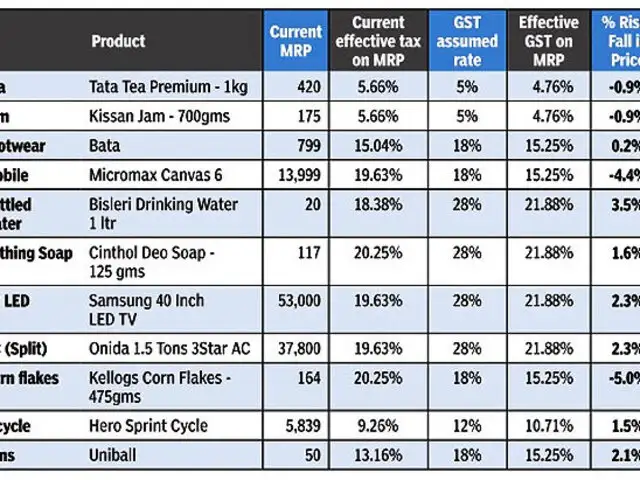
The GST Council, headed by Finance Minister Arun Jaitley, has decided a four-tier GST rate structure of 5 per cent, 12 per cent, 18 per cent and 28 per cent.
Foreign brokerage CLSA said companies such as Hindustan Unilever ( HUL), Godrej Consumer Products and Colgate-Palmolive would be beneficiaries of the new GST rates.
The government intends to keep the tax rates unchanged for the tobacco sector, which is a positive for ITC, but the new rates lack clarity on Marico, GSK Consumer and Asian Paints, the brokerage said. “While alcohol is unlikely to be under GST, there is uncertainty over key inputs such as glass bottlers, wet goods, recycled goods and other packaging material. Given the price controls in place across markets, we believe a higher-than-current rate under GST would be a big negative.”
JP Morgan noted that essential items including food, which presently constitute roughly half of the consumer inflation basket, will be taxed at zero rate. The demerit/luxury/sin products (including tobacco, luxury cars, pan masala, aerated drinks) will be taxed at 28 per cent, besides a cess.
Though the classification of consumer products has not been firmed up yet, we note that if products like toothpaste, soaps, laundry fall in the lower tax slab, it will be positive for Colgate and HUL, whose current tax incidence is higher at 20-24 per cent,” JPM report said.
“The market has factored in the rollout of GST by April 17 on a top-down basis. It will get the comfort from the fact that it is revenue neutral and non-inflationary. Keeping 50 per cent of CPI basket in zero rate will keep inflation subdued,” said Nilesh Shah, Managing Director, Kotak Mahindra Asset Management.
“On a top-down basis, the revenue-neutral and non-inflationary rate of GST is a positive development. However the devil is in the detail of how the rates are pushed into five slabs on a bottom-up basis,” Shah said.
Foreign brokerage UBS believes the services sector would face more transition troubles as it moves from a single-point registration and tax filing to that in every state on a monthly basis.
“For the manufacturing sector, the transition may be easier as it is already attuned to state VAT. Bigger companies have been preparing for GST, but smaller ones are not yet ready. Our discussions suggest a three-month transition time,” UBS said. An integrated IT network will be a key driver for the success of GST, it said.
Here’s a list of stocks and sectors that brokerages believe could gain going by the GST rates announced on Thursday.
ADVERTISEMENT
Brokerage firm Edelweiss Securities said the GST rates would be negative for the auto companies making smaller cars and two-wheelers. It will also be negative for consumer goods firms making white goods, cement and paint stocks, as the expected gains under GST will not be significant.
“The textile sector may attract higher tax than the current structure. Certain FMCG stocks (companies that produce soaps, detergents, oil and other mass consumption items) will be positively impacted due to a lower 18 per cent tax rate,” Edelweiss Securities said.
The unorganised sector accounts for 30-40 per cent of the market in sectors such as footwear, textiles and FMCG. With GST implementation, the unorganised sector may come under tax bracket, which will be a big positive for the listed organised players.
The GST Council, headed by Finance Minister Arun Jaitley, has decided a four-tier GST rate structure of 5 per cent, 12 per cent, 18 per cent and 28 per cent.
ADVERTISEMENT
Foreign brokerage CLSA said companies such as Hindustan Unilever ( HUL), Godrej Consumer Products and Colgate-Palmolive would be beneficiaries of the new GST rates.
The government intends to keep the tax rates unchanged for the tobacco sector, which is a positive for ITC, but the new rates lack clarity on Marico, GSK Consumer and Asian Paints, the brokerage said. “While alcohol is unlikely to be under GST, there is uncertainty over key inputs such as glass bottlers, wet goods, recycled goods and other packaging material. Given the price controls in place across markets, we believe a higher-than-current rate under GST would be a big negative.”
ADVERTISEMENT
JP Morgan noted that essential items including food, which presently constitute roughly half of the consumer inflation basket, will be taxed at zero rate. The demerit/luxury/sin products (including tobacco, luxury cars, pan masala, aerated drinks) will be taxed at 28 per cent, besides a cess.
Though the classification of consumer products has not been firmed up yet, we note that if products like toothpaste, soaps, laundry fall in the lower tax slab, it will be positive for Colgate and HUL, whose current tax incidence is higher at 20-24 per cent,” JPM report said.
Too busy to trade in stocks? Invest in Mutual Funds with ET Money!
Bookmark or read stories offline -
Download ET Markets APP
Download ET Markets APP
A 4-tier GST tax structure of 5, 12, 18 and 28 per cent, with lower rates for essential items and the highest for luxury and de-merits goods that would also attract an additional cess, has been agreed upon by the GST Council.
Essential items including food, which presently constitute 50 per cent of the consumer inflation basket, will be taxed at zero rate, in order to keep a check on inflation.
The schedule for goods and services under each slab rate has not been announced yet. According to Finance Minister Arun Jaitley, highest tax slab rate will be applicable to items currently taxed at 30% to 31% (excise duty plus VAT) will be taxed at a demerit rate of 28%.



ADVERTISEMENT


