Nobel Prize ceremony: Abhijit Banerjee sticks to Bengali roots in a dhoti, Esther Duflow stuns in saree
The duo added a desi twist to their choice of attire.
By ET Online and Agencies | Updated:
Abhijit Banerjee, Esther Duflo go traditional to receive Nobel Prize in Sweden
NEW DELHI: All eyes were on the 2019 Nobel Prize ceremony as Indian-American economist Abhijit Banerjee, along with French-American enonomist and wife Esther Duflo and another US-based colleague Michael Kremer, received the award in Economic Sciences on Tuesday in Stockholm, Sweden.
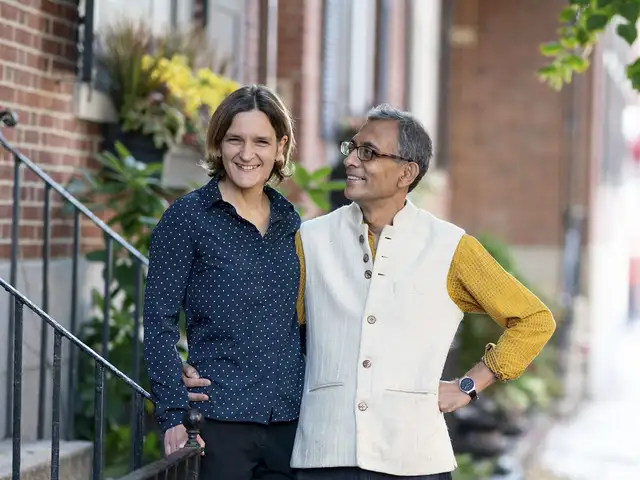
Banerjee and Duflo added a desi twist to their choice of attire. While Banerjee's emsemble was a nod to his Bengali origins, and his economist-wife was a headturner in a traditional Indian outfit.
The Mumbai-born economist looked dapper in a silk, white, gold-bordered dhoti in Bengali style paired with a beige kurta and a black bandhgala. Duflo opted for a plain blue-green saree with a gold embeslished end, and paired it with a contrast, red blouse with gold buti embriodery. She completed her look with a red bindi for the award ceremony that was held at the Stockholm Concert Hall.
Abhijit Banerjee's attire was a nod to his Bengali origins, and Esther Duflo also optd for a traditional Indian outfit for the event. In a tweet, the Nobel Prize committee shared a small video of Banerjee, Duflo and Kremer receiving the award. "Watch Abhijit Banerjee, Esther Duflo and Michael Kremer receive their medals and diplomas at the #NobelPrize award ceremony today. Congratulations! They were awarded the 2019 Prize in Economic Sciences for their experimental approach to alleviating global poverty," Nobel Prize tweeted.
Watch Abhijit Banerjee, Esther Duflo and Michael Kremer receive their medals and diplomas at the #NobelPrize award… https://t.co/dTuM5gExKz
They accepted the awarded for their work to alleviate global poverty that helped millions of children in an experimental approach that favours practical steps over theory.
ADVERTISEMENT
"The research conducted by this year's Laureates has considerably improved our ability to fight global poverty. In just two decades, their new, experiment-based approach has transformed development economics, which is now a flourishing field of research," the organisation said on its website.
Before the award ceremony began, Banerjee arrived at the Nobel banquet with Swedish finance minister Magdalena Andersson, and Duflo walked in with Prince Carl Philip of Sweden.
With this, Banerjee becomes second Indian to receive Nobel Prize in Economics. In 1998, Amartya Sen was awarded the Nobel Prize "for his contributions to welfare economics".
ADVERTISEMENT
Made In Heaven: Abhijit Banerjee & Esther Duflo Aren't Alone; Other Couples Who Won Nobel
1/6
Marriages are made in heaven, but some partnerships are formed in the laboratory. Last week, Abhijit Banerjee and Esther Duflo became the sixth married couple to get the Nobel Prize. Here are the others: (Image: AFP)
Marriages are made in heaven, but some partnerships are formed in the laboratory. Last week, Abhijit Banerjee and Esther Duflo became the sixth married couple to get the Nobel Prize. Here are the oth..
Read More
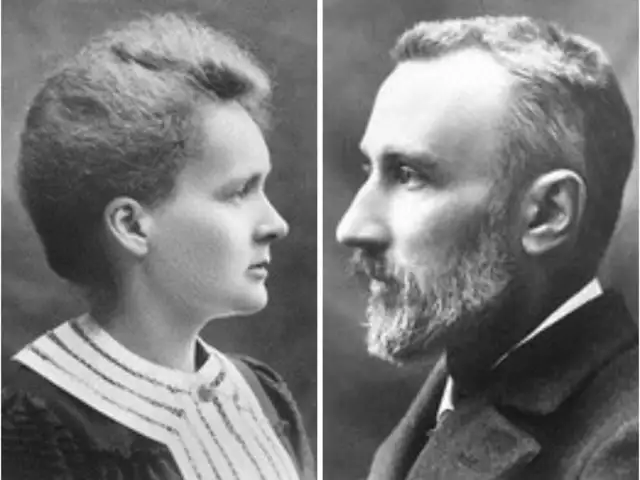
Marie and Pierre Curie Nobel Prize in Physics, 1903
In 1903, Marie and Pierre Curie shared the Nobel Prize in Physics with Professor Henri Becquerel. The duo was awarded for their joint research on the phenomenon of radiation. Their work laid the foundation for the modern-day applications of nuclear science, which range from power generation to medicine. Five years after her husband was killed in a road accident involving a horse-drawn carriage, Marie Curie won a second Nobel Prize in Chemistry in 1911 for discovering the elements radium and polonium. Curie’s efforts at isolating these radioactive elements in her lab came at great personal cost. She died in 1934 of aplastic anaemia, believed to be caused by prolonged exposure to radiation.
(Image: Nobel Foundation archive)
Marie and Pierre Curie
Nobel Prize in Physics, 1903
In 1903, Marie and Pierre Curie shared the Nobel Prize in Physics with Professor Henri Becquerel. The duo was awarded for their joint research on ..
Read More
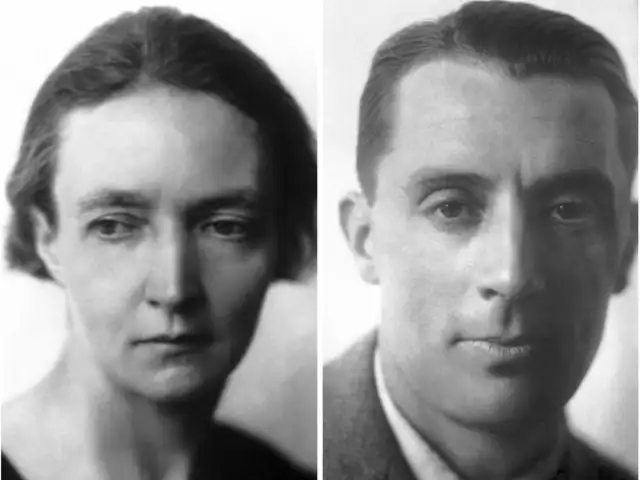
Irène Curie and Frédéric Joliot Nobel Prize in Chemistry, 1935
Irène Curie, the eldest daughter of Marie and Pierre Curie, won the Nobel Prize in Chemistry, along with her husband Frédéric Joliot. Upon graduation, Irène started working at the Radium Institute founded by her parents in Paris. In 1924, when Joliot came to work at the institute as Marie Curie’s assistant, it was Irène who showed him the ropes. They got married in 1926. Their research on the projection of nuclei led to the discovery of subatomic particles like the neutron and positron. They were jointly awarded the Nobel Prize in 1935 for discovering artificial radioactivity.
(Image: Nobel Foundation archive)
Irène Curie and Frédéric Joliot
Nobel Prize in Chemistry, 1935
Irène Curie, the eldest daughter of Marie and Pierre Curie, won the Nobel Prize in Chemistry, along with her husband Frédéric Joliot. U..
Read More
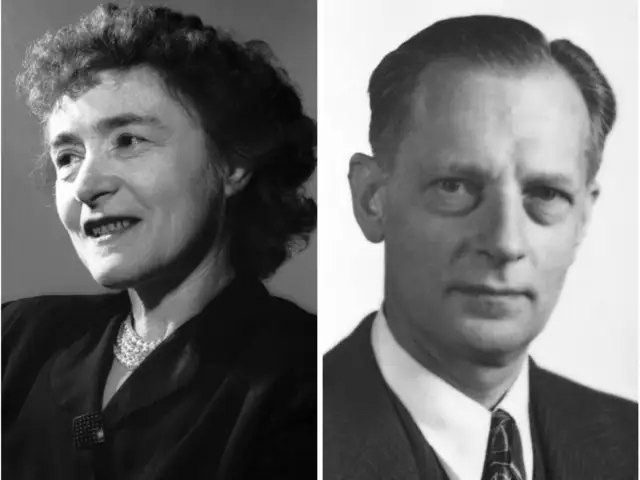
Gerty and Carl Cori Nobel Prize in Medicine, 1947
Carl Cori completed medical school in 1920, having served in the Austro-Hungarian Army during the First World War. He married his classmate Gerty Theresa Cori née Radnitz, who hailed from a Jewish family in Prague. The couple emigrated from Vienna to Buffalo, New York, in 1922 on account of the deteriorating political condition in Europe. In 1947, after nearly three decades of working together, they were awarded the Nobel for their discovery of the mechanism by which glycogen, a derivate of glucose, is broken down in muscle tissues. “Our collaboration began 30 years ago when we were still medical students at the University of Prague and has continued ever since. Our efforts have been largely complementary, and one without the other would not have gone as far as in combination,” Carl Cori said in his Nobel acceptance speech.
(Image: Nobel Foundation archive)
Gerty and Carl Cori
Nobel Prize in Medicine, 1947
Carl Cori completed medical school in 1920, having served in the Austro-Hungarian Army during the First World War. He married his classmate Gerty Th..
Read More
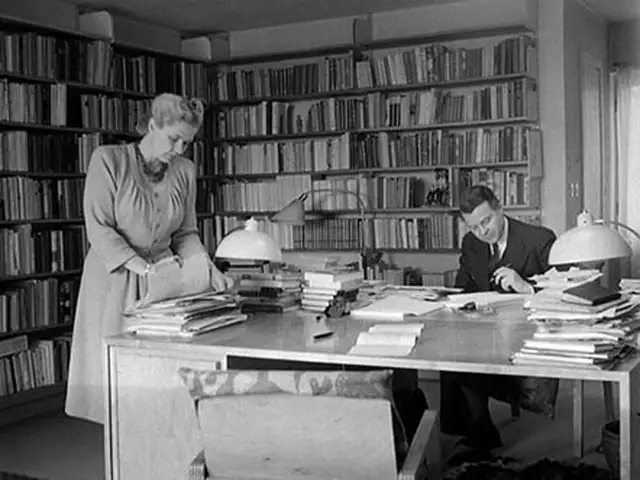
Alva and Gunnar Myrdals Nobel Prize in Economics (1974), Peace (1982)
The Myrdals are the only couple to be felicitated with the Nobel Prize in two separate disciplines. They were social scientists whose work concerned welfare economics and the role families play in shaping communities in the post-war world. Gunnar was jointly awarded the Economics Prize in 1974 for his research correlating politics with socioeconomic outcomes. Alva, a sociologist who dipped her feet in Swedish politics, was a staunch proponent of the disarmament movement. She won the Peace Prize in 1982 — at the height of the Cold War — for her efforts in creating a consensus against nuclear proliferation.
(Image: KW Gullers/Nordiska museet via Nobel Foundation archive)
Alva and Gunnar Myrdals
Nobel Prize in Economics (1974), Peace (1982)
The Myrdals are the only couple to be felicitated with the Nobel Prize in two separate disciplines. They were social scientists ..
Read More
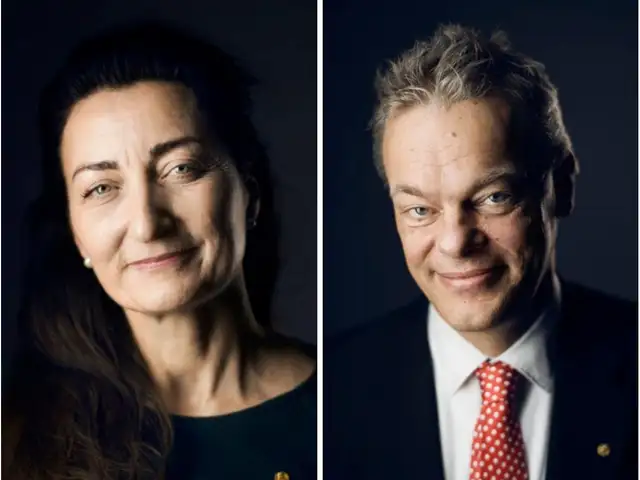
May-Britt and Edvard Moser Nobel Prize in Medicine, 2014
The Norwegian couple were awarded the 2014 Medicine Prize for their discovery of human beings’ ‘inner GPS’ – cells that constitute a native positioning system in the brain. This type of cell is located near the hippocampus, an area located at the centre of the brain. Experimental research founded that when a rat was let loose in a hexagonal grid arranged in space, certain nerve cells that formed a coordinate system for navigation were mapped. The Mosers’ work helped explain why Alzheimer’s patients are incapable of recognising their surroundings, contributing to advancement in treatment focused on targeted treatment of the affected ce
(Image: Nobel Foundation archive)
May-Britt and Edvard Moser
Nobel Prize in Medicine, 2014
The Norwegian couple were awarded the 2014 Medicine Prize for their discovery of human beings’ ‘inner GPS’ – cells that constitute a native p..
Banerjee completed his MA in Economics at the Jawaharlal Nehru University in New Delhi in 1983. Later, he went on to obtain a PhD in Economics at Harvard University in 1988.
The 58-year-old Mumbai-born economist is currently the Ford Foundation International Professor of Economics at Massachusetts Institute of Technology.
ADVERTISEMENT
Before the award ceremony began, Banerjee arrived to the Nobel banquet with Swedish finance minister Magdalena Andersson, and Duflo walked in with Prince Carl Philip of Sweden. Meanwhile, 46-year-old Duflo became only the second woman to win the prize for economics.
Following the announcement of Nobel in October, Prime Minister Narendra Modi had con gratulated Banerjee and met him. Prime Minister Modi had said that he has made notable contributions in the field of poverty alleviation.
Taking to Twitter, he tweeted: "Congratulations to Abhijit Banerjee on being conferred the 2019 Sveriges Riksbank Prize in Economic Sciences in Memory of Alfred Nobel. He has made notable contributions in the field of poverty alleviation."
Tagore, Satyarthi And 8 Other Nobel Winners Who Have Made India Proud
1/11
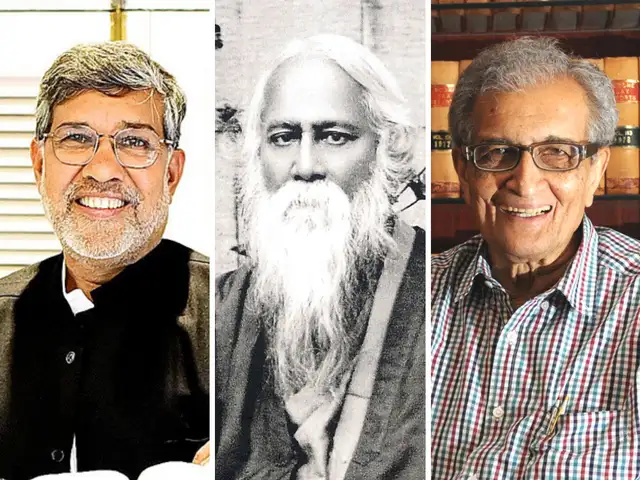
India's association with the Nobel Prize goes back, across centuries and latitudes. Poet, writer and thinker Rabindranth Tagore brought glory to the country when he became the first Indian to win the Nobel Prize for the country. The 52-year-old Tagore was accorded the honour in 1913, 12 years after it made its debut.
Ever since, nine other laureates with an India connection have been conferred the prestigious award in various categories, Abhijit Banerjee being the latest.
There were a few famous names who were nominated several times, but failed to bag the award. While Indian poet Sri Aurobindo was nominated for the Nobel Prize in Literature in 1943 and 1950, the committee had considered Mahatma Gandhi for the Peace Prize five times in 1937, 1938, 1939, 1947 & 1948 (days before his assassination).
Swedish chemist Alfred Nobel had drafted a will in 1895 where he reserved a large part of his estate to establish Nobel Prizes after concerns of how the world would remember him. He wanted the awards to be given to individuals (based on their achievements), annually, despite their nationality. He died in 1896.
It took nearly five years for the committee to set up, and the first set of awards for Physiology or Medicine, Chemistry, Literature, Physics and Peace were awarded in 1901. After 67 years, Sweden's central bank with donation from donation from the Nobel Foundation, established the Sveriges Riksbank Prize in Economic Sciences in Memory of Alfred Nobel in 1968.
Here's a look at all the Indians who brought honour to the nation.
India's association with the Nobel Prize goes back, across centuries and latitudes. Poet, writer and thinker Rabindranth Tagore brought glory to the country when he became the first Indian to win t..
Read More
Rabindranath Tagore was the first Indian to get a Nobel Prize in 1913, and in his area of expertise - Literature. He won the award for "his profoundly sensitive, fresh and beautiful verse, by which, with consummate skill, he has made his poetic thought, expressed in his own English words, a part of the literature of the West".
While he originally wrote in Bengali, Tagore reached out to a wider audience in the West with his translation of poetry that conveyed 'the peace of the soul in harmony with nature'. The Swedish academy, on its website, says that 'Tagore's writing is deeply rooted in both Indian and Western learning traditions'.
Born in 1861, the Calcutta-born writer was well known for fiction in the form of poetry, songs, stories, dramas, and it included portrayals of people's lives, literary criticism, philosophy and social issues.
Tagore was home-schooled, but went to England for formal education. However, he didn't complete his studies there. His inclination towards humanity and social reforms increased when he started managing the family estates. He often participated in the Indian nationalist movement, and Mahatma Gandhi was his dear friend. The then British Government in 1915 honoured Tagore with knighthood, but he returned it within a few years as a sign of protest against British policies in the country.
He passed away in 1941 at the age of 80.
Rabindranath Tagore was the first Indian to get a Nobel Prize in 1913, and in his area of expertise - Literature. He won the award for "his profoundly sensitive, fresh and beautiful verse, by which, ..
Read More
India's first physicist to win a Nobel Physics Prize in 1930 "for his work on the scattering of light and for the discovery of the effect named after him" was Sir Chandrasekhara Venkata Raman.
Born in 1888, the Tiruchirappalli-born scientist's discovery helped other researchers analyse different types of material using his scattering of light phenomenon.
In 1928, Venkata Raman found out that light spreads in different directions when light meets particles that are smaller than its wavelength. He further established that a small portion of the scattered light acquires other wavelengths than that of the original light because some of the incoming photons' energy can be transferred to a molecule, giving it a higher level of energy.
When he received the award, he was working with the Calcutta University. At 82, he passed away in Bangalore.
India's first physicist to win a Nobel Physics Prize in 1930 "for his work on the scattering of light and for the discovery of the effect named after him" was Sir Chandrasekhara Venkata Raman.
Born ..
Read More
Har Gobind Khorana's work on electron diffraction got him the 1968 Nobel Prize in Physiology or Medicine. He shared the award with Robert W Holley and Marshall W Nirenberg "for their interpretation of the genetic code and its function in protein synthesis".
In the 1950s, it was established that genetic information is transferred from DNA to RNA, to protein. One sequence of three nucleotides in DNA corresponds to a certain amino acid within a protein. In order to crack the genetic code, Marshall Nirenberg discovered the first piece of the puzzle. The remain part of the study was carried out in the following year.
Born in 1922, the Raipur-based built different RNA chains with the help of enzymes, which further helped him to produce proteins using these enzymes. The amino acid sequences of these proteins then solved the rest of the puzzle.
During his research, Khorana was a part of the Wisconsin University in Madison. He spent his last years in Concord, Massachusetts, and passed away in 2011.
Har Gobind Khorana's work on electron diffraction got him the 1968 Nobel Prize in Physiology or Medicine. He shared the award with Robert W Holley and Marshall W Nirenberg "for their interpretation o..
Read More
Mother Teresa was the first woman with close Indian ties to get the 1979 Nobel Peace Prize. While she was born in Macedonia (then Ottoman Empire's Uskup) to parents of Albanian descent, she was sent to Calcutta to be a teacher after she entered a nunnery.
Also known as Agnes Gonxha Bojaxhiu, she had a calling at the age of 12. After coming to India, she decided to serve the poor as she lived amongst them.
After founding Missionaries of Charity in Calcutta, she, along with her helpers, built homes for orphans, nursing homes for lepers and hospices for the terminally ill. Her organisation provided aid in other parts of the world.
While she was appreciated worldwide, she also faced criticism as the people suffering in the hospices were refused pain relief, but Mother Teresa got hospital treatment. She also had conservative views on abortion.
She became the spokesperson for the Vatican. Her canonisation took place in 2003, and Pope Francis declared her a saint in 2016.
Mother Teresa was the first woman with close Indian ties to get the 1979 Nobel Peace Prize. While she was born in Macedonia (then Ottoman Empire's Uskup) to parents of Albanian descent, she was sent ..
Read More
Subramanyan Chandrasekhar made India proud in 1983 when he bagged the Nobel Prize in Physics "for theoretical studies of the physical processes of importance to the structure and evolution of the stars". He shared the award with another physicist William Alfred Fowler.
Chandrasekhar was born in 1910 when Lahore (now in Pakistan) was a part of India. During the affiliation at the time of the award, he was a part of Chicago University in Illinois.
It is common knowledge that stars form clouds of gas and dust in the universe. When gravity pulls these clouds, energy is released in the form of heat. With the rising temperature, the atomic nuclei inside the stars start reacting. Chandrasekhar started working on his theories of the process stars subsequently undergo in 1930s. In his research, he explained how a star turns into a white dwarf when the hydrogen fuel of stars (of a certain size) begins to run out. His theory suggested that the star further collapses into a compact star known as a white dwarf.
Subramanyan Chandrasekhar made India proud in 1983 when he bagged the Nobel Prize in Physics "for theoretical studies of the physical processes of importance to the structure and evolution of the sta..
Read More
Economist Amartya Sen was the sole winner of the 1998 Sveriges Riksbank Prize in Economic Sciences, which was introduced by the Nobel Prize Committee in memory of Alfred Nobel, "for his contributions to welfare economics".
During his award, he was with Trinity College, Cambridge in United Kingdom. He researched on fundamental problems in welfare economics, important resources in a community, and ways to divide them.
Sen's research focused on the value of values in collective decision-making, and ways in which welfare and poverty can be measured. The Swedish academy, on its website, wrote that Sen's efforts stem from his interest in questions of distribution and, in particular, the lot of society's poorest members. Sen also included famines in his studies to create a deeper understanding of the economic reasons behind them and poverty.
In 1933, Sen was born in Santiniketan, West Bengal, and studied in Dhaka (now in Bangladesh) where his father was a professor of chemistry. After completing his studies from Kolkata and Cambridge University, he got his PhD in 1959. He also held professorships in India, Oxford and Cambridge universities in UK, and Harvard University in US.
He is currently married to Emma Rothschild. Before Rothschild, he was married to Eva Colorni for 7 years and Nabaneeta Dev Sen for 18 years. He has two children from each of his previous marriages.
Economist Amartya Sen was the sole winner of the 1998 Sveriges Riksbank Prize in Economic Sciences, which was introduced by the Nobel Prize Committee in memory of Alfred Nobel, "for his contributions..
Read More
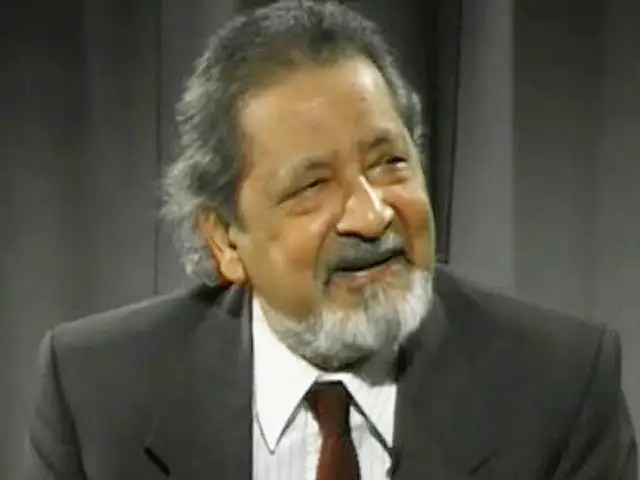
Author VS Naipaul won the 2001 Nobel Prize in Literature "for having united perceptive narrative and incorruptible scrutiny in works that compel people to see the presence of suppressed histories".
While he was born in Trinidad in 1932, he belongs to an Indian descent. According to the Nobel Prize website, the author's descendant had moved to India to work as indentured labourers in cocoa plantations of Trinidad. He later moved to UK after receiving an Oxford scholarship, and became a citizen of that country.
Before this Nobel, Naipaul was felicitated with the 1971 Booker Prize for his novel 'In a Free State', and Trinidad and Tobago's highest honour - Trinity Cross - in 1989. Britain also awarded his with knighthood in 1990.
Naipaul was married to Patricia Ann Hale for 41 years who succumbed to cancer. Two months after her death, he married Pakistani journalist Nadira Alvi, 21 years younger than him.
Known for his works of fiction and nonfiction in English, Naipaul passed away last year in August.
Author VS Naipaul won the 2001 Nobel Prize in Literature "for having united perceptive narrative and incorruptible scrutiny in works that compel people to see the presence of suppressed histories".Wh..
Read More
Tami Nadu-born Venkatraman Ramakrishnan received the 2009 Nobel Prize in Chemistry "for studies of the structure and function of the ribosome". He shared the award with Thomas A Steitz and Ada E Yonath.
Born in 1952, he was working with MRC Laboratory of Molecular Biology in Cambridge when he received the honour.
Vital functions of an organism are managed by complex protein molecules produced in cells' ribosomes. Ribosome is a molecular machine that is found in living cells' cytoplasm which synthesises proteins. Along with other researchers, Venkatraman Ramakrishnan used x-ray crystallography in 2000 to determine the structure of ribosomes, which is made up of hundreds of thousands of atoms. Among other applications, Nobel Prize website mentioned that Ramakrishnan's research has been vital in production of antibiotics.
He grew up in a family of academics. While his father, CV Ramakrishnan, got his postdoctoral fellowship in Madison, Wisconsin, his mother, R Rajalakshmi, obtained a McGill University fellowship to do PhD in psychology, which she finished in 18 months.
Tami Nadu-born Venkatraman Ramakrishnan received the 2009 Nobel Prize in Chemistry "for studies of the structure and function of the ribosome". He shared the award with Thomas A Steitz and Ada E Yona..
Read More
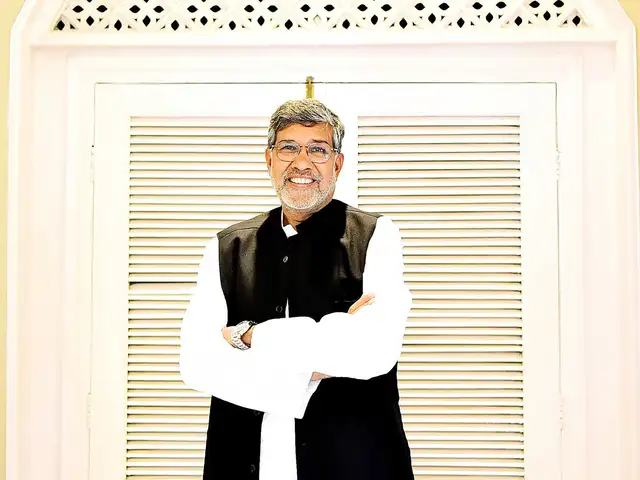
Kailash Satyarthi, along with Malala Yousafzai, received the Nobel Peace Prize in 2014 "for their struggle against the suppression of children and young people, and for the right of all children to education."
Born in 1954, he taught children in Vidisha, a small town in Madhya Pradesh, where he grew up. He had acquired his degree in electrical engineering, but decided to be a teacher. In 1980, he left teaching and founded 'Bachpan Bachao Andolan', an organisation that worked towards freeing children from slave-like conditions. He has been active for the fight against child labour and children's rights to education in a wide range of other organisations.
To achieve a peaceful world, following the tradition of Mahatma Gandhi, the Indian activist has been working towards ending child labour, exploitation, and encouraging them to attend school. He has also contributed to the development of international conventions on the rights of children, according to the Swedish academy.
As a member of UNESCO body, he works towards providing 'Education for All'. After his Nobel win, he made it to the Fortune 'World's Greatest Leaders' list in 2015.
Satyarthi is married to Sumedha, and has two children - a son and daughter.
Kailash Satyarthi, along with Malala Yousafzai, received the Nobel Peace Prize in 2014 "for their struggle against the suppression of children and young people, and for the right of all children to e..
Business News › Magazines › Panache › Nobel Prize ceremony: Abhijit Banerjee sticks to Bengali roots in a dhoti, Esther Duflow stuns in sareeText Size:AAA