Love the ride you’re taking us on: Chandrayaan-2 enters lunar orbit; Anand Mahindra celebrates on Twitter
PM Modi called it an 'important step in the landmark journey to the Moon'.

As it entered the lunar orbit, ISRO chief K Sivan - who said that their hearts almost stopped during the 30 minutes of the moment - announced that lander Vikram will make a soft landing on the Moon on September 7. The lander was named after the Father of the Indian space program, Vikram Sarabhai.
ISRO's tweet sharing the news saw Twitter burst into celebration.
Prime Minister Narendra Modi, who has reportedly been extended an invitation to witness Chandrayaan-2's landing, congratulated the team behind the mission, calling it an 'important step in the landmark journey to the Moon'.
PM Modi is reportedly determined to launch a manned mission into space by 2022.
Congratulations to Team @isro on #Chandrayaan2 entering the Moon’s orbit. This is an important step in the landmar… https://t.co/XHR3hABpLz
— Narendra Modi (@narendramodi) 1566290061000Congratulations to @isro scientists on successful insertion of #Chandrayaan2 into the Lunar Orbit. The smooth ent… https://t.co/i4R0NGCdxX
— Rajnath Singh (@rajnathsingh) 1566291497000Mahindra Group boss Anand Mahindra, who has been actively following and tweeting about the mission, took to the micro-blogging site to say that 'the great Lunar adventure continues'.
All eyes on this today....The great Lunar adventure continues... https://t.co/uU3e49orms
— anand mahindra (@anandmahindra) 1566274474000Quoting ISRO's tweet, he wrote, "And the journey is the destination, @isro. We love the ride you’re taking us on. Don’t ever cease your exploration...Next stop, Mars..."
������������������������ And the journey is the destination, @isro We love the ride you’re taking us on. Don’t ever cease your… https://t.co/kDZ3OmtnsU
— anand mahindra (@anandmahindra) 1566286498000Netflix India indulged in wordplay, quoting Nawazuddin Siddiqui's Ganesh Gaitonde from 'Sacred Games'.
Ganesh Gaitonde: Apun chand pe hai. #Chandrayaan2: Apun bhi chand pe aa raha hai.
— Netflix India (@NetflixIndia) 1566297381000Ladies and gents, sit back as #Chandrayaan2 is all set to present you its fantastic moonwalk! It has successfully e… https://t.co/dgSy0rfErX
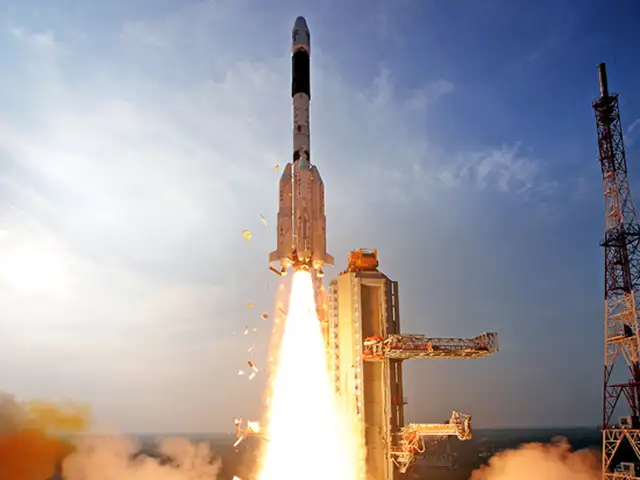
— Acko General Insurance (@AckoInsurance) 1566286381000The project, led by two women scientists, M Vanitha and Ritu Karidhal, saw Chandrayaan-2 being launched from the Satish Dhawan Space Centre at Sriharikota in Andhra Pradesh, on July 22, after an initial delay. It was launched on India's most powerful rocket, the Geosynchronous Satellite Launch Vehicle (GSLV) MkIII.
The spacecraft used in the mission comprises an orbiter, a lander and a rover almost entirely designed and made in India. The orbiter has a mission life of a year and will take images of the lunar surface.
https://t.co/UQfoAFbTx6
— ISRO (@isro) 1563791606000The mission is aimed at helping scientists understand the origin and evolution of the Moon by conducting detailed topographical studies, mineral analyses and a host of other experiments.
About $140 million was spent on preparations for the probe's mission - a much smaller price tag compared to similar operations by other countries.
India's first lunar mission in 2008 - Chandrayaan-1 - did not land on the Moon, but carried out a search for water using radar.
India also has ambitions to land a probe on Mars. In 2014, India became only the fourth nation to put a satellite into orbit around the Red Planet.
(With inputs from AFP)
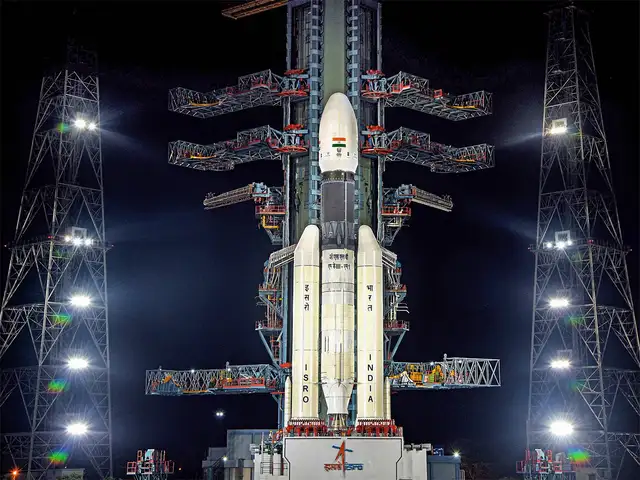
The Chandrayaan-2 launch is expected to take place today. Its postponement last week is reminiscent of other times when reaching the final frontier was delayed.
In Pic: A view of the Chandrayaan-2 on board GSLVMkIII-M1 at Satish Dhawan Space Centre in Nellore district.

The Economic Times Business News App for the Latest News in Business, Sensex, Stock Market Updates & More.


