Living the past: AR, games keeping Bengalureans in touch with city's heritage
For conservation groups, startups and individual citizens fighting to maintain heritage, getting people in touch with it is a key objective.
By Apoorva Puranik, ET Bureau |

Agencies
BENGALURU: The present and future are coming together to save the past.
For conservation groups, startups and individual citizens fighting to maintain heritage, getting people in touch with it is a key objective. The best way to do it is with technology, says FlippAR Go founder Vivek Jain.
The augmented reality (AR) platform, via its free mobile application, scans heritage structures to throw up interactive information about the sites using realtime images. “There is so much we don’t know about or own city’s history. It is very important for the younger generation to be interested in heritage and the best way to get their attention is through technology,” Jain points out. The company is working on a new addition to include Bengaluru’s flora and fauna in the app as well.
They have also launched interactive postcards of landmark places such as Cubbon Park, the State Central Library and KR Market. Like the structures, the postcards come alive on the screen when scanned, with an audio-visual commentary about their history. Timescape, another app launched in 2016, draws on the fabric of India’s cities by combining archival image material and historical data to communicate urban heritage via AR.
Gamifyi, a self-guided heritage hunt app, designs quests, treasure hunts and food trails in and around Cubbon Park, Lalbagh, Nandi Hills, Basavanagudi, etc. The games involve multiple choice questions, geo check-ins, QR code scans and selfie uploads. Once a clue is solved, the app gives out historic trivia as well. The company also hosts treasure hunt competitions on weekends.
While AR is popular with tech startups, citizen-driven projects like Inscription Stones of Bangalore are digitally documenting history by using high-resolution 3D optical scans to catalogue inscription tablets. The group has also built crowdsourced map plotting for the stones across the state. Over 1,023 stones have been mapped within BBMP boundaries and are available on Google maps. Moreover, fictionalised stories based on the inscriptions are also being documented on a Kannada blog, Girgitlay. Apart from mapping, there’s a lot of updated, relevant information about the history of these stones available on the maps.
Architect Kailash Rao, who was formerly with Manipal University and now heads a Masters program in heritage conservation in Vijayawada University, says they have set up radar surveys to scientifically documentation various historical structures in Uttar Kannada and the Chola temples in Tamil Nadu. “We work at the academic level to document the architectural and historical aspects of these structures. Research and documentation is what helps future generation rooted to the past. Technology is advancing, and so is our research,” Rao says.
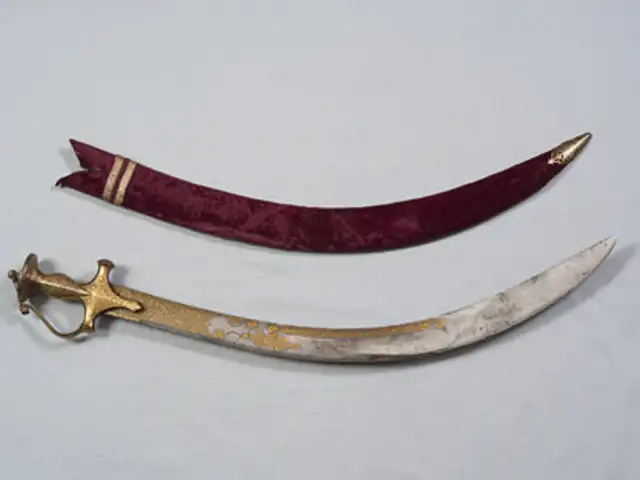
The famous sword of Tipu Sultan made news recently when Vijay Mallya, its most recent owner, gave it away as it had brought him ”bad luck”. Let’s take a look at other legendary swords and the kings who brandished them.
(Image: www.nationalmuseumindia.gov.in & Tex: Viandra Dsouza)
For conservation groups, startups and individual citizens fighting to maintain heritage, getting people in touch with it is a key objective. The best way to do it is with technology, says FlippAR Go founder Vivek Jain.
The augmented reality (AR) platform, via its free mobile application, scans heritage structures to throw up interactive information about the sites using realtime images. “There is so much we don’t know about or own city’s history. It is very important for the younger generation to be interested in heritage and the best way to get their attention is through technology,” Jain points out. The company is working on a new addition to include Bengaluru’s flora and fauna in the app as well.
They have also launched interactive postcards of landmark places such as Cubbon Park, the State Central Library and KR Market. Like the structures, the postcards come alive on the screen when scanned, with an audio-visual commentary about their history. Timescape, another app launched in 2016, draws on the fabric of India’s cities by combining archival image material and historical data to communicate urban heritage via AR.
Gamifyi, a self-guided heritage hunt app, designs quests, treasure hunts and food trails in and around Cubbon Park, Lalbagh, Nandi Hills, Basavanagudi, etc. The games involve multiple choice questions, geo check-ins, QR code scans and selfie uploads. Once a clue is solved, the app gives out historic trivia as well. The company also hosts treasure hunt competitions on weekends.
While AR is popular with tech startups, citizen-driven projects like Inscription Stones of Bangalore are digitally documenting history by using high-resolution 3D optical scans to catalogue inscription tablets. The group has also built crowdsourced map plotting for the stones across the state. Over 1,023 stones have been mapped within BBMP boundaries and are available on Google maps. Moreover, fictionalised stories based on the inscriptions are also being documented on a Kannada blog, Girgitlay. Apart from mapping, there’s a lot of updated, relevant information about the history of these stones available on the maps.
ADVERTISEMENT
Architect Kailash Rao, who was formerly with Manipal University and now heads a Masters program in heritage conservation in Vijayawada University, says they have set up radar surveys to scientifically documentation various historical structures in Uttar Kannada and the Chola temples in Tamil Nadu. “We work at the academic level to document the architectural and historical aspects of these structures. Research and documentation is what helps future generation rooted to the past. Technology is advancing, and so is our research,” Rao says.
(Image: www.nationalmuseumindia.gov.in & Tex: Viandra Dsouza)




Download
The Economic Times Business News App for the Latest News in Business, Sensex, Stock Market Updates & More.
The Economic Times Business News App for the Latest News in Business, Sensex, Stock Market Updates & More.
ADVERTISEMENT


