Lata Mangeshkar (1929-2022): A timeline of the legendary singer's accomplished journey
On Sunday morning, the nation woke up to the news of Mangeshkar's demise.

On Sunday morning, India woke up to the news of her Nightingale's demise. As the nation mourns, here's a look at Mangeshkar's accomplished life:
Pay your tribute to Lata Mangeshkar
September 28, 1929: India was blessed with the Queen of Melody who would enthral the nation with her honey-life voice. The iconic singer was born as Hema Mangeshkar in Indore to Marathi-Konkani musician Deenanath Mangeshkar and his wife Shevanti. She was the eldest among her four siblings - Meena Khadikar, Asha Bhosle, Usha Mangeshkar and Hridaynath Mangeshkar - who are all renowned singers and musicians.
Aaj hamare parichit Upendra Chinchore ji ka phone aaya,unhone mujhe bataaya ki aapne apna pehla classical performan… https://t.co/suDOACBQUS
— Lata Mangeshkar (@mangeshkarlata) 16170009840001935: From a young age, the playback singer's father - who adopted the family name Mangeshkar as he was from Goa's native town Mangeshi - started her music training. She began as an actress in Mangeshkar Sr's Marathi musical plays when she was just five years old.
1941: Much before India won its Independence from the British Raj, Mangeshkar started her musical journey at the age of 12. She sang two songs in the studio for the first time for the radio on December 16.
16 दिसम्बर 1941 को,ईश्वर का पूज्य माई और बाबा का आशिर्वाद लेकर मैंने रेडीओ के लिए पहली बार स्टूडीओ में २ गीत गाए थे… https://t.co/8F0qsBudIE
— Lata Mangeshkar (@mangeshkarlata) 16396345560001942: After her father died of a heart condition, movie company Navyug Chitrapat owner Vinayak Damodar Karnataki, who was a close friend of the Mangeshkars, helped bring the then young girl's singing and acting career on track. She got her first break when she acted in Navyug Chitrapat's Marathi movie 'Pahili Mangalaa-gaur', and sang 'Natali Chaitraachi Navalaai' in the movie.
1943: She sang her first Hindi song in Marathi film 'Gajaabhaau' - 'Mata Ek Sapoot Ki Duniya Badal De Tu'.
Aaj marathi ke mashhoor hasya abhineta Damuanna Malvankar ji ki punyatithi hai.Unki beti Bharathi se mere chote bha… https://t.co/K9Ud0onJf6
— Lata Mangeshkar (@mangeshkarlata) 16209837620001945: Mangeshkar moved to Mumbai after Karnataki shifted the headquarters of Navyug Chitrapat, and began her training in Hindustani classical music from Ustad Aman Ali Khan of Bhindibazaar Gharana.
1946: The song 'Paa Lagoon Kar Jori' was Mangeshkar's debut in a Hindi-language movie by Vasant Joglekar - 'Aap Ki Seva Mein'.
Namaskar. Aaj bahut mashhoor aur meri pasandida abhinetri Meena Kumari ki jayanti hai.Unke aur mere bahut acche sam… https://t.co/b5PK9HFRXY
— Lata Mangeshkar (@mangeshkarlata) 16278253700001948: Mangeshkar was mentored by music director Ghulam Haider right after Karnataki's death. After getting rejected by producer Sashadhar Mukherjee's 'Shaheed', Mangeshkar got mainstream with 'Majboor' with the song 'Dil Mera Toda, Mujhe Kahin Ka Na Chhora'.
1949: 'Aayega Aanewaala', featuring classic actress Madhubala, was her major hits from the movie 'Mahal'.
1950s: Mangeshkar saw great scope in movies, and produced four films - Marathi film 'Vaadal' (1953), and Hindi movies 'Jhaanjhar' (1953) and 'Kanchan Ganga' (1955).
1963: 'Aye Mere Watan Ke Logo' in Mangeshkar's soulful voice brought tears to the eyes of every citizen and the then Prime Minister, Jawaharlal Nehru, during the Sino-Indian War.
नमस्कार. भारत के प्रथम प्रधानमंत्री पंडित जवाहर लाल नेहरू जी की आज जयंती है. मैं उनको विनम्र अभिवादन करती हूँ. https://t.co/iEuf4u2oSa
— Lata Mangeshkar (@mangeshkarlata) 16368975020001963: This was the year when Mangeshkar's association with music directors Laxmikant–Pyarelal began. The singer gave voice to many of their compositions and the collaboration kept growing stronger. Some popular names include 'Mr. X in Bombay', 'Mere Hamdam Mere Dost', 'Intaquam, 'Do Raaste', among others.
1960s: This was the era when Mangeshkar tried her hand in composing music. Under Anand Ghan's pseudonym, she composed music for Marathi movies 'Ram Ram Pavhana' (
1960), 'Maratha Tituka Melvava' (1963), 'Mohityanchi Manjula' (1963), 'Sadhi Manase' (1965) and 'Tambadi Mati' (1969). The Maharashtra government honoured her with the Best Music Director Award for 'Sadhi Manase', and song 'Airanichya Deva Tula' received the Best Song Award.
1969: Mangeshwar was honoured with the third-highest civilian award - Padma Bhushan - for years of commitment to entertaining the people of the country.
1974: Mangeshkar went international. She was the first Indian to perform at the Royal Albert Hall, London.
Namaskar. Aaj mere pita samaan S D Burman sahab ki jayanti hai. Wo kitne mahan sangeetkar the ye duniya jaanti hai.… https://t.co/rD6RooWLID
— Lata Mangeshkar (@mangeshkarlata) 16330931310001974: Mangeshkar made it to the Guinness Book of Records (GBR) for being the most-recorded artist in history, between 1948 and 1974. The entry claimed she recorded "not less than 25,000 solo, duet and chorus backed songs in 20 Indian languages", singer Mohammad Rafi contested it saying he sang around 28,000 songs. The duo didn't share a strong bond after trouble with royalty payments. The entry was later discontinued without any explanation in 1991.
1970s: Mangeshkar became the common voice for Laxmikant–Pyarelal and Rahul Dev Burman compositions. She collaborated with popular evergreen singer Kishore Kumar, Manna Dey, Mukesh, Mohammed Rafi, sisters Asha and Usha, Hemant Kumar, among others.
Namaskar. Aaj meri choti behen Usha Mangeshkar ka janam din hai. Main usko aashirwad deti hun ki wo deerghayu ho, h… https://t.co/Xi9EOykXfa
— Lata Mangeshkar (@mangeshkarlata) 16395504800001989: Mangeshkar was honoured with Dadasaheb Phalke Award - India's highest award in cinema - which is given at the National Films Awards ceremony.
1997: The state government gave its highest civilian award - Maharashtra Bhushan Award - to Mangeshkar.
1999: She won her Padma Vibhushan - the second-highest civilian award for her "exceptional and distinguished service" to the nation.
1984 & 1992: The Government of Madhya Pradesh and Maharashtra instituted the Lata Mangeshkar Award to honour her legacy.
Aaj R D Burman sahab ki punyatithi hai.Bahut kam logon ko pata hai ki pancham Sarod aur tabla sikha hua tha aur acc… https://t.co/JUmM2eNw5U
— Lata Mangeshkar (@mangeshkarlata) 16097475960002001: She received the Bharat Ratna award - highest civilian honour - for her contribution to cinema and music.
2009: Mangeshkar was honoured with France's highest order, the title of Officer of the French Legion of Honour.
2012: Music label LM Music came to life, with an album of bhajans that she sang with her sister Usha.
2015: Mangeshkar's last song for a film was 'Jeena Hai Kya' for 'Dunno Y2... Life Is A Moment', a sequel to the Kapil Sharma-starrer 'Dunno Y... Na Jaane Kyun'. She recorded the song at her own studio.
2022: India lost her Nightingale. The government declared national mourning for two days with the Tricolour flying at half-mast.
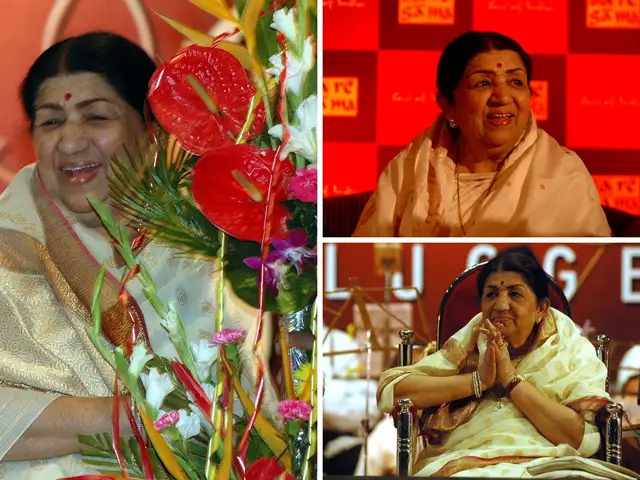
India's Nightingale, singing legend Lata Mangeshkar passed away on Sunday morning. In a career spanning over seven decades, Mangeshkar delivered memorable hits that have left a mark on the Indian music industry. She has not only paved the path for upcoming musicians but is also a source of inspiration for many of them.
Her soulful voice goes well with multiple generation of actresses - from Madhubala to Madhuri to Alia Bhatt. As the pride of our nation leaves for her heavenly abode, let us take a look at the life and times of Lata Mangeshkar.

The Economic Times Business News App for the Latest News in Business, Sensex, Stock Market Updates & More.


