Get out of sweatpants: Spring fashion is changing; bold colours, light fabrics set the pandemic mood
Floral prints, feel-good slogans and statement jewellery can jazz up working-from-home outfits.
By Reuters | Updated:
iStock
While neutral tones are still prevalent, fashion brands are trying to inject some optimism into the wardrobes with bright accents.
LISBON/CHICAGO: After a year of nesting in pastel-coloured loungewear, shoppers are opting for styles with floral prints, feel-good slogans and statement jewellery to jazz up working-from-home outfits as optimism makes a comeback in spring collections, designers and retailers told Reuters.
While neutral, comfortable clothing remains more popular than in a normal spring, retailers from Neiman Marcus to Walmart and Macy's Inc reported growing sales of bright, optimistic colour, flowy fabrics or dresses for the first time since the start of the pandemic as shoppers prepared for a return to normal life.
"We're seeing a return to occasion dresses and even bras with wires," Marie Ivanoff-Smith, fashion director at department store Nordstrom, told Reuters. "As it gets warmer and more people go outside, we thought people would really want to showcase optimism and joy with prints and vibrant colours." So far, ditzy floral prints are up 31% in Europe and 16% in the United States from last year, according to Heuritech, a data firm analyzing millions of pictures a day on social media and catwalks.
Colours seen in catwalks for spring and summer 2021 collections were vibrant pinks and bold blues - "an energizing source of inspiration to help carry us through," the company said in a February report. While vibrant colours and floral motifs are typical of spring styles, the difference this year is that fashion lines also include nude t-shirts and what Walmart's head of fashion editorial, Alison Hilzer, called "slouchy cardigans."
British online fashion retailer ASOS said in an email that it noticed in recent weeks its customers were "into feel-good slogans, brighter colours and floral accessories as the weather has started to improve and they start to get ready for the summer ahead."
"While neutral tones are still prevalent, we're excited to inject some much-needed optimism into our wardrobes with bright accents. We're loving yellows and greens for (spring)," an ASOS spokesperson told Reuters in an email.
ADVERTISEMENT
"Bold colours, draping, and light fabrics created a perfect complement to spring with collections from Dior, Loewe, and Dries van Noten," said Lana Todorovich, president and chief merchandising officer at luxury retailer Neiman Marcus.
"It's clear that the trend is also about coming out of this, although it's still a lot about comfortable garments," H&M CEO Helena Helmersson told Reuters on Wednesday after the Swedish retailer reported earnings.
Neutral, comfortable clothing remains more popular than in a normal spring. A 'NERVE-RACKING' PLANNING PROCESS Still, planning has never been harder than this year, as designers used to finishing designs months and sometimes years ahead were forced to adjust collections and marketing in line with the fluctuating circumstances of the coronavirus pandemic.
ADVERTISEMENT
In general, fashion trend forecasting will look two years out, according to consumer product director at fashion trend analysis company Stylus, Emily Gordon-Smith. But amid the uncertainty of the pandemic, the company advised its clients to play it safe with "seasonless" clothing.
"We tend to plan six months ahead, which is nerve-racking when you think about it," Nordstrom's Ivanoff-Smith said.
ADVERTISEMENT
"How are you feeling in New York? L.A.? Seattle? We realized we needed to cater to all the scenarios," Ivanoff-Smith said. The Seattle-based department store "eased into the spring season" by starting with casual clothes and then moving into special fashions like jewellery and colourful dresses.
Still, convincing consumers spoiled by comfy clothing seven days a week to go back to heels and suits may not be easy, Gordon-Smith said.
"Once consumers are embedded in a comfort-based wardrobe, it's a very tough mind-set to shift," Gordon-Smith said. "It'll be underpinned by a desire to dress up again, but by our predictions that's not going to happen on a large-scale until 2022."
'GET OUT OF SWEATSUITS' But as the return of spring and progressing vaccination campaigns brought some cheer, Neiman Marcus, Walmart and Macy's said they have already begun to see people starting to tire of cozy and comfy clothes.
"We've begun to see many of our iconic designers show looks and pieces that reflect a return to customers attending special occasions," said Neiman Marcus' Todorovich. Brands like The Row, Brunello Cucinelli and Victoria Beckham have embraced "optic whites that symbolize a sense of refresh, rebirth, and a natural reset," she added.
"The customer mentality is wanting to get out of sweatsuits and sweatshirt pajamas and put on something that makes them feel pretty and excited to go out," Walmart's Hilzer said.
At Macy's, Durand Guion, vice president of the department store's fashion office, said he is even starting to see a return to formal clothes and wedding gowns as states open up.
"Weddings can happen again, gatherings can happen again," he said. "I think a lot of that momentum will just sort of continue as vaccinations take place."
Tees That Talk: Fashion As A Political Tool Has Always Been About Optics, Subliminal Cues And Nuance
1/9
Anyone who says fashion is not political has not noticed the length of former American president Donald Trump’s red ties or thinks US Vice-President Kamala Harris’ sneakers-with-suits look is happenstance.
From the suffragette white and the keffiyeh as a symbol of Palestinian self-determination to Che’s beret and Time’s Up bracelets, fashion as a political tool has always been about optics, subliminal cues and nuance. But it’s never hidden, in fact it’s all about wearing your ideology on your sleeve. And nowhere is this more evident than in the slogan T-shirt — an incredibly visible vehicle used by people to voice opinions or support movements. Every protest or social movement has produced a talking T-shirt.
Here’s a short history of the tee that talks.
Anyone who says fashion is not political has not noticed the length of former American president Donald Trump’s red ties or thinks US Vice-President Kamala Harris’ sneakers-with-suits look is happens..
Read More
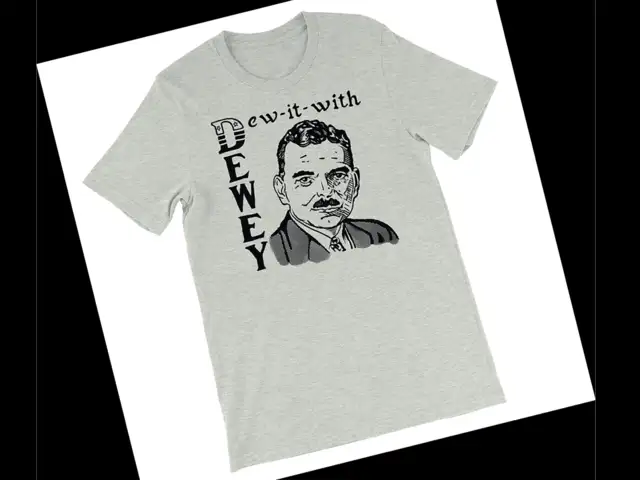
Writer Scott Fitzgerald used the word T-shirt possibly for the first time in his 1920 novel 'This Side of Paradise'. However, it was after World War II that the message potential of a T-shirt was unleashed. In 1948, Republican presidential candidate Thomas Dewey emblazoned T-shirts with “Dew it with Dewey”. He lost to Harry Truman. But the slogan T-shirt won.
In 2018, London’s Fashion and Textile Museum opened an exhibition “T-shirt: CultCulture-Subversion” with 200 iconic T-shirts that changed the status of what was originally an undergarment. In an interview to BBC.com, curator Dennis Nothdruft said, “[The T-shirt] is a really basic way of telling the world who and what you are… it was a matter of the personal as politicised.”
Writer Scott Fitzgerald used the word T-shirt possibly for the first time in his 1920 novel 'This Side of Paradise'. However, it was after World War II that the message potential of a T-shirt was unl..
Read More
In India, various protests have given us slogan tees although a lot of it is not organised and is put up on online shops outside of India.
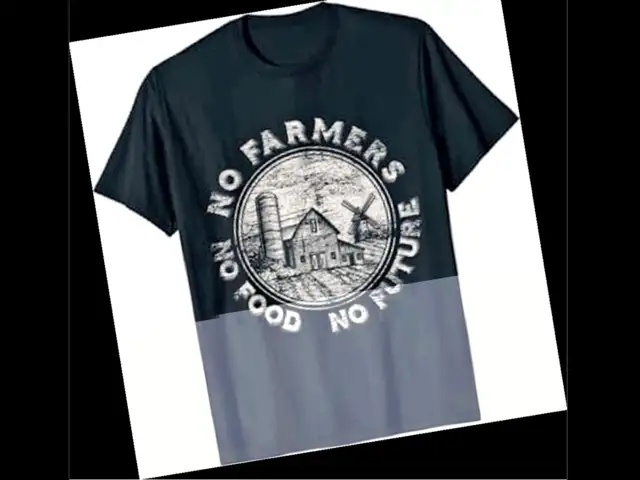
But “No Farmers, No Food, No Future” is a popular slogan as was “Sab Yaad Rakha Jayega” during the CAA-NRC protests. With the easy availability of digital printing, anyone can start a T-shirt campaign.
For instance, comedian Kunal Kamra launched his line of “Wah Modiji Wah” T-shirts in 2018 while "Hindi Theriyathu Poda" (I Don’t Understand Hindi, Get Lost) tees by MP Kanimozhi went viral in 2020 after a CISF personnel at Chennai airport had asked her if she was Indian after she said she did not know Hindi.
In India, various protests have given us slogan tees although a lot of it is not organised and is put up on online shops outside of India. But “No Farmers, No Food, No Future” is a popular slogan as ..
Read More
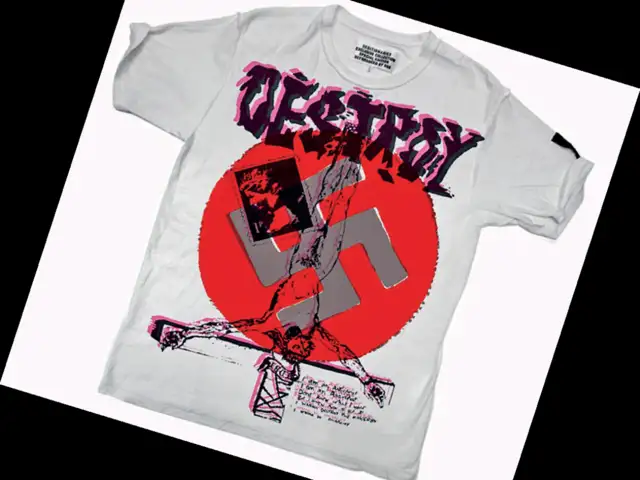
In the UK, designers Vivienne Westwood and Malcolm McLaren used tee shirt as a blank canvas for punk ideology. The UK’s punk movement was rooted in a general social malaise among British youth. Westwood and McLaren’s T-shirts tackled everything from religion to fascism.
By 1973, The New York Times dubbed the T-shirt as “the medium for the message”.
In the UK, designers Vivienne Westwood and Malcolm McLaren used tee shirt as a blank canvas for punk ideology. The UK’s punk movement was rooted in a general social malaise among British youth. Westw..
Read More
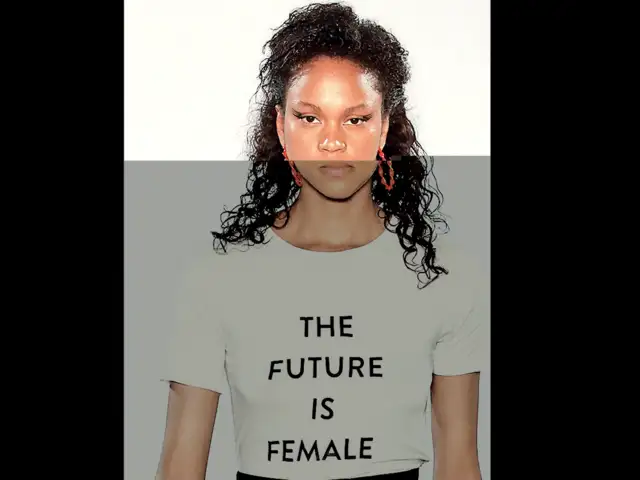
Critics call it the fourth-wave feminism slogans. The Fawcett Society, with Elle UK, took out a T-shirt with the slogan “This is what a Feminist looks Like”, designed mainly for men to wear.
In Spring/Summer 2017, Dior sent out “We Should All Be Feminists” T-shirts on to the ramp, designed by the first female head designer Maria Grazia Churi. The slogan is a reference to Nigerian writer Chimamanda Ngozi Adichie’s book of the same name.
In 2018, designer Prabal Gurung made “The Future is Female” line of tees.
Critics call it the fourth-wave feminism slogans. The Fawcett Society, with Elle UK, took out a T-shirt with the slogan “This is what a Feminist looks Like”, designed mainly for men to wear. In Sprin..
Read More
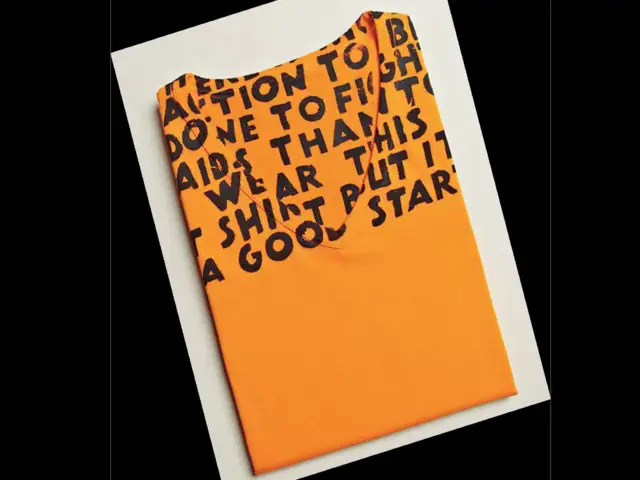
Maison Margiela was one of the first names to make T-shirt activism fashionable when he used tees to spread AIDS awareness in Fall/Winter 1994. In 2001, upscale streetwear label Supreme released T-shirts to generate aid for 9/11 victims.
In 2020, it joined forces with Takashi Murakami to raise money for Covid-19 relief. Nike too has a running “BeTrue” campaign of clothing and sneakers to show support with the LGBTQ+ community. Starting in 2006, Marc Jacobs released a series of T-shirts featuring various celebrities posing naked to raise awareness and funds for skin cancer.
Maison Margiela was one of the first names to make T-shirt activism fashionable when he used tees to spread AIDS awareness in Fall/Winter 1994. In 2001, upscale streetwear label Supreme released T-sh..
Read More
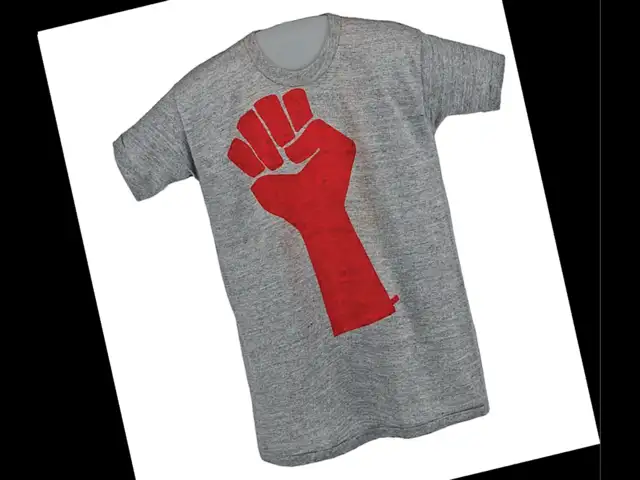
The affordability of the T-shirt and its widespread adoption made it a symbol for political activism throughout the 1960s — from the Civil Rights Movement to the Vietnam War. In 1968, Harvard students wore anti-war T-shirts during sitins. Around the same time, the NAACP and Black Panther Party too used T-shirts to promote its agenda. Since then, T-shirts have been part of the Black protest tradition, latest being Black Lives Matter.
The affordability of the T-shirt and its widespread adoption made it a symbol for political activism throughout the 1960s — from the Civil Rights Movement to the Vietnam War. In 1968, Harvard student..
Read More
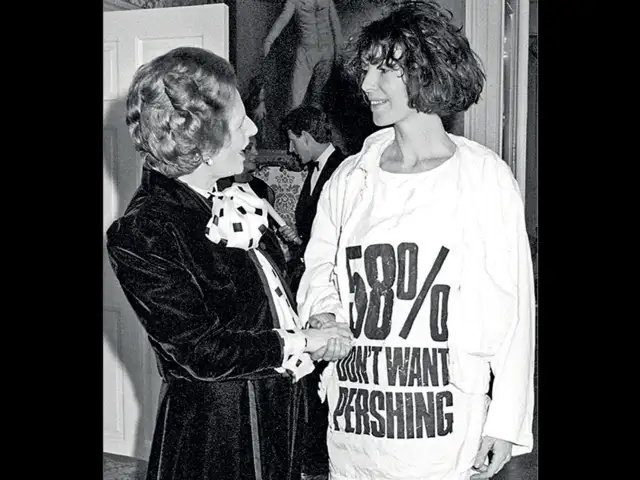
In 1984, designer Katharine Hamnett wore a slogan tee that read “58% Don’t Want Pershing” while shaking hands with UK's then prime minister Margaret Thatcher to make an anti-thermonuclear war statement. Hamnett contributed to the rise of protest clothing in her signature style — oversized, bold, black font on white cotton T-shirts with slogans like “Choose Life” to “Save The World” to recently “Cancel Brexit”.
She told The Guardian, “I wanted to put a really large message on T-shirts that could be read from 20 or 30 ft away. Slogans work on so many different levels…They are also a way of people aligning themselves to a cause. They are tribal. Wearing one is like branding yourself.”
In 1984, designer Katharine Hamnett wore a slogan tee that read “58% Don’t Want Pershing” while shaking hands with UK's then prime minister Margaret Thatcher to make an anti-thermonuclear war stateme..
Read More
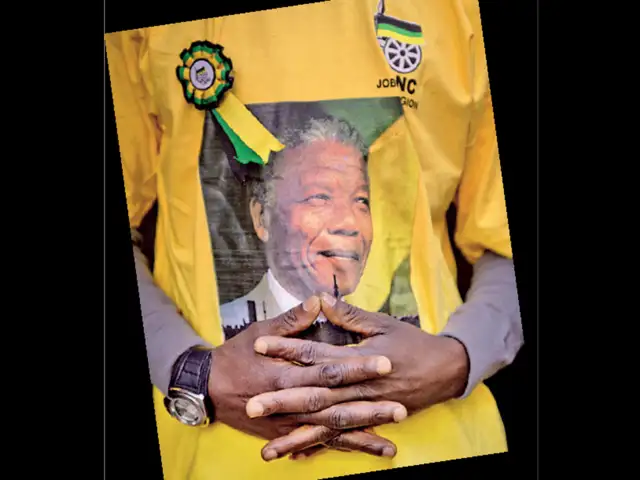
In the late 1980s, the African National Congress (ANC) used T-shirt with graphics calling to end the Apartheid in South Africa, or with portraits of the then imprisoned Nelson Mandela. It was a way for people to voice support or even make an informal donation to ANC — a major turning point in T-shirt activism as it was now used to raise funds.
In the late 1980s, the African National Congress (ANC) used T-shirt with graphics calling to end the Apartheid in South Africa, or with portraits of the then imprisoned Nelson Mandela. It was a way f..
Business News › Magazines › Panache › Get out of sweatpants: Spring fashion is changing; bold colours, light fabrics set the pandemic moodText Size:AAA