Sandoval, 70, is by no means a new star in the jazz firmament.
Arturo Sandoval does not blow his own trumpet. “Whatever I know, I learned on the street,” says the 10-time Grammy Award winner, during a recent visit to India.
Sandoval, 70, is by no means a new star in the jazz firmament, but the Cuban-American reckons that each time he steps onto the rostrum — trumpet in hand — the musical white whale has to be pursued anew.
“I have been touring for many years now. I started playing music in 1960… 60 years of playing music, my friend. My first tour was in 1971. I’m still doing it, and every time is a different experience,” Sandoval says, his words drowning in the mellow tunes of the hotel lobby. For a trumpeter with a weakness for cigars, Sandoval has a surprisingly soft voice.
It is late afternoon in South Mumbai, and the hotel’s restaurant has been largely divested of its patrons. Sandoval is wearing an open-neck T-shirt. A rosary with red and black beads hangs around his neck. A shock of grey hair is combed back in a cowlick, and red horn-rimmed glasses sit on his nose. A hero, friend and mentor Master and apprentice reunited in 1978 when Sandoval travelled to New York with his band. Sandoval, who is regarded as one of the finest musicians of his generation, is a late bloomer. As he admits, he owes his celebrity to a chance encounter with jazz legend Dizzy Gillespie, who he chaperoned during the latter’s visit to Cuba. Sandoval, who had the talent but not the agency to realise his potential, found a benefactor in the bespectacled American. The two struck an enduring friendship.
“It was May 1977. I was already playing for 17 years when I first met Dizzy,” Sandoval says. “He stopped in Havana for two days. He was playing on a cruise liner. I stopped there by the pier. I picked him up in my car and showed him the city for the very first time. He looked at me and asked his friend: ‘What is my driver doing with a trumpet in his hand?’” Sandoval says.
ADVERTISEMENT
“He was my hero even before we met. Later on, he became more than a mentor. He became like a godfather to me. He helped me a lot. He gave me opportunities to play in so many places and to travel with him. For me, it was a gift from God to get a chance to be a good friend of my hero. The whole thing started with that drive,” Sandoval says.
Master and apprentice reunited in 1978 when Sandoval travelled to New York with his band. “I set up a meeting and then we played. After that, we would meet every year and play music together. It was beautiful. We did it till Dizzy passed away in 1993,” he says.
The great escape Sandoval, who is regarded as one of the finest musicians of his generation, is a late bloomer. Gillespie took Sandoval under his wing, making introductions to jazz patrons in New York high society. But his most generous act was perhaps granting the Cuban a chance to fly his country’s stifling communist coop and realise his potential by moving to the US.
Sandoval had cold feet initially. In his early 20s, he fell in love with Marianela Gutierrez, a divorced bureaucrat with a young son. She was fiercely loyal to the communist cause and Sandoval did not seem to have the remotest chance of influencing her worldview or winning her affections.
ADVERTISEMENT
At one point during their courtship, he invited her to meet him in an empty baseball stadium. Standing at second base — and hoping to get at least that far with her — Sandoval launched into a trumpet solo that he titled ‘Marianela’. The scene, which appears at the beginning of the movie 'For Love or Country', shows a dewy-eyed Marianela relent towards Sandoval. They married in 1975.
The couple had a son, Arturo Jr. In the following years, Sandoval vowed to provide the best life for his family in the given circumstances. Marianela was reluctant to leave. The Cuban government was determined to hold on to their prized asset. “Life was tough. After I got married, I did not want to escape that much anymore because it would have meant leaving my family behind,” Sandoval says. Opportunities of a getaway were also slim.
ADVERTISEMENT
In July 1990, when Sandoval was in Rome on a tour of Europe with Gillespie, his family was allowed to travel to the UK. In the absence of Cuban officials to chaperone and monitor their movements, Marianela and the kids went into hiding in London. After a long and emotional telephone call with his wife, Sandoval decided to walk up to Gillespie’s room and ask for help. It was midnight.
“I woke him up, it was one-something in the morning ... Dizzy said, ‘Get my wallet there. I got a business card. I’m going to use it now’,” Sandoval told Public Radio International (PRI) in an earlier interview. A pyjama-clad Gillespie handed him the business card of Dan Quayle, the then-United States vice-president.
When Gillespie put in a word with the White House on his friend’s behalf, the American embassies in Italy and the UK opened their doors to the Sandovals. Arturo and Marianela made it to New York on two separate flights from London and Rome, respectively.
A new life After being granted US citizenship in 1998, Sandoval attended many jazz festivals around the world and composed music for Hollywood movies. Granted a new lease of life, Sandoval immersed himself in jazz and set about composing new songs with a passion. “I also experimented with other genres. I play some Cuban music, some Afro-Cuban jazz, some combinations of these. I love funk. I love blues. I play the piano. As a performer, your mission is to try and entertain the people, make them have fun and enjoy the music you are doing,” he says.
After being granted US citizenship in 1998, Sandoval attended many jazz festivals around the world and composed music for Hollywood movies. In 1995, he became one of the first foreign-born musicians to perform at the NFL Super Bowl halftime show. Sandoval has also collaborated with pop stars like Alicia Keys and Justin Timberlake and composed soundtracks for the screen. An artist’s talent touched various genres, in no small part due to a friend named Dizzy.
All That Jazz: 5 Things To Know About International Jazz Day
1/5
UNESCO on November 2011 coined 30th April as the International Jazz Day. Jazz has a quality to unite people across barriers. It is celebrated for promoting peace and diversity, respect for human rights and human dignity, eradicating discrimination, promoting freedom of expression, fostering gender equality. And, did you know musicians used readily-available instruments left in pawn shops after the American Civil war?
UNESCO on November 2011 coined 30th April as the International Jazz Day. Jazz has a quality to unite people across barriers. It is celebrated for promoting peace and diversity, respect for human righ..
Read More
The form of music has its origins in Africa and is a blend of African and European traditions. Jazz provided a platform for freedom of expression and empowerment. By 20th century, the art form had started spreading its wings across continents, influencing and being influenced by other kinds of music. New Orleans was one of the few American cities which had an egalitarian society, distinct musical trends began to develop, fusing elements of West African musical traditions with European harmonic structures.
The form of music has its origins in Africa and is a blend of African and European traditions. Jazz provided a platform for freedom of expression and empowerment. By 20th century, the art form had st..
Read More
Jazz has helped to break down barriers, creating opportunities for understanding and tolerance. It has the power to reduce tension between individuals, communities and groups. Jazz not just encourages artists to innovate, improvise, but also include the old and new together. Not just encouraging, but stimulating in nature too, it can promote intercultural dialogue and empowers people from weaker societies. Jazz has the ability to build a more inclusive society.
Jazz has helped to break down barriers, creating opportunities for understanding and tolerance. It has the power to reduce tension between individuals, communities and groups. Jazz not just encourage..
Read More
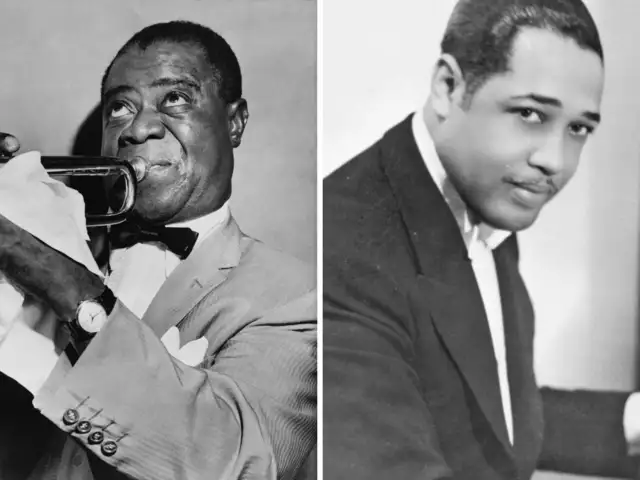
Different styles and eras in the history of jazz have built the strong legacy this music stands on today. Certain musicians have had a profound impact on the music, often altering the course of jazz entirely. These are the 4 important musicians you have to know.
Louis Armstrong (On the left) - From 1925-1928, his 'Hot Five and Hot Seven' bands recorded 55 records. He is responsible for bringing jazz to the spotlight, inspiring many of his contemporaries. He made scat singing into popularity and paved the way for vocalists such as Ella Fitzgerald, and his influence is evident till today.
Duke Ellington (On the right) - This legend wrote over 3000 songs in his career, and you are sure to have heard 'It Don’t Mean A Thing (If It Ain’t Got That Swing)' at some point in your life. His famous band, The Duke Ellington Orchestra, is one of the most important big bands of the swing era. Some of his compositions have gone on to become part of standard jazz repertoire.
Different styles and eras in the history of jazz have built the strong legacy this music stands on today. Certain musicians have had a profound impact on the music, often altering the course of jazz ..
Read More
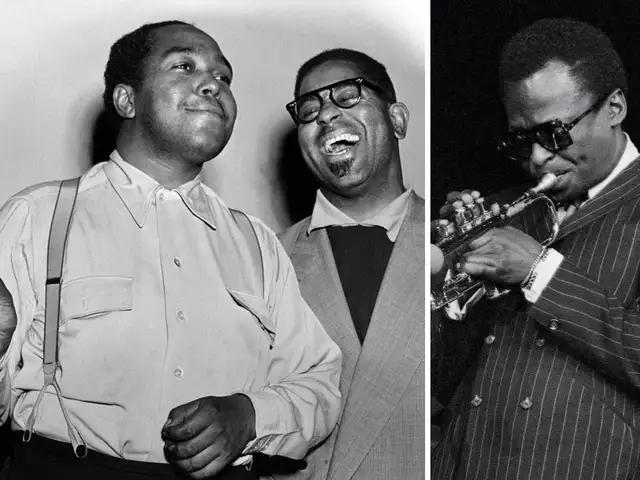
Charlie Parker and Dizzy Gillespie (On the left) - If you've heard of jazz music, you are sure to have heard of 'bebop'. They were responsible for transforming the style, making the style technical and fast, yet full of melody. They are both considered to be the most-innovative jazz musicians in history.
Miles Davis (On the right) - This man cannot be ignored from the bebop to the fusion period. He played in Charlie Parker’s band for a while and was part of the bebop era. Later, he formed his own band during the hard bop era.
Charlie Parker and Dizzy Gillespie (On the left) - If you've heard of jazz music, you are sure to have heard of 'bebop'. They were responsible for transforming the style, making the style technical a..