Earth moonstruck with its new mini-moon: A look at some spectacular lunar miracles
Jupiter’s Ganymede is the largest moon in our solar system.
By ET Bureau | Updated:
iStock
This isn’t the first mini-moon that researchers have found. In 2016, NASA reported that another asteroid called 2016 HO3 had been caught in Earth’s gravity. (Representative image)
Earth has a new ‘mini-moon’. It was spotted recently circling the planet by a researcher at the Catalina Sky Survey. Between two to three metres wide, scientists estimate that Asteroid 2020 CD3 has been lingering around for the past three years. An orbit model developed by an amateur astrophysicist estimates that 2020 CD3 could be making its exit from Earth’s orbit as early as April.
This, however, isn’t the first mini-moon that researchers have found. In 2016, NASA reported that another asteroid called 2016 HO3 had been caught in Earth’s gravity.
Here are some interesting facts about other moons in the solar system:
Mars’s moon Phobos is slowly falling apart. The long, shallow grooves lining its surface are early signs of the structural failure that will destroy it in 30 to 50 million years. It is also closer to its planet than any other moon in the solar system.
The long, shallow grooves lining its surface are early signs of the structural failure that will destroy it in 30 to 50 million years. Jupiter’s Ganymede is the largest moon in our solar system. It is larger than Mercury and Pluto and was discovered by Galileo Galilei in 1610.
ADVERTISEMENT
Tremendous gravitational forces in Jupiter’s moon Io cause its surface to bulge up and down. This makes Io the most volcanically active moon in the solar system, with some volcanoes erupting lava fountains several kilometres high.
Jupiter’s moon Europa has twice as much water as Earth, although frozen.
Apophis Can Wipe Out A Country: A Look At Every Massive Asteroid That Has Hit Earth
1/5
A monster asteroid - named Apophis after the Egyptian 'God of Chaos' - is likely to swoosh past Earth, but there is a slight chance that it may hit the planet.
The bigger-than-Eiffel Tower asteroid, weighing around 27 billion-kg, could leave a crater impact of 1.6 km wide in diameter and 518 metre deep. It has the capacity of an 880 million tonne TNT explosion that can wipe out large cities or even an entire country.
First spotted in August 2006, the ‘hazardous’ asteroid was initially named 2006 QQ23.
Meanwhile, the European Space Agency recently released a 'risk list' of 878 asteroids that are likely to cause a massive impact on Earth in the next 100 years.
Here's a look at all the asteroids Earth has braved.
A monster asteroid - named Apophis after the Egyptian 'God of Chaos' - is likely to swoosh past Earth, but there is a slight chance that it may hit the planet.The bigger-than-Eiffel Tower asteroid, w..
Read More
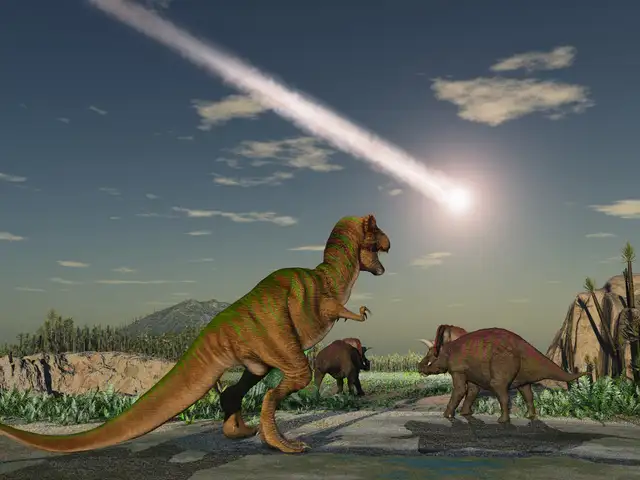
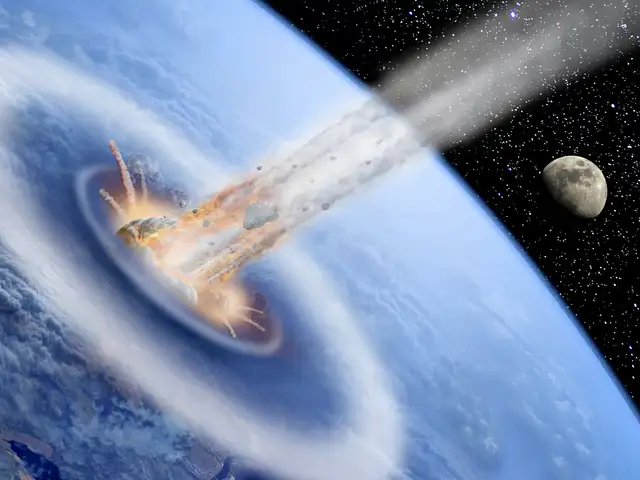
This is the famous asteroid impact that hit Earth approximately 66 million years ago in the present-day town of Chicxulub in Mexico's Yucatan Peninsula state, during the end of the Cretaceous period.
The asteroid was between 11-81 km in diameter. Its impact caused a 180 kilometre wide crater, making it one of biggest known impactors on Earth. The asteroid heated organic matter in rocks and ejected it into the atmosphere, forming soot in the stratosphere. Soot is a strong, light-absorbing aerosol that caused global climate changes that triggered the mass extinction of dinosaurs, ammonites, and other animals, and led to the macroevolution of mammals and the appearance of humans.
The Apophis asteroid is relatively smaller in size compared to this one.
This is the famous asteroid impact that hit Earth approximately 66 million years ago in the present-day town of Chicxulub in Mexico's Yucatan Peninsula state, during the end of the Cretaceous period...
Read More
In March or April of 1490, China's Qingyang city experienced the Ch'ing-yang air burst. The meteor shower may have occurred because it got disintegrated from an asteroid after entering the atmosphere. While there hasn't been any confirmation, it is believed that the meteor shower may have caused a large number of casualties.
In March or April of 1490, China's Qingyang city experienced the Ch'ing-yang air burst. The meteor shower may have occurred because it got disintegrated from an asteroid after entering the atmosphere..
Read More
On June 1908, Russia's Podkamennaya Tunguska River in Yeniseysk Governorate, which is now now Krasnoyarsk Krai, saw a large explosion. With three casualties and an impact stretch of over 2,000 sq km, the carter - the circular, bowl-shaped depression on the surface of the Earth - was never found.
The researchers believe that the object was disintegrated about 5-10 km before hitting the surface. Considered as Earth's largest impact event, its size was estimated somewhere between 50 metre and 190 metre, depending on the speed at which it travelled. Its energy was estimated to be 1,000 times greater than the Hiroshima atomic bomb attack, knocking down around 80 million trees due to the shock wave, which was capable of wiping out a metropolitan city.
On June 1908, Russia's Podkamennaya Tunguska River in Yeniseysk Governorate, which is now now Krasnoyarsk Krai, saw a large explosion. With three casualties and an impact stretch of over 2,000 sq km,..
Read More
This superbolide (a meteor brighter than the moon that radiate energy due to friction or pressure, and exploded after entering the atmosphere) entered our planet's atmosphere on February 2013 over southern Ural region in Russia's Chelyabinsk Oblast. An approximately 20-metre asteroid turned into a fireball, emitting light brighter than the Sun that was visible from a distance of up to 100 km.
While the atmosphere absorbed most of the object's energy, it resulted in major shock waves that shattered glass, damaged buildings and even caused 1,500 injuries. If the energy wasn't absorbed, the impact could have been 26-33 times greater than the nuclear blast at Hiroshima.
With over 12,000K – 13,000K kg heavier than France's Eiffel Tower, this is the biggest natural object that entered the atmosphere ever since the 1908 Tunguska impact.
This superbolide (a meteor brighter than the moon that radiate energy due to friction or pressure, and exploded after entering the atmosphere) entered our planet's atmosphere on February 2013 over ..
Saturn’s moon Titan is also larger than Mercury. It has a thick atmosphere, complete with its own ‘water cycle’ — except that it’s too cold for liquid water and rains of liquid hydrocarbons like ethane and methane.
Saturn’s moons Epimetheus and Janus share their orbits. They avoid crashing into each other due to mutual acceleration and deceleration because of gravity.
ADVERTISEMENT
Saturn’s moon Mimas has a giant crater named Herschel that is 130 km across — one-third of the diameter of the moon itself — with outer walls about five km high. The impact that blasted this crater out of Mimas probably came close to breaking the moon apart.
Neptune’s largest moon Triton is the only one of its kind in the solar system to orbit in the opposite direction of its planet’s rotation, a retrograde orbit.
ADVERTISEMENT
Charon is the largest of Pluto’s moons. It is so big compared to Pluto that Pluto and Charon are sometimes referred to as a double planet system.
Out Of This World: The Many Ways You Can Explore Outer Space Without Being An Astronaut
1/4
When Japanese billionaire Yusaku Maezawa announced earlier this week that he wanted a companion to accompany him on a voyage to the Moon, it marked just the latest instance that an ordinary citizen could conceivably fly to outer space.
There have been a few private citizens before him who have expressed a desire to indulge in a spot of space tourism, while a few enterprising organisations also offer the same deal to people willing to pay top dollar. Here are all the ways one can go into outer space without actually being an astronaut.
When Japanese billionaire Yusaku Maezawa announced earlier this week that he wanted a companion to accompany him on a voyage to the Moon, it marked just the latest instance that an ordinary citizen c..
Read More
Many companies like Virgin Galactic, SpaceX and Blue Origin have invested heavily in outer space, and they have even opened up slots to people. The only catch: These slots don’t come cheap. An out-of-this-world trip could cost seven-digit amounts. But what’s even more uncertain is the time frame. Impatient types may try other options.
Many companies like Virgin Galactic, SpaceX and Blue Origin have invested heavily in outer space, and they have even opened up slots to people. The only catch: These slots don’t come cheap. An out-of..
Read More
Unfortunately, a very real fear is that space tourism will not become a viable reality within our lifetime. Fear not. One space robotics company, Astrobotic Technology, has planned a lunar memorial service for paying customers, whereby they can send the ashes of their loved ones to the Moon. The term “love you to the Moon” will just not have the same impact once this takes off.
Unfortunately, a very real fear is that space tourism will not become a viable reality within our lifetime. Fear not. One space robotics company, Astrobotic Technology, has planned a lunar memorial s..
Read More
Technically speaking, outer space begins at 100 kilometres above the surface of the Earth, what’s known as the Kármán line. There are, however, startups that take you to one part of the journey.
The US-based World View Enterprises, for instance, will take you to an altitude of 30 kilometres, enough to acknowledge the vastness of the universe and marvel at its blackness. And isn’t that what space tourism is all about, after all?
Technically speaking, outer space begins at 100 kilometres above the surface of the Earth, what’s known as the Kármán line. There are, however, startups that take you to one part of the journey. The ..