
Save tax before March 31: Smart strategy equity investors should use in FY26

1/8
How to turn market ups and downs into tax savings
If some of your stocks or equity mutual funds are making gains while others are in loss, you can reduce your tax by using tax harvesting. This strategy helps you balance profits and losses smartly. By doing this, you can lower your taxable income and keep more money in your pocket. The last day to do tax loss harvesting is March 31, 2026.
2/8
What is tax loss harvesting?
Tax loss harvesting means selling investments that are currently in loss to offset gains from profitable ones. This reduces your total taxable capital gains. After selling, you can reinvest again if you want. It involves booking profits within the tax-free limit. Long-term capital gains up to Rs 1.25 lakh are tax-free. By selling and reinvesting, you reset your purchase price higher, which reduces future tax when you sell again.

3/8
When tax loss harvesting may not help
If all your investments are in loss, you won’t get immediate tax benefits. But you can still sell them and carry forward the losses. These losses can be used in subsequent years to offset gains. This ensures that even in a bad year, your losses don’t go waste.
Amazon Top Deals
POWERED BY

Crompton Ozone 75 Litres Desert Air Cooler for home | Large & Easy Clean Ice Chamber | 4-Way Air Deflection | High Density Honeycomb Pads | Everlast Pump | Auto Fill| 3 Year Brand Warranty
₹9,798Buy Now43%
OFF

LG 32 L Convection Microwave Oven (MC3286BRUM, Black, 360° Motorised Rotisserie for Bar-be-queing, 301 Auto Cook Menu, Stainless steel cavity, Indian Cuisine, Tandoor Se, Steam Clean & Diet Fry)
₹19,340Buy Now19%
OFF

4/8
How much can you actually save through tax harvesting?
With tax gain harvesting, you can save up to Rs 15,625 since LTCG up to Rs 1.25 lakh are exempt i.e. Rs 1.25 lakh*12.5% = Rs 15,625. Plus, with tax gains harvesting method, your acquisition cost can go up, lowering your future tax bill whenever you sell the asset.
In tax loss harvesting, there is no upper limit on savings because losses can fully offset gains. The more efficiently you plan, the more tax you save.
In tax loss harvesting, there is no upper limit on savings because losses can fully offset gains. The more efficiently you plan, the more tax you save.
5/8
Simple example to understand savings through STCG tax loss harvesting
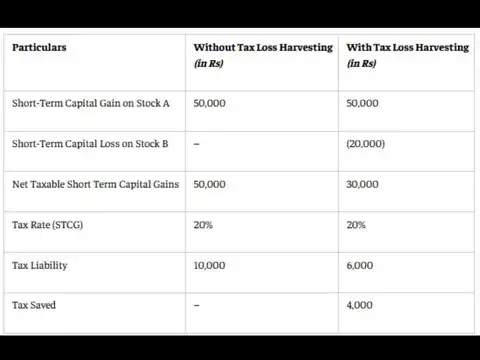
Imagine you earn Rs 50,000 profit from one stock and have a Rs 20,000 loss in another. Without harvesting, tax applies on full Rs 50,000. With harvesting, taxable gain becomes Rs 30,000. This directly reduces your tax liability and increases your net returns.

6/8
LTCG harvesting: Book gains smartly, pay zero tax
Long-term capital gains (LTCG) harvesting means selling your equity investments to realise gains up to Rs 1.25 lakh in a financial year, completely tax-free. After selling, you can reinvest the same amount.

7/8
Using two demat accounts: Is it allowed?
You can sell shares in one demat account and buy them in another under the same PAN. These are treated as separate delivery transactions, not intraday trades. However, this may increase costs due to brokerage and taxes on both buy and sell transactions.

8/8
Key rules you must remember before tax harvesting
Short-term losses can be adjusted against both short-term and long-term gains. Long-term losses can only offset long-term gains. Also, the Rs 1.25 lakh LTCG exemption applies before adjusting losses. Plan carefully and consider expert advice before making moves.
READ MORE:
tax loss harvesting India |capital gains tax saving India |LTCG tax exemption India 2026 |stock market tax saving strategies |equity mutual fund tax rules India |short term capital gains tax India |long term capital gains tax India |how to reduce tax on stocks India |tax harvesting meaning India |income tax saving investments India