
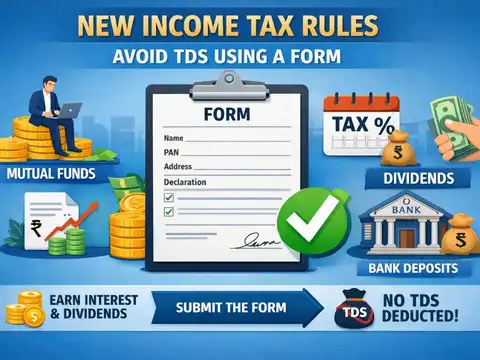
New Income Tax Rules 2026: Do you have income from mutual funds, dividends or bank deposit interest? Avoid TDS using this form
1/7
New Income Tax Rules 2026
The Income Tax Act, 2025, has come into effect from April 1, 2026, introducing several changes, aimed at streamlining, simplifying tax code with reduced compliance and consolidated provisions.
Under the new rules, many Sections, schedules, rules, and forms have been consolidated and reduced.
Under the new rules, many Sections, schedules, rules, and forms have been consolidated and reduced.

2/7
Forms reduced under Income Tax Act, 2025
Under the new act, the number of forms has been brought down from 399 to 190. As part of this exercise, a new Form 121 has been introduced.
3/7
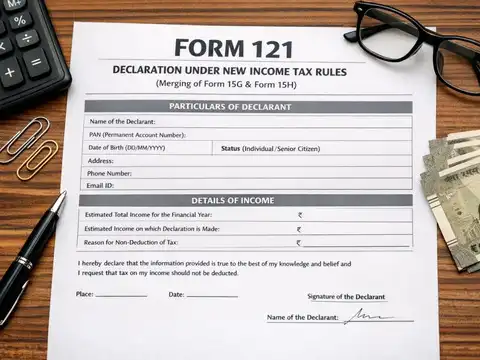
Form 121 in Income Tax Act, 2025
Income Tax Act, 1961, allowed depositors to avoid Tax Deducted at Source (TDS), by submitting Form 15G/Form 15H to the bank. These led to a confusion among some depositors as to which form applies to them.
The new act has merged these two forms into one – Form 121.
The new act has merged these two forms into one – Form 121.
Amazon Top Deals
POWERED BY

Crompton Ozone 75 Litres Desert Air Cooler for home | Large & Easy Clean Ice Chamber | 4-Way Air Deflection | High Density Honeycomb Pads | Everlast Pump | Auto Fill| 3 Year Brand Warranty
₹9,798Buy Now43%
OFF

atomberg Studio Smart+ 1200mm BLDC Ceiling Fan with IoT & Remote | BEE 5 star Rated Energy Efficient Ceiling Fan | High Air Delivery with LED Indicators | 3 Year Warranty (Earth Brown)
₹5,882Buy Now36%
OFF

LG 32 L Convection Microwave Oven (MC3286BRUM, Black, 360° Motorised Rotisserie for Bar-be-queing, 301 Auto Cook Menu, Stainless steel cavity, Indian Cuisine, Tandoor Se, Steam Clean & Diet Fry)
₹19,340Buy Now19%
OFF

4/7
Who is Form 121 for?
Under the Income Tax Act, 2025, Form 15G and Form 15H have been consolidated into a single form - Form 121. This form can be used to avoid TDS by any depositor, whether a senior citizen or not.

5/7
What incomes are covered in Form 121?
Income Tax Act, 2025 says Form 121 is a self-declaration form furnished by individuals to ensure no deduction of tax at source (TDS) on specified incomes such as interest on bank deposits, post office deposits, or other specified incomes, when their total income is below the taxable limit.
It also covers incomes like PF withdrawals and pension, insurance commission, rent, interest on deposits, income from mutual funds, payments in respect of Life Insurance Policy, dividend etc.
It also covers incomes like PF withdrawals and pension, insurance commission, rent, interest on deposits, income from mutual funds, payments in respect of Life Insurance Policy, dividend etc.

6/7
Who is eligible to use Form 121?
Resident Individuals both below 60 years and 60 years or above, HUFs, and other specified entities meeting stipulated criteria can use it to avoid TDS on specific incomes.
Note that companies and firms are not eligible to file Form 121. Non-residents are also not eligible to file this form.
Note that companies and firms are not eligible to file Form 121. Non-residents are also not eligible to file this form.

7/7
When to submit Form 121?
It is to be submitted before income is credited or paid, such as at the beginning of the tax year or before receiving the first interest payment. The form is usually given to the bank, financial institution, or payer.