
Buyback taxation Budget 2026 explained: How share buybacks will be taxed

1/8
What the Budget 2026 announcement says
Finance Minister Nirmala Sitharaman has announced that share buybacks will now be taxed as capital gains for all shareholders. The move aims to curb tax arbitrage and protect shareholders by aligning buyback taxation with capital gains rules.
2/8
Differential tax rates for promoters
To discourage promoters from using buybacks for tax arbitrage, the Budget has proposed higher effective tax rates for promoters. Gains from buybacks will be taxed at an effective rate of 22% for corporate promoters and 30% for non- corporate promoters.

3/8
What is a share buyback?
A share buyback, also called a share repurchase, occurs when a company buys back its own shares from shareholders or from the market directly.
Amazon Top Deals
POWERED BY

4/8
How buybacks were taxed earlier
Under the framework introduced in Budget 2024 (effective October 1, 2024), buyback proceeds were treated as dividend income in the hands of shareholders and taxed at their applicable slab rates. Companies also deducted TDS before making payments.

5/8
How taxation changes for shareholders
As reported in The Times of India, under the proposed regime, individual shareholders benefit as their tax liability shifts from the highest slab rate of 30% to capital gains tax rates, which is 20% for short-term gains and 12.5% for long-term gains.

6/8
TDS rules under the existing system
In case of resident individuals, TDS was deducted at 10% if buyback proceeds were Rs 5,000 or more. For non-resident individuals, TDS is applied at 20%, subject to relief under applicable tax treaties.
7/8
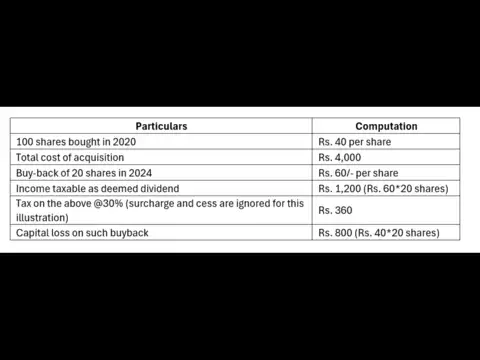
Buyback taxation for shareholders: Current rules
According to Lubna Kably, TOI reporter, the table above illustrates how share buybacks are taxed under the current rules. Note: The capital loss could be set off in that year or in the subsequent eight years, only if the shareholder had capital gains income.
8/8
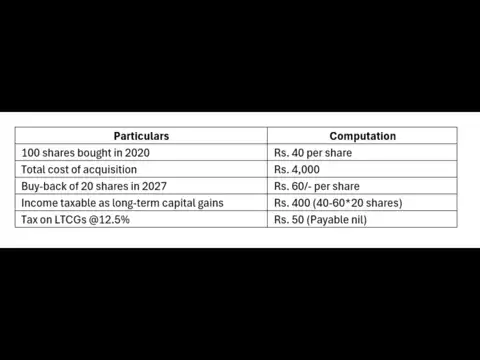
Buyback taxation under the proposed capital gains regime
Kably explains that the table above shows how buyback taxation changes under the proposed regime, with gains taxed as capital gains instead of dividend income. Note: LTCGs are exempt up to Rs. 1.25 lakh.
READ MORE:
buyback taxation budget 2026 |buyback taxation |Buyback taxation budget 2026 |Buyback of shares income tax exemption Section |New buyback taxation rules |Buyback taxation in india |New buyback taxation rules in India |Buyback taxable from which date |share buyback taxation |Tax on buyback of shares of listed company