
Hyundai, Kia, Tata & more: Know the difference between connected cars & software-defined vehicles
1/9
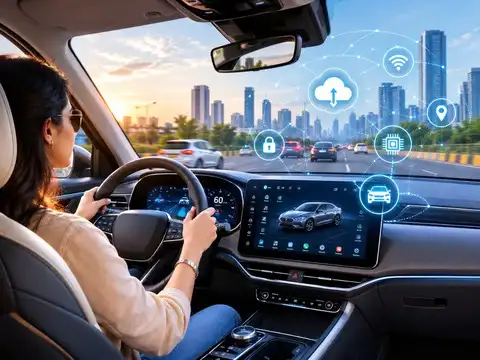
Your next car could be a computer on wheels
Cars are no longer defined only by their engine, battery, transmission and hardware.
A Software-Defined Vehicle (SDV) puts software and computing at the centre of functions such as connectivity, infotainment, vehicle controls, driver assistance and remote updates.
For Indian car buyers, the important change is this:
Some vehicle capabilities can continue to evolve after the car leaves the showroom.
And this isn't limited to one automaker. Connected and software-led technologies are increasingly appearing across different brands and vehicle segments in India.
The bigger shift:
Cars are moving from hardware-first machines to increasingly software-driven platforms.
A Software-Defined Vehicle (SDV) puts software and computing at the centre of functions such as connectivity, infotainment, vehicle controls, driver assistance and remote updates.
For Indian car buyers, the important change is this:
Some vehicle capabilities can continue to evolve after the car leaves the showroom.
And this isn't limited to one automaker. Connected and software-led technologies are increasingly appearing across different brands and vehicle segments in India.
The bigger shift:
Cars are moving from hardware-first machines to increasingly software-driven platforms.
2/9
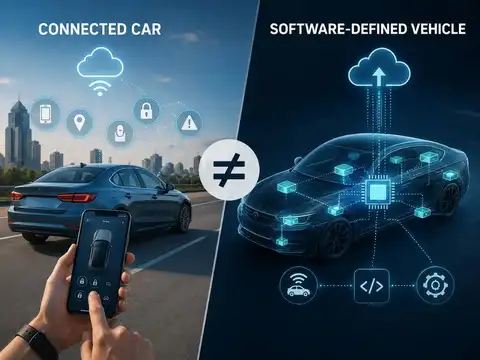
Connected car ≠ Software-Defined Vehicle
The terms connected car and Software-Defined Vehicle are often used interchangeably, but they are not the same.
Connected car
A connected car uses internet and cloud connectivity for functions such as:
Remote vehicle controls
Live location and tracking
Connected navigation
Vehicle health alerts
Digital keys
Voice assistants
Emergency and safety services
Software-Defined Vehicle
An SDV goes a step further.
Its electronic and computing architecture is designed so that software can control, coordinate and update a wider range of vehicle functions over the vehicle's lifecycle.
In simple terms:
Connected car → Your car can communicate
SDV → Software increasingly determines what your car can do
Connected car
A connected car uses internet and cloud connectivity for functions such as:
Remote vehicle controls
Live location and tracking
Connected navigation
Vehicle health alerts
Digital keys
Voice assistants
Emergency and safety services
Software-Defined Vehicle
An SDV goes a step further.
Its electronic and computing architecture is designed so that software can control, coordinate and update a wider range of vehicle functions over the vehicle's lifecycle.
In simple terms:
Connected car → Your car can communicate
SDV → Software increasingly determines what your car can do
3/9
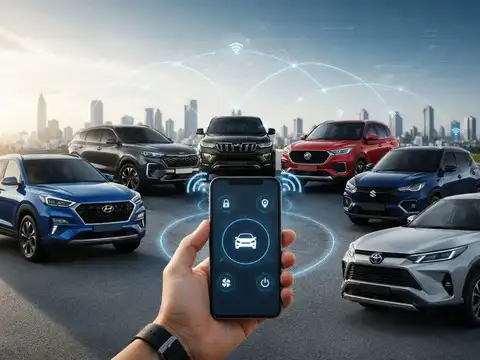
Connected cars are already available across India
Connected-car technology is no longer limited to a handful of automakers.
Depending on the model and variant, Indian buyers can find connected features across brands including:
Hyundai — Bluelink
Kia — Kia Connect
MG — i-SMART
Mahindra — connected vehicle ecosystem
Maruti Suzuki — Suzuki Connect
Tata Motors — connected-car technology
Toyota — connected services on selected models
And several premium automakers also offer connected technology.
What this means
Connected-car technology is becoming a multi-brand feature of India's automotive market.
It is no longer simply a differentiator offered by one or two companies.
Features and availability vary by model and variant.
Current manufacturer information confirms extensive connected functions across Hyundai and Kia, including remote controls, tracking, diagnostics, navigation, voice features and OTA capabilities.
Depending on the model and variant, Indian buyers can find connected features across brands including:
Hyundai — Bluelink
Kia — Kia Connect
MG — i-SMART
Mahindra — connected vehicle ecosystem
Maruti Suzuki — Suzuki Connect
Tata Motors — connected-car technology
Toyota — connected services on selected models
And several premium automakers also offer connected technology.
What this means
Connected-car technology is becoming a multi-brand feature of India's automotive market.
It is no longer simply a differentiator offered by one or two companies.
Features and availability vary by model and variant.
Current manufacturer information confirms extensive connected functions across Hyundai and Kia, including remote controls, tracking, diagnostics, navigation, voice features and OTA capabilities.
Amazon Top Deals
POWERED BY

Crompton Ozone 75 Litres Desert Air Cooler for home | Large & Easy Clean Ice Chamber | 4-Way Air Deflection | High Density Honeycomb Pads | Everlast Pump | Auto Fill| 3 Year Brand Warranty
₹9,798Buy Now43%
OFF

LG 32 L Convection Microwave Oven (MC3286BRUM, Black, 360° Motorised Rotisserie for Bar-be-queing, 301 Auto Cook Menu, Stainless steel cavity, Indian Cuisine, Tandoor Se, Steam Clean & Diet Fry)
₹19,090Buy Now20%
OFF
4/9
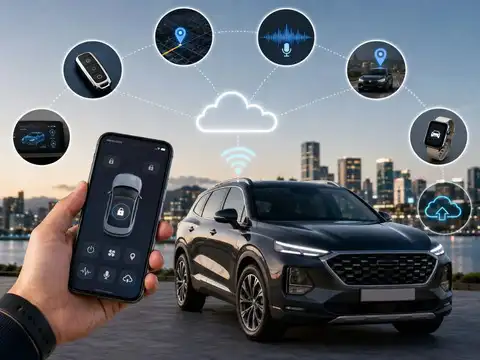
What can a connected car actually do?
So, what does “connected” really mean for the owner?
Depending on the vehicle and variant, connected systems can offer:
Control from your phone
Lock/unlock, remote start and climate-control functionsKnow where your car is
Live location, tracking and geofencingMonitor vehicle health
Vehicle-status information, alerts and diagnosticsStay connected
Navigation, live traffic, cloud services and in-car applicationsUse your voice
Voice assistants and voice-controlled vehicle functionsGo digital
Digital keys, smartwatch integration and smartphone connectivityStay updated
OTA map, infotainment or compatible software updates
The important point:
A connected car is more than a car with a touchscreen.
It creates a digital link between the vehicle, owner, cloud and automaker.
Hyundai and Kia, for example, currently list remote controls, vehicle tracking, health reports, diagnostics, voice functions and OTA-related features among their connected-car capabilities.
Depending on the vehicle and variant, connected systems can offer:
Control from your phone
Lock/unlock, remote start and climate-control functionsKnow where your car is
Live location, tracking and geofencingMonitor vehicle health
Vehicle-status information, alerts and diagnosticsStay connected
Navigation, live traffic, cloud services and in-car applicationsUse your voice
Voice assistants and voice-controlled vehicle functionsGo digital
Digital keys, smartwatch integration and smartphone connectivityStay updated
OTA map, infotainment or compatible software updates
The important point:
A connected car is more than a car with a touchscreen.
It creates a digital link between the vehicle, owner, cloud and automaker.
Hyundai and Kia, for example, currently list remote controls, vehicle tracking, health reports, diagnostics, voice functions and OTA-related features among their connected-car capabilities.
5/9
OTA updates could change how you own a car
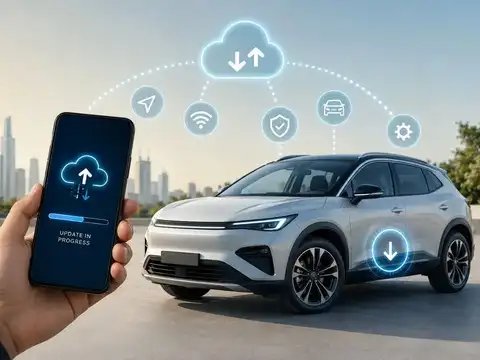
One of the most visible building blocks of software-led vehicles is Over-the-Air (OTA) updating.
Instead of requiring a workshop visit for every compatible software improvement, certain systems can receive updates remotely through a connected network.
Depending on the vehicle and update, OTA can support areas such as:
Infotainment
Navigation
Connectivity
Vehicle software
Diagnostics
Some driver-assistance functions
Security and system fixes
But there is an important catch:
OTA does not mean every repair can be done remotely.
Mechanical problems, hardware failures and some safety-related interventions may still require a workshop.
Why OTA matters
The car you buy on Day 1 may not have exactly the same software experience on Day 500 or Day 1,000.
That is one of the fundamental ideas behind the move towards software-defined vehicles.
Hyundai and Kia currently advertise OTA-related map/system capabilities on selected vehicles.
Instead of requiring a workshop visit for every compatible software improvement, certain systems can receive updates remotely through a connected network.
Depending on the vehicle and update, OTA can support areas such as:
Infotainment
Navigation
Connectivity
Vehicle software
Diagnostics
Some driver-assistance functions
Security and system fixes
But there is an important catch:
OTA does not mean every repair can be done remotely.
Mechanical problems, hardware failures and some safety-related interventions may still require a workshop.
Why OTA matters
The car you buy on Day 1 may not have exactly the same software experience on Day 500 or Day 1,000.
That is one of the fundamental ideas behind the move towards software-defined vehicles.
Hyundai and Kia currently advertise OTA-related map/system capabilities on selected vehicles.
6/9
From connected cars to software-defined vehicles
Connected technology is only the beginning.
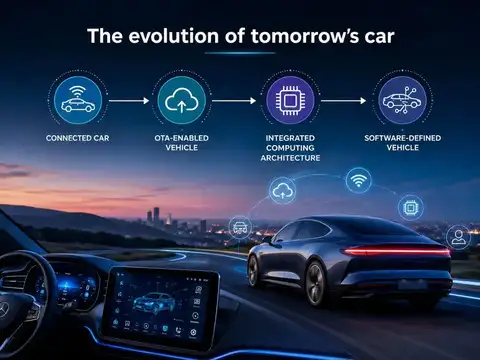
The next stage is the move towards vehicles where software, computing and electronic architecture work together across multiple functions.
The evolution
1. Connected car
The vehicle communicates with the internet, smartphone and cloud.
↓
2. OTA-enabled vehicle
Compatible software and digital systems can be updated remotely.
↓
3. Integrated computing architecture
Multiple vehicle functions can increasingly be managed through more integrated computing systems.
↓
4. Software-Defined Vehicle
Software becomes a core part of how vehicle functions are developed, coordinated and upgraded.
Why this matters
An SDV architecture can create a foundation for:
AI + ADAS + Connectivity + Digital cockpit + OTA + Future software features
The bigger change:
The car is no longer necessarily a fixed product at the moment you buy it.
Its software can become an increasingly important part of the ownership experience.
The next stage is the move towards vehicles where software, computing and electronic architecture work together across multiple functions.
The evolution
1. Connected car
The vehicle communicates with the internet, smartphone and cloud.
↓
2. OTA-enabled vehicle
Compatible software and digital systems can be updated remotely.
↓
3. Integrated computing architecture
Multiple vehicle functions can increasingly be managed through more integrated computing systems.
↓
4. Software-Defined Vehicle
Software becomes a core part of how vehicle functions are developed, coordinated and upgraded.
Why this matters
An SDV architecture can create a foundation for:
AI + ADAS + Connectivity + Digital cockpit + OTA + Future software features
The bigger change:
The car is no longer necessarily a fixed product at the moment you buy it.
Its software can become an increasingly important part of the ownership experience.
7/9
What does the SDV architecture bring together?
The real significance of SDVs isn't any single feature.
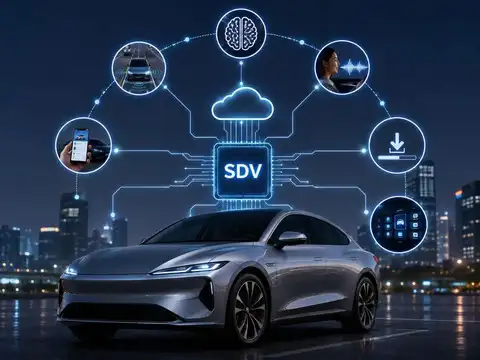
It is the possibility of bringing multiple technologies together on a common software and computing foundation.
AI
Voice interaction, personalisation and intelligent in-car services
ADAS
Software processes information from cameras, radar and other sensors to support driving assistance
Connected car
Remote functions, navigation, cloud services and vehicle data
OTA
Software and system updates after the vehicle leaves the showroom
Digital services
Apps, digital keys, subscriptions and other connected experiences
The SDV idea:
Instead of treating every feature as a separate system, a more integrated software architecture can allow different functions to work together and evolve over time.
It is the possibility of bringing multiple technologies together on a common software and computing foundation.
AI
Voice interaction, personalisation and intelligent in-car services
ADAS
Software processes information from cameras, radar and other sensors to support driving assistance
Connected car
Remote functions, navigation, cloud services and vehicle data
OTA
Software and system updates after the vehicle leaves the showroom
Digital services
Apps, digital keys, subscriptions and other connected experiences
The SDV idea:
Instead of treating every feature as a separate system, a more integrated software architecture can allow different functions to work together and evolve over time.
8/9
Real-world examples show where India is heading
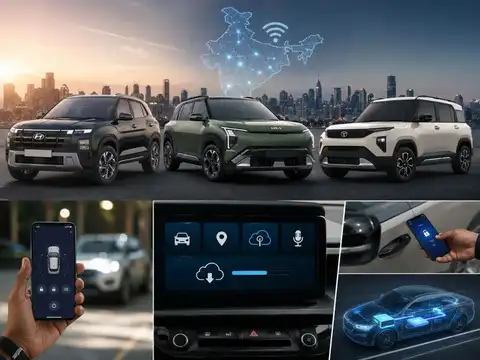
The shift is already visible in India's automotive market — but different automakers are at different stages of the transition.
Hyundai has crossed 8 lakh cumulative connected-car sales in India and is targeting 1 million connected-car sales by 2027, according to the company. It says connected-vehicle adoption across its portfolio reached 20% in 2026 and describes OTA-enabled technology and its SDV roadmap as part of its next phase.
Kia's current connected ecosystem includes remote controls, live tracking, vehicle diagnostics, OTA map/system updates, AI voice functions and digital-key technology on applicable vehicles.
Meanwhile, the Tata Sierra illustrates another important part of the story: SDV architecture does not have to be restricted to EVs.
The takeaway:
India is moving from connected features towards increasingly software-centric vehicles — but the transition is happening at different speeds across manufacturers and models.
Hyundai has crossed 8 lakh cumulative connected-car sales in India and is targeting 1 million connected-car sales by 2027, according to the company. It says connected-vehicle adoption across its portfolio reached 20% in 2026 and describes OTA-enabled technology and its SDV roadmap as part of its next phase.
Kia's current connected ecosystem includes remote controls, live tracking, vehicle diagnostics, OTA map/system updates, AI voice functions and digital-key technology on applicable vehicles.
Meanwhile, the Tata Sierra illustrates another important part of the story: SDV architecture does not have to be restricted to EVs.
The takeaway:
India is moving from connected features towards increasingly software-centric vehicles — but the transition is happening at different speeds across manufacturers and models.
9/9
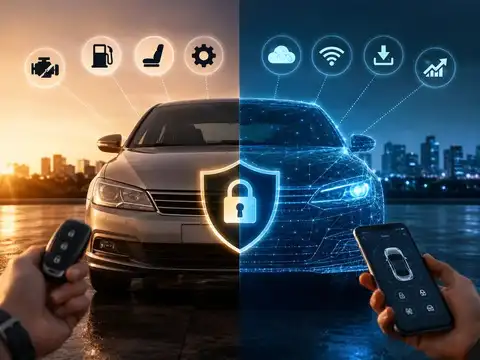
The next car battle may be fought in software
India's automotive industry is gradually moving towards vehicles where software, computing power and connectivity matter alongside mechanical hardware.
But the shift also creates new questions.
Cybersecurity
Can connected vehicle systems be protected from attacks?
Data privacy
Who controls the data generated by the vehicle?
Software failures
What happens when a digital system doesn't work as intended?
Safety validation
How should software updates be tested before reaching vehicles?
Long-term support
How long will an automaker continue providing updates?For buyers, the definition of a “good car” could therefore change.Yesterday
Engine + Mileage + Space + Features
Tomorrow
Hardware + Software + Connectivity + Upgradeability
But the shift also creates new questions.
Cybersecurity
Can connected vehicle systems be protected from attacks?
Data privacy
Who controls the data generated by the vehicle?
Software failures
What happens when a digital system doesn't work as intended?
Safety validation
How should software updates be tested before reaching vehicles?
Long-term support
How long will an automaker continue providing updates?For buyers, the definition of a “good car” could therefore change.Yesterday
Engine + Mileage + Space + Features
Tomorrow
Hardware + Software + Connectivity + Upgradeability