
Buying a car? 30 September, 31 December or 31 March—which date gets you the best deal?

1/14
Buying a car on 30 September, 31 December or 31 March?
The date you buy your car could affect more than just the discount.
In India, buyers often look at quarter-end, calendar-year-end and financial-year-end periods for better car deals.
But which date is actually best?
30 September vs 31 December vs 31 March
The answer depends on what matters most to you:
Lower price, newer stock, better resale value or stronger negotiation power?
In India, buyers often look at quarter-end, calendar-year-end and financial-year-end periods for better car deals.
But which date is actually best?
30 September vs 31 December vs 31 March
The answer depends on what matters most to you:
Lower price, newer stock, better resale value or stronger negotiation power?

2/14
Why do these dates matter?
Car manufacturers and dealerships work with sales targets.
As important sales periods approach, dealers may become more willing to negotiate on selected models and inventory.
You may see offers such as:
Cash discounts
Exchange bonuses
Free accessories
Insurance benefits
Finance offers
Dealer-specific discounts
But there is no guaranteed discount simply because it is 30 September, 31 December or 31 March.
The actual deal depends on the model, variant, demand, inventory and dealer.
As important sales periods approach, dealers may become more willing to negotiate on selected models and inventory.
You may see offers such as:
Cash discounts
Exchange bonuses
Free accessories
Insurance benefits
Finance offers
Dealer-specific discounts
But there is no guaranteed discount simply because it is 30 September, 31 December or 31 March.
The actual deal depends on the model, variant, demand, inventory and dealer.

3/14
30 September: The balanced option?
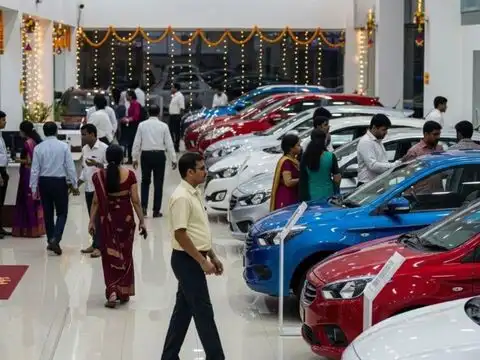
September can be an interesting time to buy because it falls around an important sales period and the festive season.
A dealer may have more reason to negotiate on selected inventory.
Potential advantages
Better negotiation than normal periods
Festive-season offers
Good availability of popular variants
Potential exchange and accessory benefits
The catch
Festive demand can also be strong.
If a particular car is selling quickly, the dealer may have little reason to offer a major discount.
Best for: Buyers looking for a balance between price, availability and vehicle freshness.
A dealer may have more reason to negotiate on selected inventory.
Potential advantages
Better negotiation than normal periods
Festive-season offers
Good availability of popular variants
Potential exchange and accessory benefits
The catch
Festive demand can also be strong.
If a particular car is selling quickly, the dealer may have little reason to offer a major discount.
Best for: Buyers looking for a balance between price, availability and vehicle freshness.
Amazon Top Deals
POWERED BY

Crompton Ozone 75 Litres Desert Air Cooler for home | Large & Easy Clean Ice Chamber | 4-Way Air Deflection | High Density Honeycomb Pads | Everlast Pump | Auto Fill| 3 Year Brand Warranty
₹9,798Buy Now43%
OFF

LG 32 L Convection Microwave Oven (MC3286BRUM, Black, 360° Motorised Rotisserie for Bar-be-queing, 301 Auto Cook Menu, Stainless steel cavity, Indian Cuisine, Tandoor Se, Steam Clean & Diet Fry)
₹19,090Buy Now20%
OFF
4/14
31 December: Why buyers chase year-end deals
December is one of the most popular periods for car discounts.
Dealers may want to:
Close calendar-year sales targets
Clear existing inventory
Make room for newer stock
Sell outgoing inventory
That can give buyers greater bargaining power.
You may find attractive combinations of:
Cash discount + exchange bonus + accessories + finance offers
But there is one thing you should never ignore:
The manufacturing date.
Dealers may want to:
Close calendar-year sales targets
Clear existing inventory
Make room for newer stock
Sell outgoing inventory
That can give buyers greater bargaining power.
You may find attractive combinations of:
Cash discount + exchange bonus + accessories + finance offers
But there is one thing you should never ignore:
The manufacturing date.

5/14
December's biggest catch: Older manufacturing stock
A large December discount may sometimes be attached to older inventory.
For example:
Car A: Manufactured in December 2026
Car B: Manufactured in January 2027
Both may be brand-new when sold.
But the manufacturing dates are different.
This can matter when you eventually sell the vehicle because the car's age and manufacturing/model year can influence resale negotiations.
So before accepting a December deal, ask:
"What is the manufacturing month and year of this exact vehicle?"
A bigger discount isn't automatically a better deal.
For example:
Car A: Manufactured in December 2026
Car B: Manufactured in January 2027
Both may be brand-new when sold.
But the manufacturing dates are different.
This can matter when you eventually sell the vehicle because the car's age and manufacturing/model year can influence resale negotiations.
So before accepting a December deal, ask:
"What is the manufacturing month and year of this exact vehicle?"
A bigger discount isn't automatically a better deal.

6/14
31 March: The financial-year-end opportunity
March is another important period for car buyers because 31 March marks the end of India's financial year.
Dealers may be looking to close annual sales targets and clear selected inventory.
That can improve your negotiating position.
You could potentially negotiate on:
Dealer discounts
Exchange bonuses
Accessories
Insurance
Financing
Older inventory
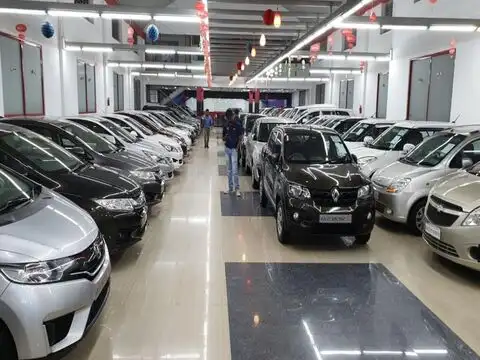
March can be especially attractive if you are flexible about colour, variant or available stock.
Dealers may be looking to close annual sales targets and clear selected inventory.
That can improve your negotiating position.
You could potentially negotiate on:
Dealer discounts
Exchange bonuses
Accessories
Insurance
Financing
Older inventory
March can be especially attractive if you are flexible about colour, variant or available stock.
7/14
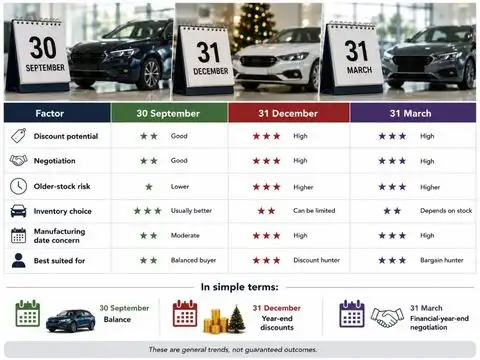
December vs March: Which one gives the better deal?
Both can be strong buying periods, but your priority matters.
31 December
Best for: Year-end discount hunting
Potential advantage: Dealers may want to clear calendar-year inventory.
Potential concern: Older manufacturing/model-year stock.
31 March
Best for: Aggressive negotiation
Potential advantage: Financial-year-end target pressure.
Potential concern: Limited choice if you're particular about colour or variant.
Bottom line:
Don't wait for a particular date if the exact car you want is already available at an excellent price.
31 December
Best for: Year-end discount hunting
Potential advantage: Dealers may want to clear calendar-year inventory.
Potential concern: Older manufacturing/model-year stock.
31 March
Best for: Aggressive negotiation
Potential advantage: Financial-year-end target pressure.
Potential concern: Limited choice if you're particular about colour or variant.
Bottom line:
Don't wait for a particular date if the exact car you want is already available at an excellent price.

8/14
What happens to resale value?
This is where many buyers make a mistake.
A car bought at a huge discount can still face a resale disadvantage if it has an older manufacturing/model year.
Suppose you buy a car in December 2026 and sell it after three years.
A buyer comparing it with a similar car manufactured in 2027 may consider the difference in vehicle age.
This doesn't mean December cars are bad purchases.
It means:
The longer you plan to keep the car, the less important a small manufacturing-year difference may become.
If you change cars frequently, pay more attention to it.
A car bought at a huge discount can still face a resale disadvantage if it has an older manufacturing/model year.
Suppose you buy a car in December 2026 and sell it after three years.
A buyer comparing it with a similar car manufactured in 2027 may consider the difference in vehicle age.
This doesn't mean December cars are bad purchases.
It means:
The longer you plan to keep the car, the less important a small manufacturing-year difference may become.
If you change cars frequently, pay more attention to it.

9/14
Never confuse these 3 dates
Before taking delivery, understand the difference between:
Manufacturing date
When the vehicle was produced.
Invoice date
When the dealer billed the vehicle.
Registration date
When the vehicle was registered with the RTO.
These dates can be different.
Before delivery:
Check the VIN/chassis number, manufacturing details and documents carefully.
If the dealer is offering a large discount, ask why the vehicle is being discounted.
Manufacturing date
When the vehicle was produced.
Invoice date
When the dealer billed the vehicle.
Registration date
When the vehicle was registered with the RTO.
These dates can be different.
Before delivery:
Check the VIN/chassis number, manufacturing details and documents carefully.
If the dealer is offering a large discount, ask why the vehicle is being discounted.

10/14
Don't fall for a ₹1 lakh discount blindly
Imagine a dealer says:
"₹1 lakh discount on this car!"
Sounds great.
But compare the complete deal.
Check:
Final on-road price
Insurance
Accessories
Finance charges
Exchange value
Extended warranty
Manufacturing month
Model year
Exact variant
A ₹1 lakh advertised discount may not mean ₹1 lakh of actual savings if other costs are higher.
The number that matters most:
Final on-road price for the exact vehicle you are getting.
"₹1 lakh discount on this car!"
Sounds great.
But compare the complete deal.
Check:
Final on-road price
Insurance
Accessories
Finance charges
Exchange value
Extended warranty
Manufacturing month
Model year
Exact variant
A ₹1 lakh advertised discount may not mean ₹1 lakh of actual savings if other costs are higher.
The number that matters most:
Final on-road price for the exact vehicle you are getting.

11/14
The smartest way to negotiate
Don't walk into a dealership and ask only:
"How much discount will you give me?"
Instead, ask:
"What is your best final on-road price for this exact vehicle, including every charge?"
Then compare quotations from at least two or three dealers.
Ask each dealer to clearly show:
Manufacturer discount
Dealer discount
Exchange bonus
Insurance
Accessories
Registration-related charges
Finance charges
Final on-road price
Manufacturing month and year
This makes it much easier to identify the genuine bargain.
"How much discount will you give me?"
Instead, ask:
"What is your best final on-road price for this exact vehicle, including every charge?"
Then compare quotations from at least two or three dealers.
Ask each dealer to clearly show:
Manufacturer discount
Dealer discount
Exchange bonus
Insurance
Accessories
Registration-related charges
Finance charges
Final on-road price
Manufacturing month and year
This makes it much easier to identify the genuine bargain.
12/14
30 September vs 31 December vs 31 March: The winner
In simple terms:
30 September → Balance
31 December → Year-end discounts
31 March → Financial-year-end negotiation
These are general trends, not guaranteed outcomes.
30 September → Balance
31 December → Year-end discounts
31 March → Financial-year-end negotiation
These are general trends, not guaranteed outcomes.
13/14
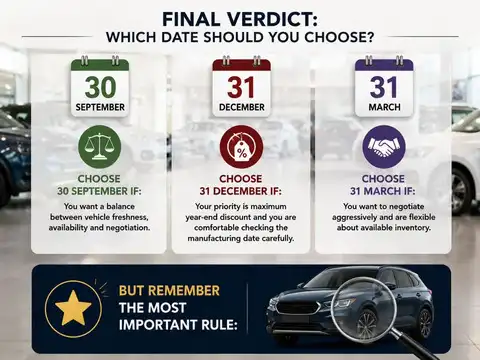
Final verdict: Which date should you choose?
Choose 30 September if:
You want a balance between vehicle freshness, availability and negotiation.
Choose 31 December if:
Your priority is maximum year-end discount and you are comfortable checking the manufacturing date carefully.
Choose 31 March if:
You want to negotiate aggressively and are flexible about available inventory.
But remember the most important rule:
You want a balance between vehicle freshness, availability and negotiation.
Choose 31 December if:
Your priority is maximum year-end discount and you are comfortable checking the manufacturing date carefully.
Choose 31 March if:
You want to negotiate aggressively and are flexible about available inventory.
But remember the most important rule:

14/14
The best car-buying date isn't the date with the biggest discount.
It's the date when you get the:
Right car + right manufacturing date + right on-road price + right resale equation.
A ₹1 lakh discount isn't necessarily better than a ₹70,000 discount if the cheaper car has older inventory or higher ownership costs.
Buy the deal, not just the discount.
Right car + right manufacturing date + right on-road price + right resale equation.
A ₹1 lakh discount isn't necessarily better than a ₹70,000 discount if the cheaper car has older inventory or higher ownership costs.
Buy the deal, not just the discount.