
Where to keep your emergency fund in India: 5 safe options and 4 to avoid

1/8
Your emergency fund is not an investment. Here’s where it belongs
Saving 3-6 months of expenses is the hard part. The next question is where to keep that money. In India you can choose from savings accounts, liquid funds, FDs, arbitrage funds and more, but not all of them suit emergency money.
The goal of an emergency fund is liquidity and safety, not high returns.
What it’s for: medical emergencies, job loss, urgent home or car repairs and family emergencies.
How big it should be: 3 to 6 months of essential expenses. If you are self-employed or in an unstable job, 6-12 months is safer.
What it needs: money you can reach immediately, low or zero risk, a stable value, and no job of creating wealth.

2/8
Savings account: The only option that works at 2 AM
If you need money in the middle of a medical emergency, this is the only option with no delay. It is your first responder.
ProsInstant access through ATM, UPI or net bankingNo lock-in periodNo risk to your principal
ConsReturns are very low, typically 2-3%Interest is taxed at your slab rate, which can be 30%It doesn’t beat inflation
Best for: the 1-2 months of expenses you may need immediately.
ProsInstant access through ATM, UPI or net bankingNo lock-in periodNo risk to your principal
ConsReturns are very low, typically 2-3%Interest is taxed at your slab rate, which can be 30%It doesn’t beat inflation
Best for: the 1-2 months of expenses you may need immediately.

3/8
Liquid funds: Your second line of defence
Liquid funds are mutual funds that invest in short-term money market instruments. You get better returns than a savings account and still have your money within one business day.Pros
- Redemption is usually T+1, so money is credited the next working day
- Historically 5-7%, depending on market conditions
- Low volatility compared with other mutual funds
- Gains are taxed at your slab rate if you bought after 2023
- Not instant like a savings account
- Slightly more complex than a bank account

4/8
Arbitrage funds: The tax-smart pick for a bigger corpus
Arbitrage funds exploit price differences between the cash and futures markets. They are taxed as equity funds, which can change the maths if you hold them beyond a year.Pros
- Redemption is typically T+2 working days
- Low volatility compared with pure equity funds
- Better tax treatment than debt funds when held over one year
- Short-term gains (under one year) are taxed at 20%
- Returns depend on market spreads
- Less predictable than liquid funds

5/8
Bank FDs vs Small Finance Bank FDs: How much extra return is worth it?
Use FDs for the part of your fund you won’t need within 24 hours.Large bank FD
- Returns of 6-7.5%, depending on the bank and tenure
- Can be broken early, with money usually credited the same day or within 24 hours
- Pre-closure penalty of 0.5-1% lower interest
- Covered by DICGC insurance up to ₹5 lakh per depositor per bank
- Helps build a banking relationship that is useful for future loans
- Returns of 8-8.5% in many cases
- Same DICGC cover, up to ₹5 lakh per depositor per bank
- Slightly higher institutional risk than large banks
- Not ideal for your entire emergency fund

6/8
4 places you should never park your emergency fund
Equity funds. They can fall 20-40% in a market crash, and an emergency is the worst time to sell at a loss.Hybrid funds. Many still hold 30-65% in equity, so market swings can hit your capital.Debt funds. They are less volatile than equity but still carry interest rate risk, credit risk and market risk. Even small dips can be a problem when you need the money.High-yield lease financing, invoice discounting and structured credit products. They may promise 10-12%, but liquidity is limited, credit risk is high and exits may not be flexible. Your emergency fund should never depend on a borrower repaying.Physical cash also carries theft and loss risk. Keep only a small amount at home, if any.
7/8
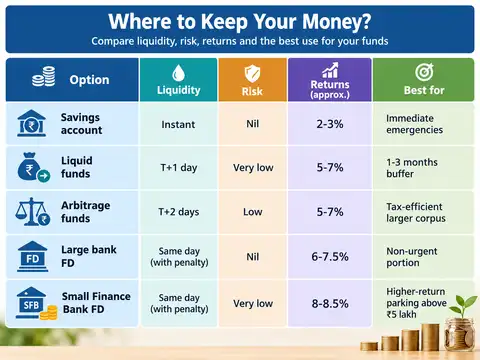
Quick comparison: Which option fits which job?
Choosing where to park your money depends on how quickly you need access to it, your risk tolerance and the returns you expect.Savings account (2–3% returns): Offers instant access with virtually no investment risk, making it suitable for immediate emergencies and everyday cash needs.Liquid funds (5–7% returns): Typically allow redemption proceeds to reach your bank account within one business day (T+1). They are suitable for building a short-term buffer for expenses over the next one to three months, though returns are not guaranteed.Arbitrage funds (5–7% returns): Generally offer redemption within two business days (T+2). They may be suitable for larger cash reserves where tax efficiency matters, depending on the investor's tax situation and holding period.Large bank fixed deposits (6–7.5% returns): Offer relatively predictable returns and may allow premature withdrawal with a penalty. They are better suited to funds that are not required immediately.Small Finance Bank FDs (8–8.5% returns): May offer higher interest rates, making them attractive for parking surplus funds above ₹5 lakh. However, investors should consider bank-specific risks, premature withdrawal conditions and deposit insurance limits.Key takeaway: Keep immediate emergency money in a savings account, use liquid funds for short-term needs, and consider FDs for money you can afford to lock away.

8/8
The 5 rules for where to keep your emergency fund
- Liquidity first, returns later. If you can’t reach the money quickly, it isn’t an emergency fund.
- No capital risk. Avoid options where the NAV swings significantly.
- Split across instruments. For example, 1 month in a savings account, 2 months in a liquid fund and the rest in FDs or Small Finance Bank FDs.
- Diversify across banks above ₹5 lakh. Stay within DICGC limits per bank.
- Keep it simple. Emergency money shouldn’t need daily monitoring.
READ MORE:
emergency fund India |where to keep emergency fund |best place to keep emergency fund in India |emergency fund options India |liquid funds for emergency fund |arbitrage funds for emergency fund |savings account vs liquid fund |bank FD vs small finance bank FD |small finance bank FD rates |DICGC insurance limit ₹5 lakh