
Retiring at 60? How to make your savings last 30 years without a salary

1/8
Can your savings last 30 years without a salary?
You spent three decades earning. Now your money may need to last another 30 years.
Retirement used to feel distant. For people in their 50s, it is now a real financial question. Quitting a salary does not end household expenses. Children’s needs, loan EMIs, healthcare and daily bills often continue well past 60. With life expectancy rising, your corpus may need to last until 85 or even 90.
The real question is no longer when you can retire, but whether you can afford to stop earning.
Retirement used to feel distant. For people in their 50s, it is now a real financial question. Quitting a salary does not end household expenses. Children’s needs, loan EMIs, healthcare and daily bills often continue well past 60. With life expectancy rising, your corpus may need to last until 85 or even 90.
The real question is no longer when you can retire, but whether you can afford to stop earning.
2/8
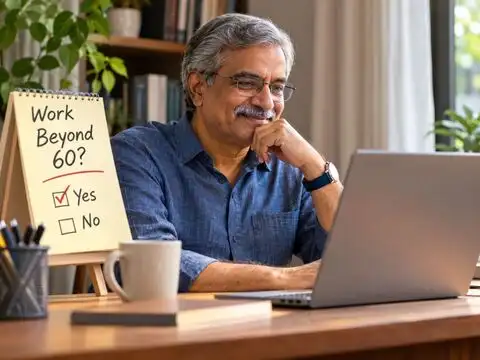
Should you keep working after 60? Most Indians say yes
For many, a hard stop at 60 is neither practical nor desirable. Consulting, freelancing, part-time work and small businesses are becoming popular ways to keep an income going.
The Axis Max Life IRIS 6.0 study found that 82% of Gen X+ respondents expect to keep working for a steady income.
Even a few extra years can help:
*Less pressure on your retirement savings
*More time for investments to grow
*Delayed withdrawals from your corpus
This works only if your health and personal circumstances allow it.
The Axis Max Life IRIS 6.0 study found that 82% of Gen X+ respondents expect to keep working for a steady income.
Even a few extra years can help:
*Less pressure on your retirement savings
*More time for investments to grow
*Delayed withdrawals from your corpus
This works only if your health and personal circumstances allow it.
3/8
Is ₹1 crore enough to retire in India?
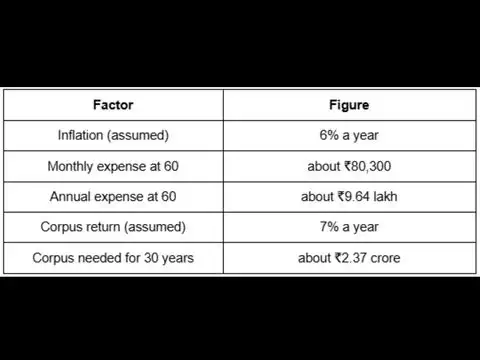
A ₹1 crore corpus sounds big, but whether it is enough depends on when you retire, what you spend and how long the money must last.
Example: A 55-year-old spending ₹60,000 a month today plans to retire at 60.
This uses a simplified model where withdrawals rise 6% each year, and it excludes large medical bills and one-time expenses. Plan around your future expenses, not today’s savings target.
Example: A 55-year-old spending ₹60,000 a month today plans to retire at 60.
This uses a simplified model where withdrawals rise 6% each year, and it excludes large medical bills and one-time expenses. Plan around your future expenses, not today’s savings target.

4/8
Planning for 85 or 90? Prepare for higher healthcare costs
Retirement planning does not end with everyday expenses at 60. Later in life, spending can shift toward medicines, treatment, rehabilitation, home nursing and caregivers. Healthcare costs can also rise faster than general inflation.
How to prepare:
*Keep a separate medical emergency fund
*Review your health insurance cover
*Hold enough liquid savings so you never have to sell long-term investments during a market fall
How to prepare:
*Keep a separate medical emergency fund
*Review your health insurance cover
*Hold enough liquid savings so you never have to sell long-term investments during a market fall

5/8
NPS at retirement: how much can you withdraw?
For eligible non-government subscribers under normal-exit rules, you can withdraw up to 80% of your accumulated pension wealth as a lump sum. At least 20% must go toward an annuity.
Example: On a ₹20 lakh NPS corpus, you could withdraw up to ₹16 lakh, and at least ₹4 lakh would go toward an annuity. Your pension then depends on the annuity product and the insurer’s terms.
PFRDA also introduced a framework for Retirement Income Schemes and drawdown options in May 2026. The 80:20 split is not universal, so check your exit category, corpus thresholds and available options before deciding.
Example: On a ₹20 lakh NPS corpus, you could withdraw up to ₹16 lakh, and at least ₹4 lakh would go toward an annuity. Your pension then depends on the annuity product and the insurer’s terms.
PFRDA also introduced a framework for Retirement Income Schemes and drawdown options in May 2026. The 80:20 split is not universal, so check your exit category, corpus thresholds and available options before deciding.
6/8
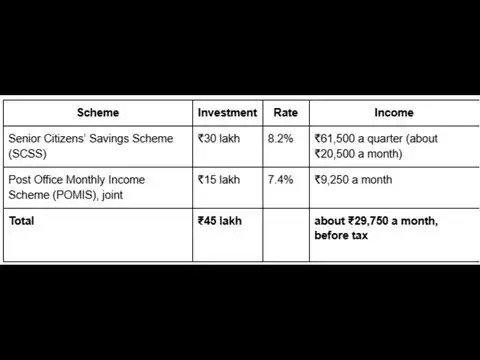
How much monthly income can ₹45 lakh generate? SCSS and POMIS compared
Once your salary stops, the goal shifts from building wealth to creating dependable cash flow.
The Senior Citizen Savings Scheme (SCSS) pays quarterly and the Post Office Monthly Income Scheme (POMIS) pays monthly. Both have investment limits, eligibility conditions and fixed tenures. You may need other investments to cover the remaining expenses and keep up with inflation.
Rates change quarterly, so confirm current rates before publishing.
The Senior Citizen Savings Scheme (SCSS) pays quarterly and the Post Office Monthly Income Scheme (POMIS) pays monthly. Both have investment limits, eligibility conditions and fixed tenures. You may need other investments to cover the remaining expenses and keep up with inflation.
Rates change quarterly, so confirm current rates before publishing.

7/8
Retirement home, rent or family? What makes financial sense
Senior living communities offer independent homes, maintenance, security and care services. But buying a retirement home is not automatically the smartest move.
Compare before you decide:
*Buying vs. renting
*Staying in your current home vs. moving closer to family
*Nearby hospitals and emergency support
*Monthly maintenance charges
*Quality of care
The right choice fits both your family’s finances and your long-term healthcare needs.
Compare before you decide:
*Buying vs. renting
*Staying in your current home vs. moving closer to family
*Nearby hospitals and emergency support
*Monthly maintenance charges
*Quality of care
The right choice fits both your family’s finances and your long-term healthcare needs.

8/8
Your 7-point retirement checklist
Use the years before retirement to close financial gaps and prepare for a different income pattern.
1.Calculate your monthly expenses after retirement.
2.Check whether your corpus can last 25 to 30 years.
3.Review EPF, NPS and other investments before choosing when to withdraw.
4.Clear expensive debt before you stop working.
5.Get adequate health insurance and a separate medical emergency fund.
6.Plan how to generate regular income without exhausting savings.
7.Update nominations, wills and property arrangements.
Retirement planning does not end when you leave your job. A solid withdrawal strategy, enough liquidity and a diversified portfolio can be the difference between financial independence and depending on others.
1.Calculate your monthly expenses after retirement.
2.Check whether your corpus can last 25 to 30 years.
3.Review EPF, NPS and other investments before choosing when to withdraw.
4.Clear expensive debt before you stop working.
5.Get adequate health insurance and a separate medical emergency fund.
6.Plan how to generate regular income without exhausting savings.
7.Update nominations, wills and property arrangements.
Retirement planning does not end when you leave your job. A solid withdrawal strategy, enough liquidity and a diversified portfolio can be the difference between financial independence and depending on others.
READ MORE:
Retirement planning in India |How much money is needed to retire in India |Retirement corpus calculation |How to generate monthly income after retirement |How to make retirement savings last 30 years |Retirement income planning |Retirement savings in India |Financial planning for senior citizens |Retirement planning for 30 years