
PPF, SCSS, NSC interest rates: Has the government changed rates for October- December 2026?

1/6
Small savings interest rates for October-December 2026
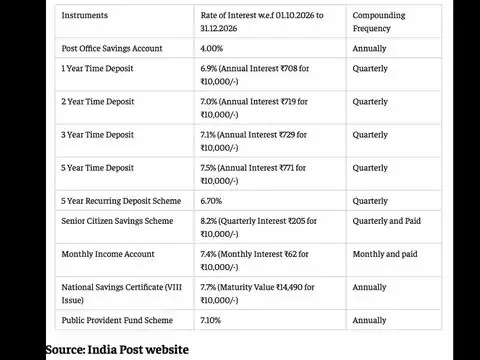
The Finance Ministry has kept small savings scheme interest rates unchanged for the October- December 2026 quarter. The Department of Economic Affairs said rates for Q3 FY 2026-27, from October 1 to December 31, 2026, will remain the same as those applicable in July- September 2026.
The last revision was in December 2024, when interest rates for the Sukanya Samriddhi Account and 3- year time deposit scheme were increased.
The last revision was in December 2024, when interest rates for the Sukanya Samriddhi Account and 3- year time deposit scheme were increased.
2/6
Small savings schemes interest rates after October 2026 review
The existing rates will continue for schemes including PPF, SCSS, NSC, Sukanya Samriddhi Account and other small savings schemes during the October-December 2026 quarter.

3/6
Why did inflation support a possible rate hike?
CPI inflation rose from 3.48% in April 2026 to 4.82% in August 2026. Higher inflation can support higher small savings rates because the government seeks to maintain attractive real returns for investors.
Inflation is still below the RBI's upper band of 6%, but rising prices could create pressure to consider higher rates in future reviews.
Inflation is still below the RBI's upper band of 6%, but rising prices could create pressure to consider higher rates in future reviews.
Amazon Top Deals
POWERED BY


4/6
Small savings interest rates: What is the G-Sec formula?
The Shyamala Gopinath Committee's 2014 recommendation linked small savings rates to average G-Sec yields of similar maturities, with a positive spread of around 25-100 basis points.
For example, the PPF rate is 7.1%. The near-three-month average 10-year G-Sec yield is approximately 6.875%. Adding 25 basis points gives about 7.125%, slightly above the current PPF rate. However, this formula is a recommendation, not binding on the Finance Ministry.
For example, the PPF rate is 7.1%. The near-three-month average 10-year G-Sec yield is approximately 6.875%. Adding 25 basis points gives about 7.125%, slightly above the current PPF rate. However, this formula is a recommendation, not binding on the Finance Ministry.

5/6
What experts say about small savings rates
Aakanksha Shukla, AVP, Wealth Management, Master Capital Services, said 10-year G-Sec yields rose above 7% during the July-September period, while August inflation stood at 4.82%. She said the formula has broadly caught up with the PPF rate, while SCSS remains above its formula value. Adhil Shetty, CEO, Bankbazaar, said G-Sec yields are an important reference when small savings rates are reviewed and recent yield increases could support higher rates.
6/6
Why did the government keep rates unchanged?
Small savings schemes are already offering relatively high rates compared with other low-risk investments. The savings account rate is 4%, while other small savings schemes offer 6.7% or more.
SCSS and Sukanya Samriddhi Account (SSA) currently offer 8.2%. With several schemes already offering competitive returns, the government may not have felt the need to raise rates despite the recent movement in inflation and G-Sec yields.
SCSS and Sukanya Samriddhi Account (SSA) currently offer 8.2%. With several schemes already offering competitive returns, the government may not have felt the need to raise rates despite the recent movement in inflation and G-Sec yields.
READ MORE:
small savings interest rates October December 2026 |small savings scheme interest rates 2026 |small savings rates October 2026 |post office interest rates October December 2026 |small savings scheme rates 2026 |government small savings interest rates |small savings interest rates unchanged |October December 2026 small savings rates