
Learn how you can use 8-4-3 rule to turn a Rs 21,250 monthly SIP into Rs 1 crore in 15 years

1/9
The 8-4-3 rule: A simple roadmap to Rs 1 crore
Many young investors wonder how long it actually takes to build a Rs 1 crore investment corpus. The answer often depends on two things: how much you invest regularly and how long you stay invested.
One popular strategy among financial planners is the 8-4-3 rule of compounding. This approach shows how consistent monthly investing combined with the power of compounding can help investors cross the Rs 1 crore milestone in about 15 years.
The idea is simple: invest a fixed amount every month and allow compounding to accelerate wealth growth over time.
The rule demonstrates how wealth creation is slow in the early years but dramatically speeds up later as returns start generating additional returns.
One popular strategy among financial planners is the 8-4-3 rule of compounding. This approach shows how consistent monthly investing combined with the power of compounding can help investors cross the Rs 1 crore milestone in about 15 years.
The idea is simple: invest a fixed amount every month and allow compounding to accelerate wealth growth over time.
The rule demonstrates how wealth creation is slow in the early years but dramatically speeds up later as returns start generating additional returns.

2/9
Understanding the power of compounding
Compounding is one of the most powerful concepts in personal finance.
Unlike simple interest, where returns are earned only on the original investment, compounding allows investors to earn returns on both the principal amount and previously accumulated returns.
Over time, this creates a snowball effect.
In the early years of investing, growth appears slow because the investment base is small. But as the corpus grows larger, even modest returns can add significant value.
This is why financial planners often say time in the market is more important than timing the market.
The earlier you start investing, the more powerful compounding becomes.
Unlike simple interest, where returns are earned only on the original investment, compounding allows investors to earn returns on both the principal amount and previously accumulated returns.
Over time, this creates a snowball effect.
In the early years of investing, growth appears slow because the investment base is small. But as the corpus grows larger, even modest returns can add significant value.
This is why financial planners often say time in the market is more important than timing the market.
The earlier you start investing, the more powerful compounding becomes.
3/9
How the 8-4-3 rule works
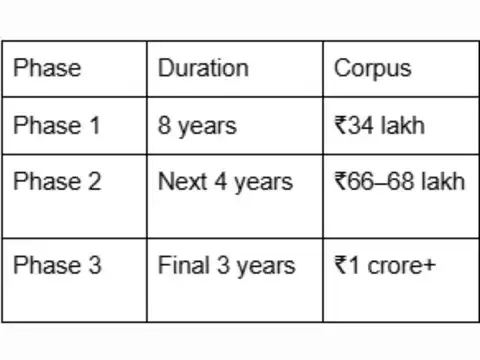
If you invest Rs 21,250 every month in an investment that generates roughly 12% annual returns, the investment grows through these stages:
What’s fascinating is that while the first Rs 34 lakh takes eight years to accumulate, the next similar amount takes only four years, and the final phase just three.
That is the true magic of compounding.
What’s fascinating is that while the first Rs 34 lakh takes eight years to accumulate, the next similar amount takes only four years, and the final phase just three.
That is the true magic of compounding.
Amazon Top Deals
POWERED BY

Crompton Ozone 75 Litres Desert Air Cooler for home | Large & Easy Clean Ice Chamber | 4-Way Air Deflection | High Density Honeycomb Pads | Everlast Pump | Auto Fill| 3 Year Brand Warranty
₹9,798Buy Now43%
OFF

LG 32 L Convection Microwave Oven (MC3286BRUM, Black, 360° Motorised Rotisserie for Bar-be-queing, 301 Auto Cook Menu, Stainless steel cavity, Indian Cuisine, Tandoor Se, Steam Clean & Diet Fry)
₹19,340Buy Now19%
OFF

4/9
Phase 1 (Years 1-8): The discipline stage
The first eight years require patience and consistency.
During this period, investors contribute most of the money themselves. Returns are relatively small because the investment base is still building.
If you invest Rs 21,250 every month, your total investment during this stage will be roughly Rs 20.4 lakh.
With an assumed annual return of around 12%, the corpus may grow to about Rs 33-34 lakh.
This stage often feels slow, and many investors become discouraged here. But this period is crucial because it lays the foundation for the powerful compounding that follows.
During this period, investors contribute most of the money themselves. Returns are relatively small because the investment base is still building.
If you invest Rs 21,250 every month, your total investment during this stage will be roughly Rs 20.4 lakh.
With an assumed annual return of around 12%, the corpus may grow to about Rs 33-34 lakh.
This stage often feels slow, and many investors become discouraged here. But this period is crucial because it lays the foundation for the powerful compounding that follows.

5/9
Phase 2 (Years 9-12): When compounding accelerates
In the next four years, something interesting happens.
The investment base has become large enough for compounding to start working faster.
Your corpus can grow from around Rs 34 lakh to nearly Rs 66-68 lakh.
This means the next Rs 33 lakh accumulation happens in half the time compared with the first phase.
At this stage, investment returns begin contributing significantly to overall growth, reducing the relative contribution required from fresh investments.
The investment base has become large enough for compounding to start working faster.
Your corpus can grow from around Rs 34 lakh to nearly Rs 66-68 lakh.
This means the next Rs 33 lakh accumulation happens in half the time compared with the first phase.
At this stage, investment returns begin contributing significantly to overall growth, reducing the relative contribution required from fresh investments.

6/9
Phase 3 (years 13-15): The exponential growth stage
* The final phase of the 8-4-3 rule demonstrates the most powerful impact of compounding.
* In just three years, the investment corpus can grow from around Rs 68 lakh to more than Rs 1 crore.
* By this stage, returns are doing much of the heavy lifting.
* Instead of relying primarily on monthly contributions, the accumulated investment base generates large gains on its own.
* This stage shows why long-term investors often experience rapid wealth growth after many years of disciplined investing.
* In just three years, the investment corpus can grow from around Rs 68 lakh to more than Rs 1 crore.
* By this stage, returns are doing much of the heavy lifting.
* Instead of relying primarily on monthly contributions, the accumulated investment base generates large gains on its own.
* This stage shows why long-term investors often experience rapid wealth growth after many years of disciplined investing.

7/9
Important assumptions behind the 8-4-3 rule
The 8-4-3 rule works based on certain assumptions.
The most important assumption is achieving around 12% average annual returns, which historically has been possible through diversified equity investments over long periods.
Other key factors include:
* Consistent monthly investing without interruption
* Staying invested during market volatility
* Choosing diversified equity mutual funds or index funds
* Regularly reviewing the portfolio
Market returns can vary in the short term, but long-term equity investing has historically delivered strong results.
The most important assumption is achieving around 12% average annual returns, which historically has been possible through diversified equity investments over long periods.
Other key factors include:
* Consistent monthly investing without interruption
* Staying invested during market volatility
* Choosing diversified equity mutual funds or index funds
* Regularly reviewing the portfolio
Market returns can vary in the short term, but long-term equity investing has historically delivered strong results.

8/9
What happens after Rs 1 crore?
* The most exciting part of compounding begins after the first major milestone.
* Once the investment corpus crosses Rs 1 crore, wealth can grow even faster.
* For example, if the same return assumptions hold, the corpus could potentially grow to around Rs 2 crore in about six more years.
* As the investment base becomes larger, annual returns themselves become significant.
* This demonstrates how long-term investing can eventually create financial momentum.
* Once the investment corpus crosses Rs 1 crore, wealth can grow even faster.
* For example, if the same return assumptions hold, the corpus could potentially grow to around Rs 2 crore in about six more years.
* As the investment base becomes larger, annual returns themselves become significant.
* This demonstrates how long-term investing can eventually create financial momentum.

9/9
The biggest lesson: Start early and stay consistent
The 8-4-3 rule highlights an important lesson about wealth creation.
Building large investment corpuses is less about timing the market and more about starting early and staying disciplined.
Many people delay investing because they believe wealth creation takes too long. But the reality is that once compounding begins working, progress accelerates rapidly.
The earlier you begin investing—even with modest monthly contributions—the greater your chances of building significant wealth over time.
In personal finance, patience and consistency often matter more than chasing quick returns.
Building large investment corpuses is less about timing the market and more about starting early and staying disciplined.
Many people delay investing because they believe wealth creation takes too long. But the reality is that once compounding begins working, progress accelerates rapidly.
The earlier you begin investing—even with modest monthly contributions—the greater your chances of building significant wealth over time.
In personal finance, patience and consistency often matter more than chasing quick returns.