
Latest EPF withdrawal TDS exemption rules: EPFO says Form 121 has replaced 15G/15H from tax year 2026-27; check who needs to submit it
1/5
EPF withdrawal TDS exemption
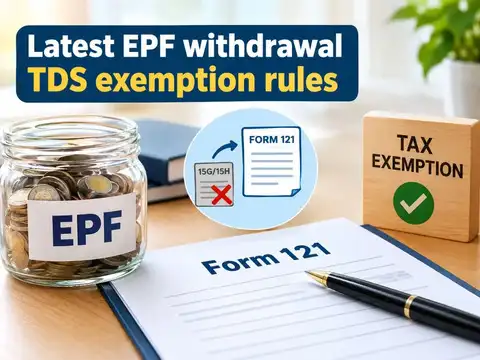
Employees’ Provident Fund Organisation (EPFO) members withdrawing their Employees’ Provident Fund (EPF) before five years of service will have to use a new form to claim exemption from tax deducted at source (TDS) from tax year 2026-27 onwards. Form 121 will replace the earlier Forms 15G and Form 15H for claiming TDS exemption on EPF withdrawals, as per a tweet from the EPFO.

2/5
Is Form 15G/15H no longer valid for TDS exemption on EPF?
From tax year 2026-27 onwards, EPF members cannot use Form 15G or Form 15H to claim exemption from TDS on eligible EPF withdrawals, the tweet says.
Instead, an EPFO member has to submit Form 121 for claiming the TDS exemption. The form is applicable under the Income-ax Act, 2025.
Instead, an EPFO member has to submit Form 121 for claiming the TDS exemption. The form is applicable under the Income-ax Act, 2025.

3/5
When do you need to submit Form 121 for EPF withdrawal?
As per the Income tax-Act 2025, income tax is deducted at source (TDS) under Section 192A on withdrawals from the EPF if the employee has not completed five years of continuous service. TDS is deducted at 10% if the withdrawal amount exceeds Rs 50,000.
Form 121 is a statutory declaration prescribed under the Income Tax Rules, 2026, through which a taxpayer declares that tax liability on its estimated total income for the relevant tax year is nil, as per the Income Tax portal.
Based on this declaration, the payer (deductor) is permitted to not deduct TDS on specified payments.
In case of the EPF withdrawals before five years of service, Form 121 is submitted to claim exemptions from TDS.
Therefore, an EPF member should check the withdrawal amount, total service period and annual income before claiming the TDS exemption through Form 121.
Form 121 is a statutory declaration prescribed under the Income Tax Rules, 2026, through which a taxpayer declares that tax liability on its estimated total income for the relevant tax year is nil, as per the Income Tax portal.
Based on this declaration, the payer (deductor) is permitted to not deduct TDS on specified payments.
In case of the EPF withdrawals before five years of service, Form 121 is submitted to claim exemptions from TDS.
Therefore, an EPF member should check the withdrawal amount, total service period and annual income before claiming the TDS exemption through Form 121.
Amazon Top Deals
POWERED BY

4/5
For which types of income does Form 121 apply to?
Form 121 is a self-declaration form furnished by individuals to ensure no deduction of TDS on specified incomes such as interest on bank deposits, post office deposits or other specified incomes when their total income is below the taxable limit. For EPF members, Form 121 becomes relevant while filing an eligible withdrawal claim where TDS would otherwise apply.

5/5
Who should file Form 121?
Individuals (whether below 60 years or 60 years and above), Hindu Undivided Families (HUFs), and other specified eligible entities that meet the stipulated criteria.
Companies and firms are not eligible to file Form 121.
Non-residents are not eligible to file Form 121
Companies and firms are not eligible to file Form 121.
Non-residents are not eligible to file Form 121