
Family pension rules 2026: Who gets it first after a central govt employee dies?
1/8
Who gets family pension first? The Centre just settled it
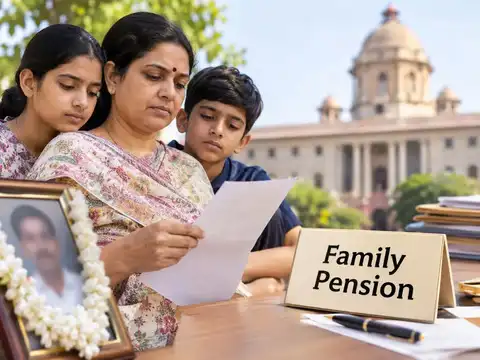
The Department of Pension and Pensioners’ Welfare has restated the order in which family members qualify for family pension. The instruction was issued on 29 October 2026 and applies to central government employees and pensioners. It tells every ministry to examine claims the same way. The order is spouse first, then children, then dependent parents. Nothing in the rule has changed. If you or a family member are waiting on a claim, this is the order officials must now follow.
2/8
The spouse comes first, even if married after retirement
Under Rule 50 of the CCS (Pension) Rules, 2021, the surviving spouse is considered first. This includes a spouse of the employee or pensioner married after retirement, subject to the conditions in the rule. Children do not get family pension while the spouse is eligible. They become eligible only after the spouse dies or the spouse’s entitlement ends. For most families, this means the spouse receives the pension for as long as they qualify. This includes childless spouses who have remarried after the pensioner's death as long as they meet certain criteria.

3/8
Children are next, and the eldest goes first
Once the spouse is no longer eligible, children are considered. The children who count include adopted children, step-children, and children born after the employee or pensioner’s retirement or death. When more than one child is eligible, the order of birth decides, with the eldest eligible child first. This is the first category of children, and the rules for when their pension ends are on the next slide.
4/8
The Age 25 Rule: When a child’s pension stops
A child’s family pension in this first category ends at the earliest of three events: the child turns 25, the child marries, or the child starts earning a livelihood. Whichever happens first ends it. Families should plan for this, because the pension does not continue just because the child is still studying or living at home after one of these events. Children with a disability are treated differently, as the next slide explains.

5/8
Disabled children and dependent daughters get extra protection
Once no child in the first category is eligible, children with a mental or physical disability come next, again in order of birth. A disabled child keeps the pension until they start earning, and marriage does not end it. After that come unmarried, widowed or divorced daughters, who must have been dependent on the parent and must not be earning when the pension becomes payable to them. Their pension runs until marriage, remarriage or the start of earnings, whichever is earlier.
6/8
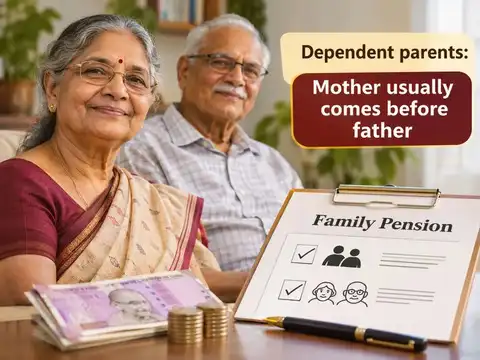
Dependent parents: The mother usually comes before the father
Dependent parents, including adoptive parents, are considered only after the spouse’s and children’s eligibility has fully ended. Between the two parents, the mother ordinarily comes first. Last in line are dependent brothers and sisters with a mental or physical disability, who can receive family pension only when the spouse, children and dependent parents are no longer eligible. This is why it matters to record dependants correctly in service records.
7/8
Two exceptions where the spouse does not come first
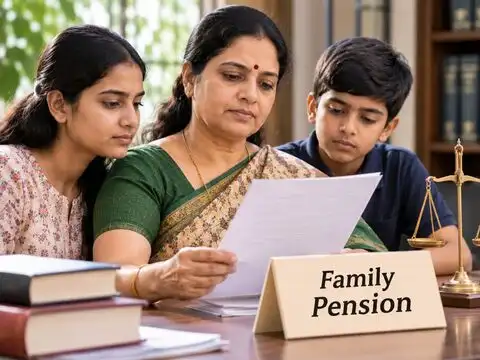
The memorandum names two cases. In marital discord, a woman government servant or pensioner may nominate her children to receive family pension ahead of her husband, if the prescribed conditions are met. Where a couple is judicially separated, eligible children are paid first, and the separated spouse may be paid only after the children stop being eligible. In the cases covered by Rule 50(8)(e) to (g), a widow may also share the pension with eligible children of another deceased wife, a divorced wife, or a void or voidable marriage.
8/8
Who this covers, who it doesn’t, and what to do next
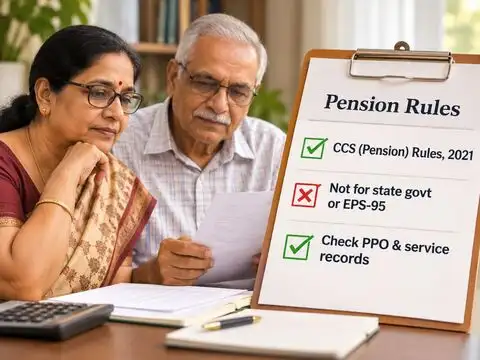
This instruction covers families whose pension falls under the CCS (Pension) Rules, 2021. It does not cover state government employees or EPS-95 pensioners, whose rules are separate. It restates the existing rule, asks nothing of families, and does not say how much pension is paid. Check your Pension Payment Order and service records so that the spouse, children and dependants are listed correctly. If a claim is delayed or disputed, ask the pension-sanctioning office to confirm which part of Rule 50 it is applying.
Source: Department of Pension and Pensioners’ Welfare, O.M. No. 1/1(39)/2026-P&PW (E), 29 October 2026
Source: Department of Pension and Pensioners’ Welfare, O.M. No. 1/1(39)/2026-P&PW (E), 29 October 2026
READ MORE:
Family pension rules 2026 |Family pension latest news |Central government family pension rules |Family pension eligibility rules |Who gets family pension first |Family pension rules after death |CCS Pension Rules 2021 |Family pension eligibility for spouse and children |Central government pension rules 2026 |Family pension order of priority