
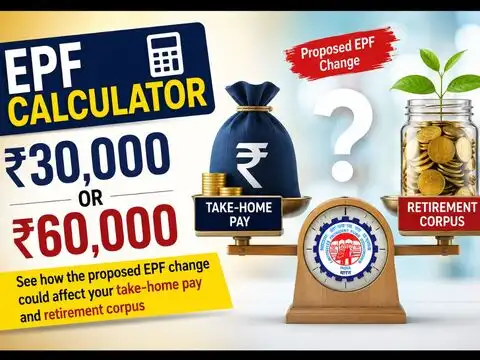
EPF calculator: ₹30,000 or ₹60,000 basic salary? See how the proposed EPF change could affect your take-home pay and retirement corpus
1/6
Proposed EPF change: Who could be affected?
The proposal is expected to mainly affect employees whose EPF contributions are currently calculated on their actual Basic Salary plus DA, instead of the statutory wage ceiling of ₹15,000. Employees whose EPF contribution is already capped at ₹1,800 per month are unlikely to see any change if the proposal is implemented.
2/6
EPF calculator: How much could your take-home salary increase?
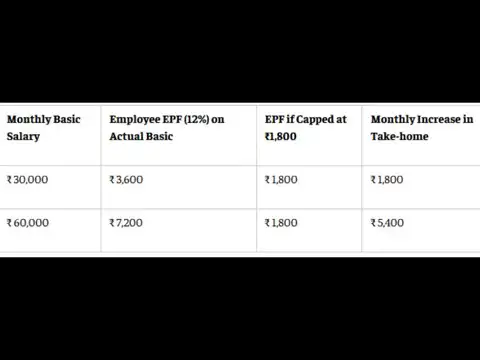
If the proposal is implemented, employees who currently contribute above ₹1,800 could choose to reduce their EPF contribution to the statutory minimum.
*₹30,000 basic salary: Take-home pay could increase by ₹1,800 a month
*₹60,000 basic salary: Take-home pay could increase by ₹5,400 a month
The increase would broadly equal the reduction in the employee's EPF contribution.
*₹30,000 basic salary: Take-home pay could increase by ₹1,800 a month
*₹60,000 basic salary: Take-home pay could increase by ₹5,400 a month
The increase would broadly equal the reduction in the employee's EPF contribution.
3/6
EPF retirement calculator: How much retirement corpus could you forego?
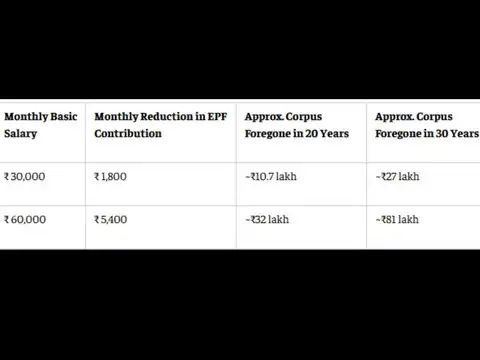
Contributing less to EPF means lower monthly savings and less compounding over time.
*₹30,000 basic salary: Retirement corpus could reduce by about ₹10.7 lakh after 20 years and ₹27 lakh after 30 years
*₹60,000 basic salary: Retirement corpus could reduce by about ₹32 lakh after 20 years and ₹81 lakh after 30 years
These are illustrative estimates assuming an 8.1% annual EPF return and a constant salary.
*₹30,000 basic salary: Retirement corpus could reduce by about ₹10.7 lakh after 20 years and ₹27 lakh after 30 years
*₹60,000 basic salary: Retirement corpus could reduce by about ₹32 lakh after 20 years and ₹81 lakh after 30 years
These are illustrative estimates assuming an 8.1% annual EPF return and a constant salary.
Amazon Top Deals
POWERED BY

4/6
EPF vs EPS: Will your pension also reduce?
According to experts, for most employees, reducing EPF contributions is unlikely to materially affect EPS pension benefits. This is because EPS contributions are already calculated on the statutory wage ceiling of ₹15,000. The proposal mainly affects retirement wealth creation through EPF, not pension eligibility.

5/6
Should you choose a higher take-home salary?
Experts say there is no one-size-fits-all answer. Employees facing short-term cash- flow needs may prefer a higher take-home salary. However, those relying on EPF as their primary retirement savings vehicle may benefit from continuing with higher contributions. The right choice depends on your age, financial goals, liquidity needs and investment discipline.

6/6
What if you invest the extra money elsewhere?
Experts say reducing EPF contributions makes financial sense only if the additional take-home salary is invested consistently in long-term options such as PPF, NPS or equity mutual funds, depending on your risk profile. Simply spending the extra cash could leave you with a significantly smaller retirement corpus in the long run.