
DR hike to 63%: ₹900 more on ₹30,000 pension? Check impact on regular, family and commuted pension
1/8
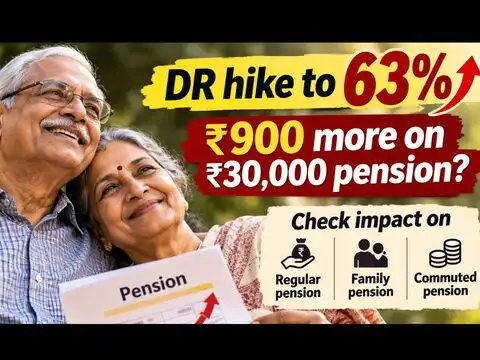
DR hike to 63%: How much more will central government pensioners get?
The Centre has increased dearness relief (DR) by 3 percentage points, taking it from 60% to 63%. Union Minister Ashwini Vaishnaw said the higher DR will benefit around 68 lakh pensioners. The increase applies to eligible central government pensioners, including regular and family pensioners under OPS and UPS, as well as OPS pensioners who have commuted part of their pension.
2/8
3% DR hike: ₹30,000 basic pension will rise by ₹900 a month
DR is calculated on the basic pension. With the rate increasing from 60% to 63%, a ₹10,000 basic pension gets ₹300 more per month. For ₹20,000, the increase is ₹600; for ₹30,000, ₹900; for ₹40,000, ₹1,200; and for ₹50,000, ₹1,500. These figures illustrate the impact before considering any other applicable pension components
3/8
OPS and UPS pension: How will the 63% DR rate affect you?
Under OPS, pension is generally 50% of the last basic pay or average emoluments of the last 10 months, whichever is higher. Under UPS, the payout is 50% of the last 12-month average basic pay for 25 years of qualifying service, with proportionate benefits for shorter service. Both schemes provide DR on the basic pension, so the 3% increase raises the monthly payout.
4/8
DR hike on ₹10,000 to ₹50,000 pension: Check your monthly increase
At 63% DR, a ₹10,000 basic pension becomes ₹16,300, compared with ₹16,000 at 60% DR. For ₹20,000, the payout rises to ₹32,600 from ₹32,000. A ₹30,000 pension becomes ₹48,900, while ₹40,000 becomes ₹65,200. For ₹50,000 basic pension, the payout rises from ₹80,000 to ₹81,500—a ₹1,500 monthly increase.

5/8
Family pension under OPS: How much will the 3% DR hike add?
Under OPS, family pension is generally 30% of the employee’s last-drawn pay, subject to the applicable minimum and maximum. For example, a ₹50,000 basic family pension gets ₹15,000 as basic family pension. At 60% DR, the total becomes ₹24,000; at 63%, it rises to ₹24,450. A ₹90,000 last-drawn pay would mean a ₹27,000 basic family pension and a ₹810 monthly increase.
6/8
UPS family pension: 3% DR hike can add up to ₹1,080 in these examples
Under UPS, family pension is 60% of the employee’s admissible UPS payout. If the admissible payout is ₹20,000, the basic family pension is ₹12,000 and the 3% DR increase adds ₹360 a month. For a ₹60,000 admissible payout, the basic family pension is ₹36,000, taking the monthly increase from the DR revision to ₹1,080.
7/8
Commuted pension: Why DR is still calculated on the original pension
Under OPS, an employee can commute up to 40% of the pension, reducing the monthly pension paid after commutation. However, DR continues to be calculated on the original pension before the commuted portion is deducted. For example, a ₹50,000 pension reduced to ₹30,000 after 40% commutation still receives DR based on ₹50,000. Therefore, the 3% hike adds ₹1,500 a month.
8/8
Commuted pension: ₹6,000 to ₹30,000 examples after 3% DR hike
For a commuted pension of ₹6,000, the total payout at 60% DR is ₹12,000 and rises to ₹12,300 at 63%, adding ₹300. A ₹12,000 pension gets ₹600 more, while ₹18,000 gets ₹900 more. For ₹24,000, the increase is ₹1,200. At ₹30,000, the 3% DR hike adds ₹1,500 per month.