
Daily chai to festive season: How saving ₹60 a day adds up to ₹21,900 a year, & 14 more good micro money habits

1/12
The small money habits that help you save more without giving up everything you enjoy
You don’t need a big salary or a strict budget to feel in control of your money. You need a few tiny routines that run on their own. This slideshow covers easy habits for every week, month and year, simple ways to calm money stress, and a plan to enjoy the festive season without a guilty bank balance afterwards.

2/12
Good money habits are smaller and easier than you think
A good financial habit is a small routine that keeps your spending, saving and debt pointed at your goals without constant effort. Once they are set up, most take only a few minutes a week.
1.Saving a fixed share of your salary before you can spend it.
2.Paying your credit card bill in full every month.
3.Checking your accounts a few times a week.
4.Waiting a day or two before any big purchase.
5.Reviewing your money plan once or twice a year.
1.Saving a fixed share of your salary before you can spend it.
2.Paying your credit card bill in full every month.
3.Checking your accounts a few times a week.
4.Waiting a day or two before any big purchase.
5.Reviewing your money plan once or twice a year.

3/12
The “tiny habit” trick that makes saving feel almost effortless
Micro money habits are routines so small they feel almost too easy, like checking your balance while the tea brews. The idea comes from James Clear’s book Atomic Habits, which says tiny actions repeated often add up, the same way interest does.
*Start small. Moving ₹500 a week to savings beats a huge plan you drop by March.
*Tie it to a cue. Review your spending every Sunday night, or every time you pay a bill.
*Stack it. If you check the weather each morning, open your bank app right after.
*Track it. A streak on a calendar keeps you going.
You can do the same with spending. Set a small limit on one thing, like food delivery or subscriptions, and track only that. Add another category once it sticks.
4/12
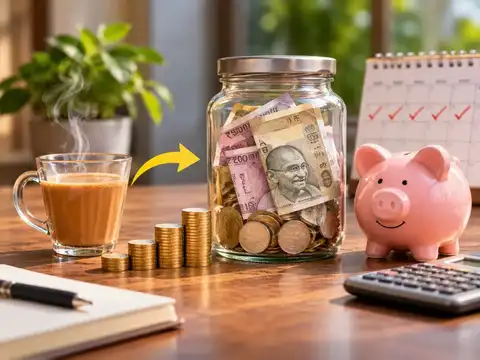
Your daily ₹60 chai habit could become a ₹21,900 savings jar
Pick one small daily spend, like a cup of tea, a snack or an impulse buy online. Say it costs ₹60. Saved every day, that is ₹1,800 a month and ₹21,900 a year, and it grows faster if you put it in a recurring deposit.
Try the match rule. Every time you buy that small treat, move the same amount into a separate savings wallet.
Then automate it. Set up an auto-debit of ₹50 or ₹100 for the day your salary or allowance arrives, so the money is gone before you can spend it.
Try the match rule. Every time you buy that small treat, move the same amount into a separate savings wallet.
Then automate it. Set up an auto-debit of ₹50 or ₹100 for the day your salary or allowance arrives, so the money is gone before you can spend it.

5/12
4 weekly money habits that take about 10 minutes
Look at your transactions a few times a week. Two minutes is enough to catch overspending, forgotten subscriptions and fraud early.
Wait before big purchases. Pick an amount, say ₹5,000, and give yourself 48 hours before buying anything above it. If you still want it after two days, buy it without guilt.
Price things per use. A ₹3,000 jacket worn 200 times costs ₹15 a wear. A ₹600 shirt worn twice costs ₹300 a wear.
Talk about money with someone you trust. Many people avoid it to dodge an argument, but one honest chat can change how you both spend.

6/12
5 monthly habits that stop your money from quietly slipping away
These take about 30 minutes in total.
Pay yourself first. Automate a transfer to savings the day your salary lands. If it leaves before you see it, you won’t miss it.
Pay your credit card in full. Interest on unpaid balances adds up fast.
Track what you own minus what you owe. A rising number keeps you motivated. A falling one tells you something needs attention.
Check your cash flow. Compare what came in with what went out. If spending ran ahead, find the category that caused it before next month repeats it.
Pay bills on one fixed day, or use autopay. Late fees and a damaged credit score are expensive ways to learn this.

7/12
3 yearly money check-ins that are worth an hour or two
Raise your savings a little each year. Add one more percentage point of your salary every January, or whenever you get a raise. In a well-known study by Richard Thaler and Shlomo Benartzi, workers who agreed to automatic increases went from saving 3.5% of their pay to 13.6% within 40 months.
Review your goals. Write down what you are saving for and by when, then check your progress. Look for ways to earn more. A raise, a side project or part-time work can do more for your plan than cutting small expenses.
Review your goals. Write down what you are saving for and by when, then check your progress. Look for ways to earn more. A raise, a side project or part-time work can do more for your plan than cutting small expenses.

8/12
2 mindset habits that make every other money habit stick
Learn one small thing about money every week. It could be how a loan works, what a fee really costs, or how to spot a scam. Small bits of knowledge add up.
End each week by naming one good money decision you made. Noticing your wins helps you repeat them. Feeling grateful for what you already have can also take the edge off the urge to spend just to feel better.
End each week by naming one good money decision you made. Noticing your wins helps you repeat them. Feeling grateful for what you already have can also take the edge off the urge to spend just to feel better.

9/12
Money worries keeping you awake? Start by writing them down
Financial anxiety can lead to burnout, poor sleep and avoiding your bank account altogether. A few grounding habits help you take control back.
Name the fear. Write down your exact worries instead of letting them spin in your head.
Separate what is fixed from what is imagined. Rent and bills are real and can be planned for. “What if” scenarios are only possibilities, and they usually look smaller on paper.
Name the fear. Write down your exact worries instead of letting them spin in your head.
Separate what is fixed from what is imagined. Rent and bills are real and can be planned for. “What if” scenarios are only possibilities, and they usually look smaller on paper.

10/12
A ₹5,000 cushion and a 15-minute “money date” can calm your mind
Schedule a weekly money date. Pick one calm 15-minute slot to check your balances and upcoming expenses, instead of looking at your account in a panic all day.
Build a small buffer. Even an emergency fund of ₹5,000 to ₹10,000 gives you a feeling of safety that eases everyday stress.
Use the pause rule. Wait 24 to 48 hours before buying anything you don’t need. It breaks the habit of shopping to cheer yourself up.
Build a small buffer. Even an emergency fund of ₹5,000 to ₹10,000 gives you a feeling of safety that eases everyday stress.
Use the pause rule. Wait 24 to 48 hours before buying anything you don’t need. It breaks the habit of shopping to cheer yourself up.

11/12
Festive season budget: Decide before the sale messages start
Durga Puja, Diwali and wedding season all test your budget with gifts, social pressure and big sales.
Create a festive bucket. Fix your total festive budget before the season begins, then split it into gifts, food and outings, clothes, and decor.
Use a cash or prepaid limit. For shopping and pandal hopping, carry a fixed amount of cash or a separate prepaid card. When it runs out, the spending stops.

12/12
Beat festive FOMO by asking one question before you buy
Shops use fake urgency and big “Save 50%” banners to get you to spend 100% on things you didn’t plan to buy. Before you pay, ask yourself: would I buy this at full price on a normal Tuesday?
Spend on moments, not on excess. Shared meals, homemade sweets and time with family often feel better than an expensive outfit or gift.
Ready to start? Pick two or three habits from this slideshow and add more once they feel automatic.
Spend on moments, not on excess. Shared meals, homemade sweets and time with family often feel better than an expensive outfit or gift.
Ready to start? Pick two or three habits from this slideshow and add more once they feel automatic.