
Beyond Ethanol: 7 alternative fuels other than E20 that could change what powers your car in India
1/9
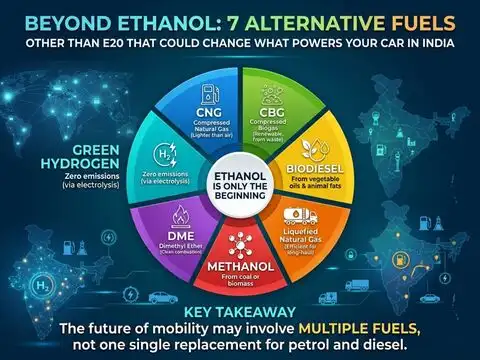
Ethanol is only the beginning
India's shift away from petrol and diesel is not limited to ethanol blending. CNG, compressed biogas, biodiesel, LNG, methanol, DME and green hydrogen are among the alternative fuels being developed or promoted for different parts of the transport and energy sectors. India's long-term strategy is to diversify the fuel mix, reduce crude-oil dependence and cut emissions.
Key takeaway: The future of mobility may involve multiple fuels, not one single replacement for petrol and diesel.
Key takeaway: The future of mobility may involve multiple fuels, not one single replacement for petrol and diesel.
2/9
CNG: The alternative fuel already on Indian roads
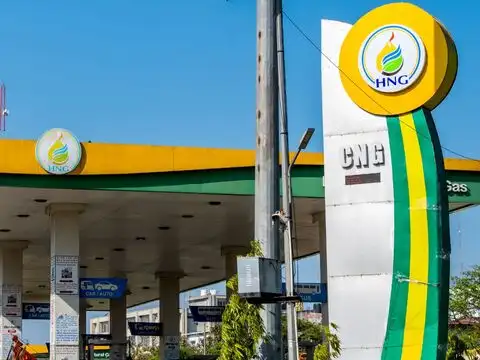
Compressed Natural Gas (CNG) is one of India's most established alternatives to petrol and diesel, particularly for cars, taxis, buses and commercial vehicles.
Pros
Lower tailpipe emissions than conventional petrol/diesel in many applications
Established vehicle and refuelling ecosystem
Suitable for urban mobility
Cons
Still a fossil fuel
Requires a widespread gas and refuelling network
Climate benefits depend on the full fuel supply chain
Best suited for: City cars, taxis, buses and commercial fleets.
India's automotive regulations already recognise CNG and several other alternative-fuel configurations.
Pros
Lower tailpipe emissions than conventional petrol/diesel in many applications
Established vehicle and refuelling ecosystem
Suitable for urban mobility
Cons
Still a fossil fuel
Requires a widespread gas and refuelling network
Climate benefits depend on the full fuel supply chain
Best suited for: City cars, taxis, buses and commercial fleets.
India's automotive regulations already recognise CNG and several other alternative-fuel configurations.
3/9
Bio-CNG: Turning farm waste into fuel
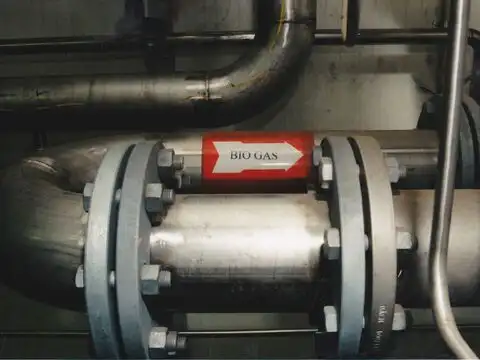
Compressed Biogas (CBG), often called Bio-CNG, is produced by processing organic waste such as agricultural residues, cattle dung and other biodegradable material.
Unlike conventional CNG, its feedstock can come from locally available biological waste.
Why it matters
*Converts waste into usable fuel
*Can create an additional revenue stream for farmers
*Can reduce dependence on fossil natural gas
*Can use existing gas-based mobility applications where specifications and infrastructure permit
Best suited for: Buses, trucks, commercial vehicles and fleets.
India's policy framework has identified CBG as an important alternative fuel, while recent government initiatives have further increased attention on the sector.
Unlike conventional CNG, its feedstock can come from locally available biological waste.
Why it matters
*Converts waste into usable fuel
*Can create an additional revenue stream for farmers
*Can reduce dependence on fossil natural gas
*Can use existing gas-based mobility applications where specifications and infrastructure permit
Best suited for: Buses, trucks, commercial vehicles and fleets.
India's policy framework has identified CBG as an important alternative fuel, while recent government initiatives have further increased attention on the sector.
Amazon Top Deals
POWERED BY

Crompton Ozone 75 Litres Desert Air Cooler for home | Large & Easy Clean Ice Chamber | 4-Way Air Deflection | High Density Honeycomb Pads | Everlast Pump | Auto Fill| 3 Year Brand Warranty
₹9,798Buy Now43%
OFF
LG 32 L Convection Microwave Oven (MC3286BRUM, Black, 360° Motorised Rotisserie for Bar-be-queing, 301 Auto Cook Menu, Stainless steel cavity, Indian Cuisine, Tandoor Se, Steam Clean & Diet Fry)
₹18,689Buy Now22%
OFF
4/9
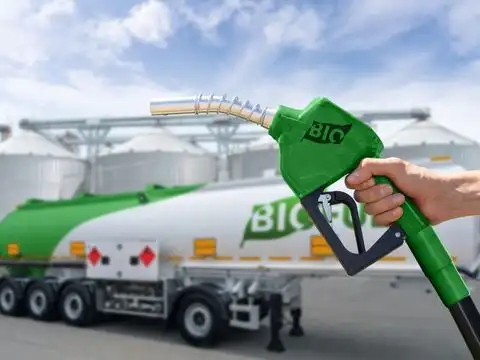
Biodiesel: A diesel alternative made from biological sources
Biodiesel can be produced from vegetable oils, used cooking oil and other suitable feedstocks.
It can be used in diesel applications, subject to the applicable fuel standards, vehicle compatibility and blend requirements.
Pros
Renewable feedstock potential
Can reduce dependence on conventional diesel
Can support waste-oil utilisation
Cons
Feedstock availability can limit scale
Production economics vary
Sustainability depends on how the feedstock is sourced
Best suited for: Diesel vehicles, commercial fleets and selected industrial applications.
India's long-term low-emission strategy identifies biodiesel as one of the alternative fuels that can play a role alongside other options.
It can be used in diesel applications, subject to the applicable fuel standards, vehicle compatibility and blend requirements.
Pros
Renewable feedstock potential
Can reduce dependence on conventional diesel
Can support waste-oil utilisation
Cons
Feedstock availability can limit scale
Production economics vary
Sustainability depends on how the feedstock is sourced
Best suited for: Diesel vehicles, commercial fleets and selected industrial applications.
India's long-term low-emission strategy identifies biodiesel as one of the alternative fuels that can play a role alongside other options.
5/9
LNG: A potential fuel for heavy transport
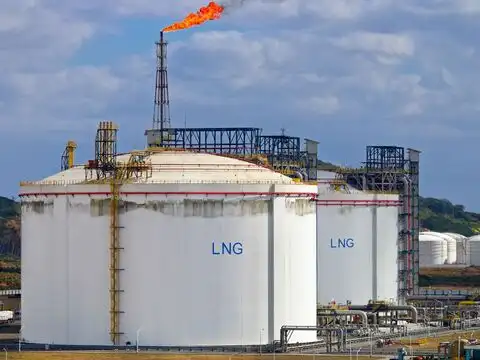
Liquefied Natural Gas (LNG) is natural gas cooled to a liquid state, allowing it to be transported and stored more compactly.
Its biggest opportunity in India could be long-distance and heavy-duty transport, where battery-electric solutions can face range, payload and charging challenges.
Pros
Higher energy density than CNG by volume
Potentially useful for long-haul trucks
Can support cleaner transport compared with conventional diesel in appropriate applications
Cons
Still fossil-based
Requires specialised storage and refuelling infrastructure
Benefits depend on methane leakage and the broader supply chain
Best suited for: Long-haul trucks, buses and other heavy-duty applications.
India's automotive framework already recognises LNG-powered vehicles and dual-fuel configurations.
Its biggest opportunity in India could be long-distance and heavy-duty transport, where battery-electric solutions can face range, payload and charging challenges.
Pros
Higher energy density than CNG by volume
Potentially useful for long-haul trucks
Can support cleaner transport compared with conventional diesel in appropriate applications
Cons
Still fossil-based
Requires specialised storage and refuelling infrastructure
Benefits depend on methane leakage and the broader supply chain
Best suited for: Long-haul trucks, buses and other heavy-duty applications.
India's automotive framework already recognises LNG-powered vehicles and dual-fuel configurations.
6/9
Methanol & DME: The fuels most people overlook
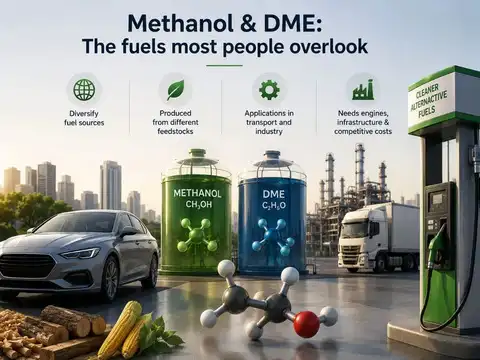
Methanol and Dimethyl Ether (DME) are alternative fuels that could have applications beyond conventional petrol and diesel.
Methanol can be produced from several feedstocks, while DME has properties that make it particularly relevant to diesel-type applications.
Potential advantages
Can diversify India's fuel sources
Can be produced from different feedstocks
Could have applications in transport and industry
The catch: Their large-scale adoption requires suitable engines, fuel standards, infrastructure and competitive production costs.
India's long-term strategy specifically identifies methanol/DME among medium-term alternative-fuel options.
Methanol can be produced from several feedstocks, while DME has properties that make it particularly relevant to diesel-type applications.
Potential advantages
Can diversify India's fuel sources
Can be produced from different feedstocks
Could have applications in transport and industry
The catch: Their large-scale adoption requires suitable engines, fuel standards, infrastructure and competitive production costs.
India's long-term strategy specifically identifies methanol/DME among medium-term alternative-fuel options.
7/9
Green hydrogen: The long-term game changer
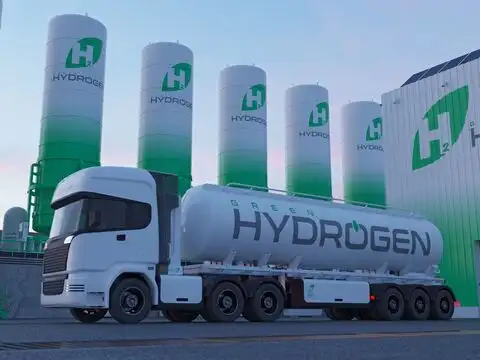
Green hydrogen is produced using renewable electricity and electrolysis rather than fossil-fuel-based processes.
It could become particularly important where direct electrification is difficult.
Potential applications
Heavy-duty road transport
Shipping
Steel
Industrial processes
Green ammonia and green methanol production
India's National Green Hydrogen Mission aims to build a domestic green-hydrogen ecosystem, with dedicated support for production, manufacturing and pilot projects, including transport and shipping.
India also notified Green Ammonia and Green Methanol Standards in February 2026, strengthening the framework for hydrogen-derived fuels.
It could become particularly important where direct electrification is difficult.
Potential applications
Heavy-duty road transport
Shipping
Steel
Industrial processes
Green ammonia and green methanol production
India's National Green Hydrogen Mission aims to build a domestic green-hydrogen ecosystem, with dedicated support for production, manufacturing and pilot projects, including transport and shipping.
India also notified Green Ammonia and Green Methanol Standards in February 2026, strengthening the framework for hydrogen-derived fuels.
8/9
So, what will power India's future?
There may not be one winner.
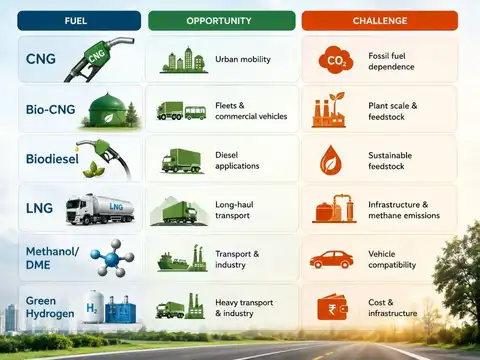
India’s alternative-fuel future may not have a single winner, with CNG, Bio-CNG, biodiesel, LNG, methanol/DME and green hydrogen serving different segments.
The biggest opportunities range from urban mobility to heavy transport and industry, but challenges such as cost, infrastructure, feedstock availability and emissions remain.
India’s alternative-fuel future may not have a single winner, with CNG, Bio-CNG, biodiesel, LNG, methanol/DME and green hydrogen serving different segments.
The biggest opportunities range from urban mobility to heavy transport and industry, but challenges such as cost, infrastructure, feedstock availability and emissions remain.
9/9
Bottom line
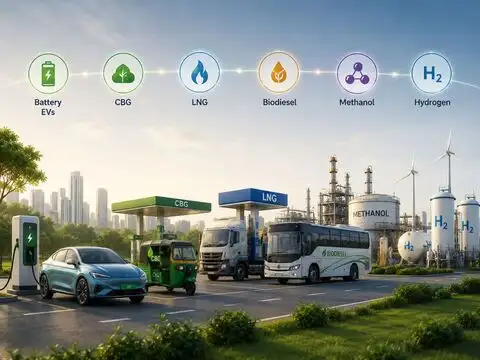
India's alternative-fuel transition is likely to be multi-fuel rather than one-size-fits-all. Battery EVs may dominate some passenger-vehicle segments, while CBG, LNG, biodiesel, methanol and hydrogen could serve applications where liquid or gaseous fuels remain advantageous. India's own long-term strategy envisages different alternative fuels playing different roles over time.