
Are cheque book rules changing from January 1, 2027? RBI clarifies after viral WhatsApp message; here's what customers should know
1/6
New cheque book rules from January 1, 2027?
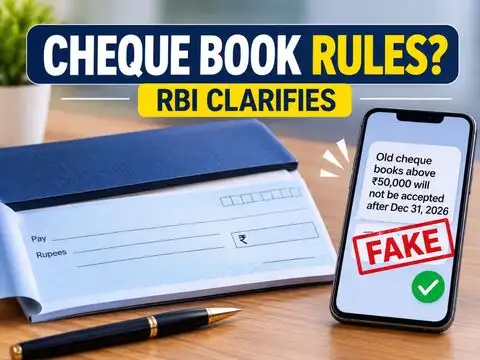
A message is making the rounds on WhatsApp and other social media channels, claiming that the Reserve Bank of India (RBI) will implement new cheque book rules from January 1, 2027. The message claims that the current Cheque Truncation System (CTS) cheque books will not be valid after January 1, 2027, and banks will issue new cheque books with better security options.
However, the claim is false. The Press Information Bureau (PIB), through its Fact Check Team handle, has clarified that the RBI has made no such announcement.
The central bank has also cautioned people against believing or forwarding unverified messages
However, the claim is false. The Press Information Bureau (PIB), through its Fact Check Team handle, has clarified that the RBI has made no such announcement.
The central bank has also cautioned people against believing or forwarding unverified messages

2/6
What did the RBI say about the viral cheque book message?
The RBI has clarified that it had come to its notice that a message was circulating on social media claiming that the standard CTS cheque books currently in use would change from December 31, 2026.
The message further claims that new cheque books with updated security features will be introduced from January 1, 2027
The message further claims that new cheque books with updated security features will be introduced from January 1, 2027
3/6
RBI says viral WhatsApp message is fake
The RBI has not issued any such notification or announcement. Therefore, customers do not need to replace their existing cheque books based on this viral message.
The PIB Fact Check team has also labelled the claim as fake and advised people to verify such information through official sources before sharing it.
The PIB Fact Check team has also labelled the claim as fake and advised people to verify such information through official sources before sharing it.

4/6
What is cheque truncation?
Cheque truncation means stopping the flow of a physical cheque during the course of a clearing cycle, immediately on generation of an electronic image for transmission. In the extant Cheque Truncation System (CTS) of India, physical cheques are truncated by the presenting bank.

5/6
Benefits of cheque truncation
Cheque truncation thus obviates the need to move physical instruments across bank branches for clearing purposes, other than in exceptional circumstances. This effectively eliminates the associated cost of movement of physical cheques, enables automation of clearing processes and reduces the time required for their collection.

6/6
Which precautions should you take while writing cheques?
There are three images of each cheque that are taken in CTS – front gray scale, front black and white and back black and white. Customers should use image-friendly coloured ink to write cheques to facilitate clear image of written information.
Further, customers should use permanent ink to prevent fraudulent alternation of contents later.
However, the Reserve Bank of India (RBI) has not prescribed specific ink colours to be used to write cheques.
Further, customers should use permanent ink to prevent fraudulent alternation of contents later.
However, the Reserve Bank of India (RBI) has not prescribed specific ink colours to be used to write cheques.