
8th Pay Commission: Will fitment factor or a higher annual increment give a bigger salary hike on Rs 30,000–Rs 40,000 basic pay?

1/7
8th Pay Commission: What are employees demanding on annual increments?
Employee and pensioner bodies have recommended increasing the annual increment rate from the current 3% to 5%-7% under the 8th Pay Commission.
The All India New Pension Scheme Employees’ Federation (AINPSEF) has recommended a 7% annual increment. The National Council of the Joint Consultative Machinery (NC-JCM), All India Defence Employees Federation (AIDEF) and Federation of National Postal Organisations (FNPO) have sought 6%, while the Indian Railways Technical Supervisors Association (IRTSA) has proposed 5% along with a fitment factor of up to 4.0.
The All India New Pension Scheme Employees’ Federation (AINPSEF) has recommended a 7% annual increment. The National Council of the Joint Consultative Machinery (NC-JCM), All India Defence Employees Federation (AIDEF) and Federation of National Postal Organisations (FNPO) have sought 6%, while the Indian Railways Technical Supervisors Association (IRTSA) has proposed 5% along with a fitment factor of up to 4.0.

2/7
Why do employee bodies want a higher annual increment?
According to Manjeet Singh Patel, President of AINPSEF, under the current system, applying a fitment factor along with a 3% annual increment and DA means an employee's salary may take around 10 years to substantially increase.
AINPSEF recommends a 7% increment rate, which Patel says could help an employee's salary double in around 6-7 years. Employee associations argue that a higher increment could provide employees with more substantial salary increases without having to wait for another Pay Commission.
AINPSEF recommends a 7% increment rate, which Patel says could help an employee's salary double in around 6-7 years. Employee associations argue that a higher increment could provide employees with more substantial salary increases without having to wait for another Pay Commission.

3/7
8th Pay Commission salary calculation: Fitment factor vs higher increment
To compare the two approaches, we estimate salary growth under four scenarios:
● 2.15 fitment factor + 3% annual increment
● No fitment factor + 5% annual increment
● No fitment factor + 7% annual increment
● No fitment factor + 10% annual increment
The calculations have taken into consideration employees with basic pay between Rs 30,000 and Rs 40,000 under the 7th Pay Commission.
● 2.15 fitment factor + 3% annual increment
● No fitment factor + 5% annual increment
● No fitment factor + 7% annual increment
● No fitment factor + 10% annual increment
The calculations have taken into consideration employees with basic pay between Rs 30,000 and Rs 40,000 under the 7th Pay Commission.
Amazon Top Deals
POWERED BY

Crompton Ozone 75 Litres Desert Air Cooler for home | Large & Easy Clean Ice Chamber | 4-Way Air Deflection | High Density Honeycomb Pads | Everlast Pump | Auto Fill| 3 Year Brand Warranty
₹9,798Buy Now43%
OFF

LG 32 L Convection Microwave Oven (MC3286BRUM, Black, 360° Motorised Rotisserie for Bar-be-queing, 301 Auto Cook Menu, Stainless steel cavity, Indian Cuisine, Tandoor Se, Steam Clean & Diet Fry)
₹19,090Buy Now20%
OFF
4/7
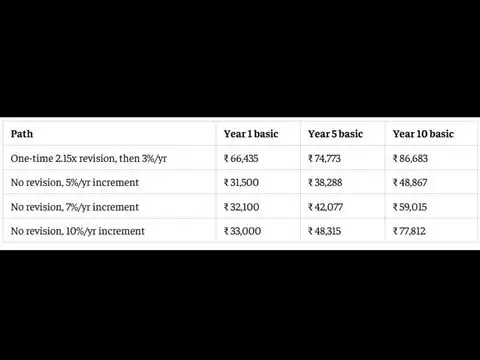
Rs 30,000 basic pay: Fitment factor vs higher annual increment
What happens to salary when an employee earning Rs 30,000 basic pay is given a 2.15 fitment factor with a 3% annual increment, compared with scenarios where there is no one-time revision based on a fitment factor but the rate of annual increment is higher?
5/7
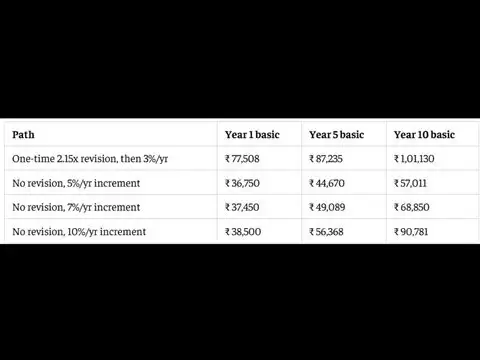
Rs 35,000 basic pay: Which option gives higher salary growth?
For an employee with Rs 35,000 basic pay, compare salary growth under a one-time revision at 2.15 fitment factor + 3% increment against basic pays at higher annual increment rates of 5%, 7% and 10%, respectively, without the boost of a fitment facto
6/7
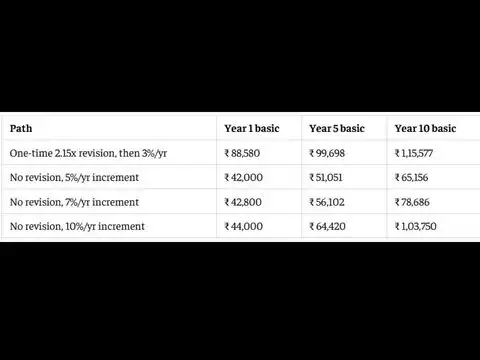
Rs 40,000 basic pay: Does a higher increment beat the fitment factor?
The same comparison is made for an employee earning Rs 40,000 basic pay. The calculation shows how salary could evolve under a 2.15 fitment factor with a 3% increment versus higher annual increment rates without a fitment factor.

7/7
8th Pay Commission salary: Which matters more, fitment factor or increment?
A fitment factor provides an immediate increase in basic pay, while a much higher annual increment can compound the salary increase over subsequent years to a certain extent. However, these are only estimates. The actual revised salaries of central government employees will be known only after the 8th Pay Commission decides on the fitment factor and annual increment rate.
READ MORE:
8th Pay Commission |8th Pay Commission salary |8th Pay Commission salary hike |8th Pay Commission annual increment |8th Pay Commission fitment factor |8th Pay Commission latest news |8th Pay Commission salary calculation |8th Pay Commission increment rate |8th Pay Commission employee demands |8th Pay Commission pay hike