
8th Pay Commission salary hike demands: Rs 69,000 minimum pay, 6% annual increment, higher HRA proposed
1/7
8th CPC: Salary, pension and leave proposals explained
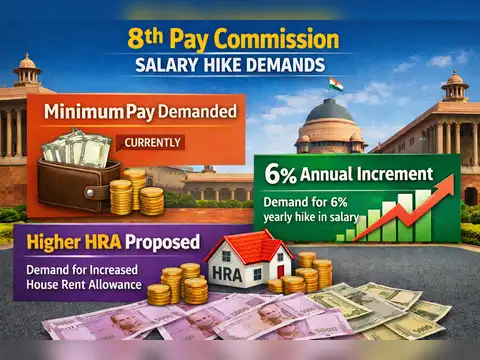
In its final memorandum submitted to the 8th CPC on Monday, April 13, 2026, the drafting committee of the National Council (Joint Consultative Machinery), or NC-JCM, they umbrella central government employee body in India, made several demands related to the 8th Pay Commission. These demands include a minimum pay of Rs 69,000, a fitment factor of 3.83, an annual increment of 6%, the restoration of Old Pension Scheme and an increase in the minimum house rent allowance (HRA) slab to 30%.
2/7
8th Pay Commission-related demands
One of the NC-JCM drafting committee members, C Srikumar, told ET Wealth Online that the 8th CPC's demand for a minimum basic pay of Rs 69,000 is justified because the current system of treating a family as three units should be abandoned and the family should be treated as five units. Here are the key 8th Pay Commission-related demands raised by the drafting committee of NC-JCM in its common memorandum.

3/7
8th Pay Commission key demands: Salary & pay-related benefits
Compassionate appointment: 100% eligibility
Date of implementation: All benefits effective January 1, 2026
Minimum pay: Rs 69,000 (for a family of 5 units)
Fitment factor: 3.833 for existing employees and pensioners
Annual increment: 6% of basic pay
Minimum five timescale promotions/financial upgradation/ACP in 30 years of service
30 days of minimum bonus guaranteed on the actual basic pay and DA
HRA slabs: 40% for X-category cities, 35% for Y-category cities, 30% for Z-category cities(linked with DA rise)
One-month wages as gratuity with no ceiling limit (maximum 33 years' of service)
Date of implementation: All benefits effective January 1, 2026
Minimum pay: Rs 69,000 (for a family of 5 units)
Fitment factor: 3.833 for existing employees and pensioners
Annual increment: 6% of basic pay
Minimum five timescale promotions/financial upgradation/ACP in 30 years of service
30 days of minimum bonus guaranteed on the actual basic pay and DA
HRA slabs: 40% for X-category cities, 35% for Y-category cities, 30% for Z-category cities(linked with DA rise)
One-month wages as gratuity with no ceiling limit (maximum 33 years' of service)
Amazon Top Deals
POWERED BY


4/7
8th Pay Commission key demands: Leave and work-life benefits
Accumulation of Earned Leave (EL) without any limit
EL encashment: Up to 600 days20 days EL encashment on LTC
Paternity leave: 45 days
Parent care leave: 60 days during entire service
Maternity leave: Increased to 240 days without 2-children restriction
EL encashment: Up to 600 days20 days EL encashment on LTC
Paternity leave: 45 days
Parent care leave: 60 days during entire service
Maternity leave: Increased to 240 days without 2-children restriction

5/7
8th Pay Commission key demands: Pension & retirement benefits
Restoration of Old Pension Scheme (OPS) for employees recruited on or after January 1, 2004
Pension: 67% of last pay drawn
Family pension: 50%
Commutation of pension: To be restored after 11 years
GPF facility: For NPS and UPS employees till OPS restoration
One Rank One Pension (OROP): For civilian employees
Insurance & compensation benefits: Rs 2 crore compensation for employees dying in accidents while on duty. Group Insurance: Group ‘C’: Rs 1 crore. Group ‘B’: Rs 1.5 crore
Pension: 67% of last pay drawn
Family pension: 50%
Commutation of pension: To be restored after 11 years
GPF facility: For NPS and UPS employees till OPS restoration
One Rank One Pension (OROP): For civilian employees
Insurance & compensation benefits: Rs 2 crore compensation for employees dying in accidents while on duty. Group Insurance: Group ‘C’: Rs 1 crore. Group ‘B’: Rs 1.5 crore

6/7
Proposed pay scale for 8th Pay Commission by NC-JCM drafting committee
Pay scale-1 (Level 1)
Existing pay matrix (7th CPC): Rs 18,000–Rs 56,900
Proposed minimum pay (fitment factor 3.833): Rs 69,000
Pay scale-2 (After merging Level 2 & 3)
Existing pay matrix (7th CPC): Rs 21,700–Rs 69,100
Proposed minimum pay: Rs 83,200
Pay scale-3 (After merging Level 4 & 5)
Existing pay matrix (7th CPC): Rs 29,200–Rs 92,300
Proposed minimum pay: Rs 1,12,000
Pay scale-4 (existing Level 6)
Existing pay matrix (7th CPC): Rs 35,400–Rs 1,12,400
Proposed minimum pay: Rs 1,35,700
Pay scale-5 (after merging Level 7 & 8)
Existing pay matrix (7th CPC): Rs 44,900–Rs 1,42,400
Proposed minimum pay: Rs 1,72,100
Pay scale-6 (after merging Level 9 & 10)
Existing pay matrix (7th CPC): Rs 53,100–Rs 1,67,800
Proposed minimum pay: Rs 2,03,500
Levels 11–17 renumbered to pay scale 7–13
Fitment factor: 3.833 applicable
Existing pay matrix (7th CPC): Rs 18,000–Rs 56,900
Proposed minimum pay (fitment factor 3.833): Rs 69,000
Pay scale-2 (After merging Level 2 & 3)
Existing pay matrix (7th CPC): Rs 21,700–Rs 69,100
Proposed minimum pay: Rs 83,200
Pay scale-3 (After merging Level 4 & 5)
Existing pay matrix (7th CPC): Rs 29,200–Rs 92,300
Proposed minimum pay: Rs 1,12,000
Pay scale-4 (existing Level 6)
Existing pay matrix (7th CPC): Rs 35,400–Rs 1,12,400
Proposed minimum pay: Rs 1,35,700
Pay scale-5 (after merging Level 7 & 8)
Existing pay matrix (7th CPC): Rs 44,900–Rs 1,42,400
Proposed minimum pay: Rs 1,72,100
Pay scale-6 (after merging Level 9 & 10)
Existing pay matrix (7th CPC): Rs 53,100–Rs 1,67,800
Proposed minimum pay: Rs 2,03,500
Levels 11–17 renumbered to pay scale 7–13
Fitment factor: 3.833 applicable
7/7
8th pay commission implementation date
The government is yet to announce the date from which recommendations of the 8th Pay Commission will be implemented. Looking at past trends, recommendations of a new pay commission are implemented from the next day of the end of the term of the previous pay commission.
READ MORE:
8th Pay Commission salary pension leave proposals |8th CPC minimum pay 69000 fitment factor 3.83 |8th pay commission pension rules OPS restoration |government employees salary hike 8th CPC |8th pay commission HRA increase 30 percent |8th CPC leave rules maternity paternity EL encashment |proposed pay scale 8th pay commission India |8th pay commission latest updates 2026 India