
8th Pay Commission pension: Rs 45,000 minimum pension demand, 67% of last salary & OROP explained

1/8
8th Pay Commission: Why pensioners want minimum pension of Rs 45,000
The Bharat Pensioners’ Samaj (BPS), which claims to represent 10 lakh central government pensioners, has proposed a minimum monthly pension of Rs 45,000 under the 8th Pay Commission. This is five times the current minimum pension of Rs 9,000 under the 7th Pay Commission. But will the government agree to such a steep increase?

2/8
67% of last salary as pension: What employee bodies have demanded
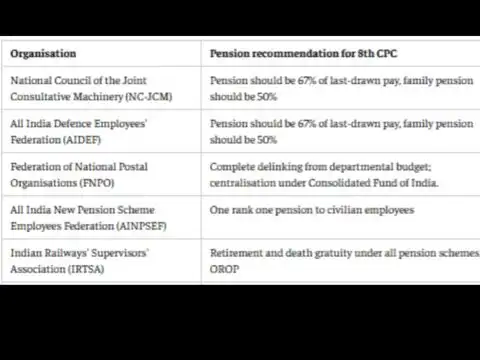
The National Council of the Joint Consultative Machinery (NC-JCM) has proposed that pension should be 67% of an employee’s last-drawn salary. It has also recommended family pension at 50%. The All India Defence Employees’ Federation (AIDEF) has made a similar proposal. These demands could significantly increase retirement payouts for central government pensioners.
3/8
8th Pay Commission pension calculation: How Rs 60,000 basic pay can become Rs 1.54 lakh
Consider an employee whose basic pay is Rs 60,000 under the 7th Pay Commission and last- drawn pay is Rs 1 lakh. Applying the proposed 3.833 fitment factor would increase basic pay to around Rs 2.30 lakh. If pension is fixed at 67% of this revised pay, the monthly pension could reach approximately Rs 1.54 lakh.

4/8
8th Pay Commission: What happens if pension remains 50% of last-drawn pay?
Even if the government retains the existing pension formula of 50% of last-drawn pay, the proposed 3.833 fitment factor could raise the pension to around Rs 1.15 lakh in this example. That is Rs 65,000 more than the existing Rs 50,000 pension. However, this is an illustration based on employee bodies' demands, not an approved pension calculation.
5/8
8th Pay Commission pension demands: What different organisations want
Apart from higher pensions, several employee and pensioner organisations have submitted other proposals.

6/8
One Rank One Pension for central government employees: What it means
One Rank One Pension (OROP) means employees retiring at different times from the same rank or designation receive equal pensions. Several employee and pensioner organisations want this system extended to civilian central government employees. The government introduced OROP for the armed forces in 2014. Extending it to all central government pensioners, however, could significantly increase pension expenditure.

7/8
Why implementing OROP for all pensioners could be expensive
Central government pensioners already outnumber serving employees. There are around 69 lakh central government pensioners compared with 58 lakh employees. Extending OROP to all pensioners could substantially increase the government's pension bill. This makes the proposal a major financial consideration for the 8th Pay Commission, even as pensioners seek equal treatment across retirement years.

8/8
8th Pay Commission minimum pension: Can Rs 9,000 really become Rs 45,000?
A fivefold increase in minimum pension appears unlikely. Under the 7th Pay Commission, the minimum pension increased to Rs 9,000 after applying a 2.57 fitment factor. Experts believe the 8th Pay Commission's fitment factor could be around 2.50 at most. If applied, the minimum pension could rise to Rs 22,500, rather than Rs 45,000. The final amount will depend on the government's decision after the commission submits its recommendations.
READ MORE:
8th Pay Commission pension |8th Pay Commission minimum pension |8th Pay Commission pension hike |8th Pay Commission pension news |8th Pay Commission pensioners demands |8th Pay Commission fitment factor |8th Pay Commission salary hike |8th Pay Commission pension calculation |Minimum pension for central government pensioners |Central government pension hike 2026