
8th Pay Commission pension calculator: ₹6.72 lakh more? See how 11-year commutation could change pension benefits

1/8
8th Pay Commission pension: Why could 15-year commutation become 11 years?
Central government pensioners can commute up to 40% of basic pension as a lump sum at retirement. The commuted portion is then deducted from monthly pension and restored after 15 years. Several employee and pensioner organisations want this period reduced to 10–12 years, arguing that the existing 15-year rule was based on financial and actuarial conditions from decades ago.
2/8
Pension commutation rules: What restoration period are employee bodies seeking?
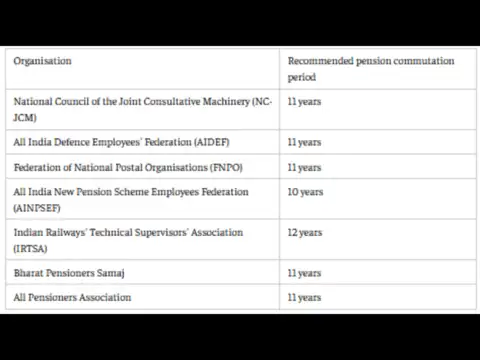
Most organisations have sought an 11-year restoration period. NC-JCM, AIDEF, FNPO, Bharat Pensioners Samaj and All Pensioners Association have recommended 11 years. AINPSEF wants 10 years, while IRTSA has proposed 12 years. Their recommendations are based on the argument that interest rates, life expectancy, mortality and actuarial risk factors have changed substantially since the existing framework was introduced.
3/8
Pension commutation calculator: How much does a pensioner receive upfront?
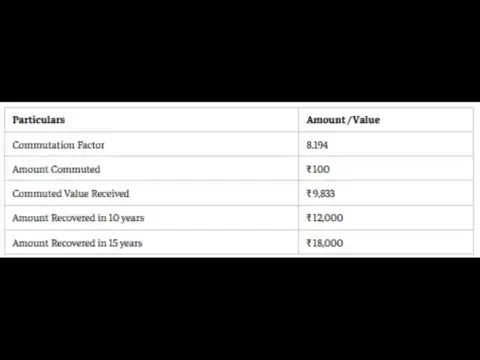
NC-JCM's estimate considers a pensioner aged 61 who commutes ₹100 a month, or ₹1,200 annually. Using a commutation factor of 8.194, the pensioner receives a lump sum of ₹9,833. However, the monthly pension reduction continues after retirement. At ₹1,200 a year, the total amount deducted reaches ₹12,000 in 10 years and ₹18,000 in 15 years.
Amazon Top Deals
POWERED BY

Crompton Ozone 75 Litres Desert Air Cooler for home | Large & Easy Clean Ice Chamber | 4-Way Air Deflection | High Density Honeycomb Pads | Everlast Pump | Auto Fill| 3 Year Brand Warranty
₹9,798Buy Now43%
OFF

LG 32 L Convection Microwave Oven (MC3286BRUM, Black, 360° Motorised Rotisserie for Bar-be-queing, 301 Auto Cook Menu, Stainless steel cavity, Indian Cuisine, Tandoor Se, Steam Clean & Diet Fry)
₹19,090Buy Now20%
OFF

4/8
8th Pay Commission pension restoration: Why NC-JCM says 11 years is reasonable
NC-JCM argues that, under its illustration, the commuted value is effectively recovered through pension deductions in about 10 years. Continuing the deduction beyond that point, it says, results in excess recovery from pensioners. Based on this calculation, the organisation has recommended that commuted pension should be restored after 11 years rather than the existing 15-year period.
5/8
Pension commutation rules: Why BPS says the 15-year period needs review
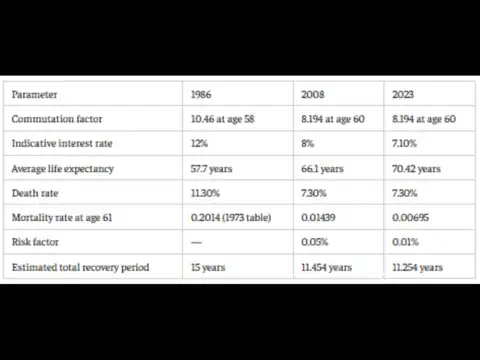
Bharat Pensioners Samaj says the 15-year restoration framework was introduced in 1986 using the conditions prevailing then. Its comparison shows indicative interest rates falling from 12% in 1986 to 7.10% in 2023, while average life expectancy rose from 57.7 years to 70.42 years. BPS says these changes justify reviewing the assumptions behind the current restoration period.
6/8
₹35,000 pension calculator: How much could an 11-year rule change?
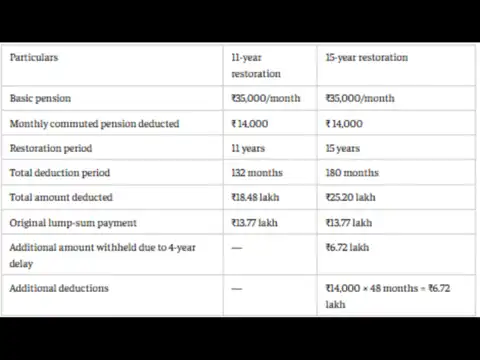
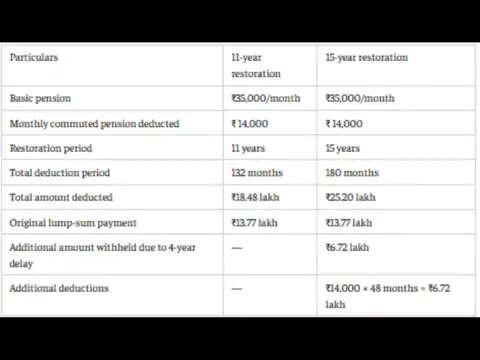
In its illustration, BPS has calculated the potential impact using a pensioner with a ₹35,000 monthly basic pension. If ₹14,000 is commuted every month, an 11-year restoration period would mean 132 months of deductions, totalling ₹18.48 lakh. Under the existing 15-year period, deductions continue for 180 months, taking the total to ₹25.20 lakh.
7/8
₹6.72 lakh pension benefit: How does the additional amount arise?
In the ₹35,000 pension example, the difference between 11 and 15 years is 48 months of additional deductions. At ₹14,000 a month, this works out to ₹6.72 lakh. BPS therefore claims that reducing the restoration period to 11 years could leave the pensioner with ₹6.72 lakh more over those four years, compared with continuing the deduction for 15 years.

8/8
8th Pay Commission pension update: Is the 15-year rule changing?
The shorter restoration period is currently a demand from employee and pensioner organisations, not an approved change. Nearly all leading associations have urged the government to review Rule 10A of the Central Civil Services (Commutation of Pension) Rules, 1981 and update the commutation tables using current actuarial, demographic and financial data. The final decision will depend on the 8th Pay Commission and government.