
8th Pay Commission Lucknow meeting schedule revealed: Last date to apply for June 22-23 meetings

1/5
8th Pay Commission to visit Lucknow in June
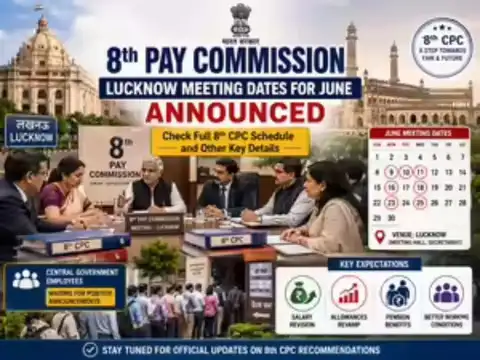
The Eighth Central Pay Commission (8th CPC) will visit Lucknow, Uttar Pradesh, on June 22 and 23, 2026. During the visit, the Commission will interact with stakeholders, including central government organisations, institutions, employee unions and associations.
2/5
How stakeholders can seek 8th CPC appointment
Stakeholders interested in meeting 8th Pay Commission officials during its Lucknow visit can apply online. Appointment requests must be submitted through the designated link available on the official 8th CPC website. The last date to apply is June 10, 2026.
Applicants are also required to submit the unique memo ID generated after filing their memorandum on the official 8th Central Pay Commission portal.
Applicants are also required to submit the unique memo ID generated after filing their memorandum on the official 8th Central Pay Commission portal.
3/5
Who can apply for Lucknow meetings with the 8th Pay Commission?
The notice said that central government organisations, institutions, unions and associations based in Uttar Pradesh and interested in interacting with the Commission during its visit may apply for appointments.
Venue details and the final meeting schedule will be shared later with the selected stakeholders, the 8th CPC said in its statement.
Venue details and the final meeting schedule will be shared later with the selected stakeholders, the 8th CPC said in its statement.
Amazon Top Deals
POWERED BY


4/5
8th CPC meeting schedule for June 2026
The Eighth Central Pay Commission will visit Srinagar, Jammu and Kashmir from June 1 to June 4 2026, to interact with stakeholders.
The Eighth Central Pay Commission will visit the Union Territory of Ladakh on June 8, 2026.
The Eighth Central Pay Commission will visit the Union Territory of Ladakh on June 8, 2026.

5/5
Which factors will the 8th Pay Commission consider while making its recommendations?
The 8th Pay Commission has been asked to make recommendations while keeping in view:
Economic conditions in the country and the need for fiscal prudence.
The need to ensure adequate resources for developmental expenditure and welfare measures.
The unfunded cost of non-contributory pension schemes.
The likely impact of its recommendations on the finances of state governments, which generally adopt recommendations with some modifications.
The existing salary structure, benefits and working conditions of employees in Central Public Sector Undertakings (CPSUs) and the private sector.
READ MORE:
8th Pay Commission Lucknow visit June 2026 |8th CPC Lucknow meeting schedule |8th Pay Commission stakeholder meeting |8th CPC employee unions appointment process |8th Pay Commission June 2026 updates |8th CPC official website appointment link |8th Pay Commission Uttar Pradesh visit |Central government employees 8th CPC |8th Pay Commission salary revision news