
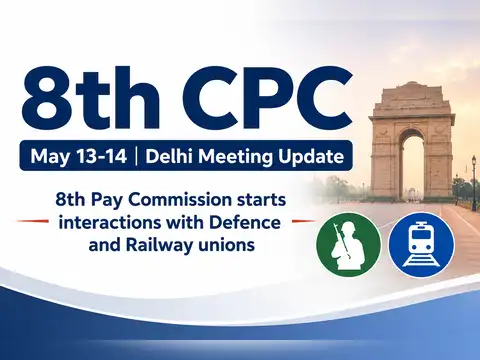
8th CPC May 13-14 Delhi meeting update: 8th Pay Commission starts interactions with Defence and Railway unions
1/5
8th CPC Delhi Meeting
8th CPC meets Defence and Railway unions in Delhi
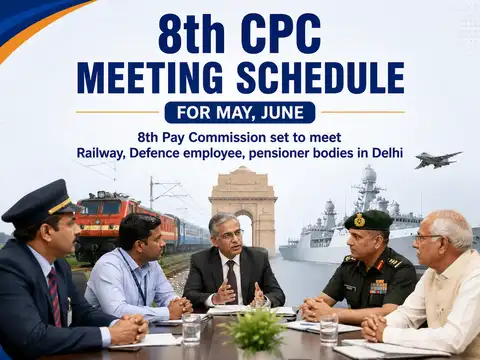
The 8th Central Pay Commission (8th CPC) is holding meetings with institutions, organisations, unions and associations related to the Ministry of Defence (MoD) and the Ministry of Railways (MoR) in Delhi today on May 13, 2026. The meetings will continue on May 14.
The 8th Central Pay Commission (8th CPC) is holding meetings with institutions, organisations, unions and associations related to the Ministry of Defence (MoD) and the Ministry of Railways (MoR) in Delhi today on May 13, 2026. The meetings will continue on May 14.
2/5
Why are 8th CPC meetings important?
Pay Commission begins stakeholder consultations
*The Commission is interacting with Defence Forces and Railway representative
*Discussions are part of the process before finalising salary and pension recommendations
*Issues related to pay, pensions, allowances and service conditions are expected to be discussed
*The Commission is interacting with Defence Forces and Railway representative
*Discussions are part of the process before finalising salary and pension recommendations
*Issues related to pay, pensions, allowances and service conditions are expected to be discussed

3/5
8th CPC appointment process for stakeholders
Stakeholders had to apply by May 10
*Unions and associations were required to submit appointment requests online by May 10, 2026
*Applicants also needed to submit the unique ‘Memo ID’ generated after filing their respective memorandums
*Meeting venue and timing were communicated separately
*Unions and associations were required to submit appointment requests online by May 10, 2026
*Applicants also needed to submit the unique ‘Memo ID’ generated after filing their respective memorandums
*Meeting venue and timing were communicated separately
Amazon Top Deals
POWERED BY


4/5
When will the 8th CPC recommendation report be submitted?
The 8th Pay Commission has an 18-month deadline for recommendation report submission.
*The government has asked the Commission to submit its report within 18 months of the release of terms of reference (ToR)
*The Commission may also submit an interim report if the submission of the recommendation report is delayed
*Employees and pensioners are closely tracking possible revisions in salaries and pensions
*The government has asked the Commission to submit its report within 18 months of the release of terms of reference (ToR)
*The Commission may also submit an interim report if the submission of the recommendation report is delayed
*Employees and pensioners are closely tracking possible revisions in salaries and pensions

5/5
Key factors before the 8th Pay Commission
What the 8th Pay Commission will consider while preparing its report
*India’s economic condition and fiscal discipline
*Availability of funds for welfare and development spending
*Financial burden of pension schemes
*Impact on state government finances
*Existing pay structures in CPSUs and the private sector
*Service conditions and employee benefits across sectors
*India’s economic condition and fiscal discipline
*Availability of funds for welfare and development spending
*Financial burden of pension schemes
*Impact on state government finances
*Existing pay structures in CPSUs and the private sector
*Service conditions and employee benefits across sectors