
8 things happening to your money now & what every middle-class Indian must do before economy gets worse
1/8
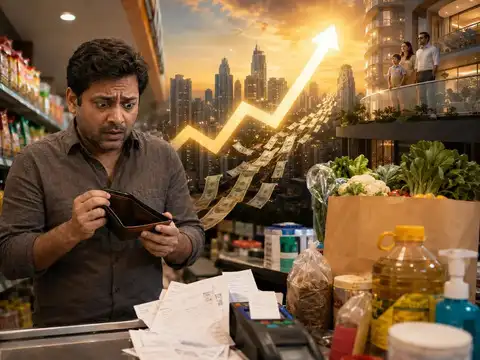
India is growing at 7.7%. So why does your wallet feel empty?
GDP measures what the nation produces, not what you earn, spend, or save. When the top tier captures most of the growth, strong macro numbers and weak household finances can exist at the same time.
7.7%
Real GDP growth rate
5.1%
CPI inflation forecast
41%
Household debt as % of GDP
These 3 numbers together explain why the economy looks good on paper but feels tight at home. So what you can do?
7.7%
Real GDP growth rate
5.1%
CPI inflation forecast
41%
Household debt as % of GDP
These 3 numbers together explain why the economy looks good on paper but feels tight at home. So what you can do?
2/8
Inflation isn't just a statistic. It's a silent tax on your salary.
The RBI's own forecast puts CPI at 5.1%, well above its 4% target. Meanwhile the Wholesale Price Index (what producers pay) is seen at 8.3%. That gap means costs are building up in the pipeline and will reach you.
RBI target
4.0%
CPI (retail forecast)
5.1%
WPI (wholesale forecast)
8.3%
What this means for you
If your salary grew 5% this year and inflation is 5.1%, your real purchasing power actually shrank. You earned more and bought less.
RBI target
4.0%
CPI (retail forecast)
5.1%
WPI (wholesale forecast)
8.3%
What this means for you
If your salary grew 5% this year and inflation is 5.1%, your real purchasing power actually shrank. You earned more and bought less.
3/8
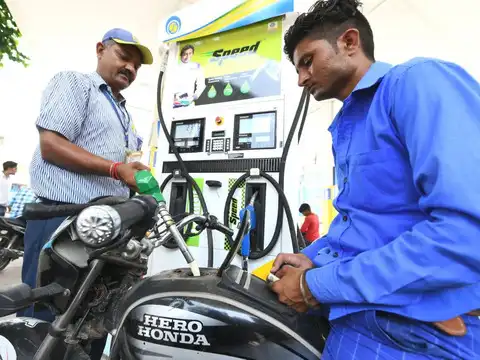
A war in West Asia raised your petrol price by ₹7.5 per litre
Geopolitical tensions pushed India's crude oil import assumption from $85 to $95/barrel, with spot prices hitting $110. Fuel costs flow into everything, your cab fare, your grocery delivery, the vegetable vendor's transport, before they even reach the pump.
Crude at $110/barrel: India imports ~85% of its oil, so global prices hit us directly.
Retail fuel up ₹7.5/litre: Transport costs rise; logistics firms pass it on to every product you buy.
A weaker rupee makes it worse: Oil is priced in dollars. When the rupee falls, every barrel costs more even if global prices stay flat.
Personal finance move
Audit your transport spend and subscription costs now. Inflation compounds. Lock in annual plans before they reprice.
Crude at $110/barrel: India imports ~85% of its oil, so global prices hit us directly.
Retail fuel up ₹7.5/litre: Transport costs rise; logistics firms pass it on to every product you buy.
A weaker rupee makes it worse: Oil is priced in dollars. When the rupee falls, every barrel costs more even if global prices stay flat.
Personal finance move
Audit your transport spend and subscription costs now. Inflation compounds. Lock in annual plans before they reprice.
Amazon Top Deals
POWERED BY

Crompton Ozone 75 Litres Desert Air Cooler for home | Large & Easy Clean Ice Chamber | 4-Way Air Deflection | High Density Honeycomb Pads | Everlast Pump | Auto Fill| 3 Year Brand Warranty
₹9,798Buy Now43%
OFF

LG 32 L Convection Microwave Oven (MC3286BRUM, Black, 360° Motorised Rotisserie for Bar-be-queing, 301 Auto Cook Menu, Stainless steel cavity, Indian Cuisine, Tandoor Se, Steam Clean & Diet Fry)
₹19,340Buy Now19%
OFF
4/8
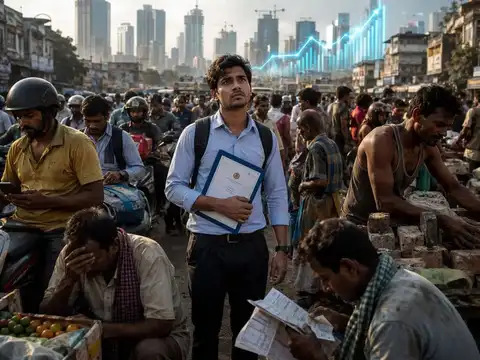
56 crore people are "employed." Most of them aren't earning a real wage.
The official unemployment rate is 5.2%, which sounds fine. But peel back the data: a huge share of those "employed" are unpaid family workers or own-account workers with no fixed income.
Labour force participation fell to 55%
Millions of discouraged workers, especially youth and women, have stopped looking for jobs entirely.
Informal sector = 80% of workforce
Four in five Indian workers are in the informal economy; no salary slip, no PF, no job security, no wage growth.
Educated youth hit hardest
Degrees are outpacing formal white-collar jobs. High qualification + low opportunity = a generation carrying debt, not building wealth.
Labour force participation fell to 55%
Millions of discouraged workers, especially youth and women, have stopped looking for jobs entirely.
Informal sector = 80% of workforce
Four in five Indian workers are in the informal economy; no salary slip, no PF, no job security, no wage growth.
Educated youth hit hardest
Degrees are outpacing formal white-collar jobs. High qualification + low opportunity = a generation carrying debt, not building wealth.
5/8
The economy recovered in two directions. One went up. Yours may have gone sideways
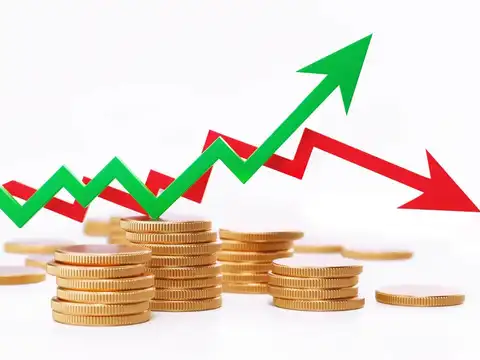
India's recovery from consecutive economic shocks followed a "K-shape"; asset owners (stocks, real estate) recovered sharply upward, while wage earners in the middle and lower rungs stagnated or declined.
Top of the K
Stock markets at record highs. Corporate profits strong. Real estate prices up. Asset owners thrived.
Bottom of the K
Discretionary spending cut back. Household debt rising. People saving defensively, not confidently.
What this means for your finances
If you rely only on a salary and have no assets, inflation erodes your position every year. Owning any income-producing asset — even a small SIP — starts moving you toward the upper arm of the K.
Top of the K
Stock markets at record highs. Corporate profits strong. Real estate prices up. Asset owners thrived.
Bottom of the K
Discretionary spending cut back. Household debt rising. People saving defensively, not confidently.
What this means for your finances
If you rely only on a salary and have no assets, inflation erodes your position every year. Owning any income-producing asset — even a small SIP — starts moving you toward the upper arm of the K.
6/8
Household debt hit 41% of GDP. Borrowing to survive is a wealth destroyer.
When wages don't grow but costs do, families borrow to fill the gap -credit cards, personal loans, BNPL. This spending feels normal until the interest compounds.
Cost of a credit card balance: At 36–42% annual interest, a ₹50,000 balance costs you ₹18,000–₹21,000 per year just in interest.
Net household financial savings are falling: This means families are not just borrowing more — they're saving less at the same time.
The exit strategy: List every debt by interest rate. Attack the highest rate first. Even ₹2,000 extra/month toward a credit card saves more than investing that same amount.
Cost of a credit card balance: At 36–42% annual interest, a ₹50,000 balance costs you ₹18,000–₹21,000 per year just in interest.
Net household financial savings are falling: This means families are not just borrowing more — they're saving less at the same time.
The exit strategy: List every debt by interest rate. Attack the highest rate first. Even ₹2,000 extra/month toward a credit card saves more than investing that same amount.
7/8
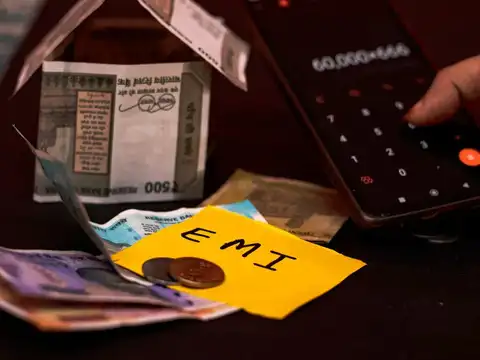
The RBI held rates at 5.25%. What that means for your EMIs and savings.
The central bank didn't raise rates because inflation is supply-driven (oil, weather), not demand-driven. Raising rates wouldn't fix an oil shock, but it would hurt borrowers. So rates held. Here's how to read this for your own finances.
Home loan and car loan EMIs stay stable
No rate hike means floating rate borrowers get a breather. But don't use this to over-borrow, rates can move later.
Fixed deposits are decent but not great
At 6.5–7%, FDs barely beat 5.1% inflation after tax. They preserve capital but don't meaningfully grow it.
Inflation is your silent enemy right now
The RBI is choosing to let inflation run rather than choke growth. Your cash in a savings account earning 3% is losing real value every month.
Home loan and car loan EMIs stay stable
No rate hike means floating rate borrowers get a breather. But don't use this to over-borrow, rates can move later.
Fixed deposits are decent but not great
At 6.5–7%, FDs barely beat 5.1% inflation after tax. They preserve capital but don't meaningfully grow it.
Inflation is your silent enemy right now
The RBI is choosing to let inflation run rather than choke growth. Your cash in a savings account earning 3% is losing real value every month.
8/8
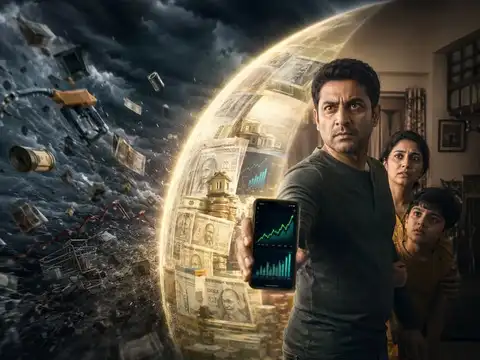
You can't fix the macro. But you can protect yourself from it.
When inflation outpaces wages and formal jobs are scarce, personal finance becomes a defensive sport. These five moves build a wall between macro instability and your household.
Track real inflation in your life: Your personal inflation rate (food, rent, school fees, fuel) likely exceeds 5.1%. Know your actual number.
Clear high-cost debt first: With no wage growth, a 36% credit card is guaranteed negative compounding on your wealth.
Beat inflation with equity: Index fund SIPs have historically returned 11–13%, far ahead of 5.1% CPI. Even ₹1,000/month matters.
Build income outside your salary: A K-shaped economy rewards asset owners. Start small: dividend stocks, a liquid fund, a skill monetised on the side.
Stay liquid: With global uncertainty high, keep 6 months of expenses accessible. Economic shocks are arriving faster than forecasts can track.
Track real inflation in your life: Your personal inflation rate (food, rent, school fees, fuel) likely exceeds 5.1%. Know your actual number.
Clear high-cost debt first: With no wage growth, a 36% credit card is guaranteed negative compounding on your wealth.
Beat inflation with equity: Index fund SIPs have historically returned 11–13%, far ahead of 5.1% CPI. Even ₹1,000/month matters.
Build income outside your salary: A K-shaped economy rewards asset owners. Start small: dividend stocks, a liquid fund, a skill monetised on the side.
Stay liquid: With global uncertainty high, keep 6 months of expenses accessible. Economic shocks are arriving faster than forecasts can track.