
NRIs returning to India: 5 tax checks to finish before you leave the US

1/10
Moving back to India? Your biggest tax mistake may happen before you board
Most NRI families think the tax work begins once they land in India. It doesn’t. The expensive decisions usually get made earlier: selling an investment, rolling over a 401(k), sending money home, or leaving a bank form untouched while you are still a US resident. None of these feel like mistakes at the time. They look perfectly normal from the American side and can carry a very different consequence on the Indian side. This slideshow walks you through what to sort out first.

2/10
Two countries, two different tests: who actually calls you a tax resident?
Before you sell, withdraw or restructure anything, find out how each country sees you. The US looks at citizenship, immigration status and physical presence. A green card holder stays a US tax resident as long as the card is held. An H-1B holder who has been in the US for years can also be treated as a resident under the substantial presence test. So “I’ll stop being a resident the day I fly” is not a plan. India has its own rules, with three outcomes: non-resident, resident but not ordinarily resident (RNOR), or resident and ordinarily resident (ROR). In the year you move, both countries can claim you at once, which is exactly the situation the tax treaty is meant to settle.

3/10
The RNOR window: Your cheapest period to restructure
RNOR is a temporary status, and it can last one, two or three years depending on your history. During this period, India treats certain foreign income and foreign assets differently from the way it will once you become ROR. Think of it as a planning window, not a formality. Before you start moving money, know four things: your likely residency status, how long RNOR will last, what changes when you become ROR, and which moves belong inside the window. Many families spend the window closing accounts, only to find that what mattered was how the accounts were held, not whether they existed.

4/10
The $60,000 number that is missing from your moving checklist
Here is the one that should worry you. A US citizen gets an estate tax exclusion of $15,000,000 in 2026. A non-resident who is not a US citizen is taxed on US-situated assets, and a US estate tax return is needed once those assets cross just $60,000. Tax above that can go up to 40% and is generally due within nine months of death. US real estate and shares in US companies are the classic assets caught by this. Some bank deposits and life insurance proceeds may be excluded, so not every US account is hit. But if you are keeping a US home, a brokerage account or a big stock holding, the gap between $15 million and $60,000 is the whole problem. Some of this planning has to happen while you are still in the US.

5/10
“I already paid tax in the US” does not mean India is off the hook
This is the most common wrong belief among returning NRIs. The India-US tax treaty, known as the DTAA, does not work as a “paid once, done” shield. It decides which country gets to tax which type of income, and the rules differ for interest, capital gains, 401(k) withdrawals, Social Security and rental income. It also affects what is withheld at source and how you claim a foreign tax credit. So skip the question “which country taxes me?” and ask five better ones: what type of income is this, who has the taxing right, what is withheld, what must be reported in India, and can I claim a credit.

6/10
Your NRE and NRO accounts will not stay the same forever
Once your residential status changes, your NRE and NRO accounts have to be updated to resident accounts, because under FEMA you are now a resident. The same goes for your demat account and other holdings. This is a status change your bank is required to reflect, not an optional tidy-up. Do the same on the US side. Tell your banks and brokerages you have moved, because your tax residency has changed, withholding can change with it, and some account forms need updating. It is the least exciting part of the move and the one that causes the most avoidable trouble.

7/10
Fifteen years in the US leaves a long list to report in India
Once you become ROR, your foreign assets and foreign income can create extra reporting in India. Think about what a long US career leaves behind: a 401(k), an IRA, bank accounts, a brokerage account, maybe a house. Many returning families have never had to report any of this in India before. If reporting is missed or done wrongly, the consequence can be separate from the tax you owe. So don’t treat compliance as paperwork. Treat it as part of your financial plan, and check the schedules in the Income Tax Department’s guidance before you file.
8/10
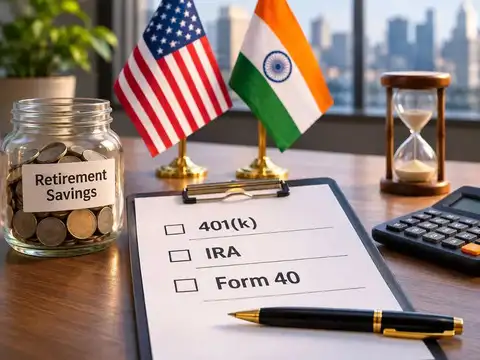
Got a 401(k) or IRA? Know these three form names
You can understand every rule and still lose the benefit by missing an election. For US retirement accounts, India has a specific relief under Section 89A of the 1961 Act, carried into Section 158 of the Income-tax Act 2025. It lets income from a specified foreign retirement account be taxed in the year you withdraw it, rather than every year as it builds up. You have to opt in using a prescribed form, which was Form 10-EE under the old rules and is now called Form 40 under the new Income-tax Rules, 2026, according to the explainer. The conditions depend on the account type, your residency and the timing, so don’t copy a friend’s approach. And since this election cannot be filed late, the deadline matters.

9/10
The one US form that decides how much tax is withheld on your income
After you stop being a US tax resident, your bank or brokerage will generally ask for Form W-8BEN. It tells them to apply the treaty rate on certain US-source income instead of the default withholding rate. Before you sign it, be clear on what you are declaring, what your tax status is, which withholding rate applies, whether the treaty covers that income, and what it means when you file in India. A form left unchanged can quietly cost you money for years.

10/10
Your pre-flight plan: four steps to take while you are still in the US
These five areas are really one decision. Residency sets your status in both countries, estate tax decides what happens to the assets you leave behind, the treaty decides who taxes what, compliance covers your accounts and reporting, and forms decide whether your plan actually works. So do this in order. First, work out your US and Indian residency positions and when each changes. Second, list the accounts and assets affected, including anything that counts as US property for estate tax. Third, finish whatever must be done while you are still a US resident, since those items have deadlines. Fourth, line up your forms and elections. And don’t fall for the shortcut of “I’ll hire someone to file my taxes after I move.” By then, a return can only report what has already happened.