
Need ₹8 lakh a year in retirement? Know the ideal withdrawal rate for your ₹2-crore corpus

1/7
Do you know your ideal withdrawal rate?
When it comes to retirement planning, we all keep reading about investment strategies on amassing a certain amount. This corpus, we believe, would last the golden years. But there’s hardly enough chatter about the ideal withdrawal amount.
Withdrawing too much from your retirement corpus could drain it quicker than you anticipate.
Withdrawing too much from your retirement corpus could drain it quicker than you anticipate.

2/7
Safe Withdrawal Rate (SWR) is the key
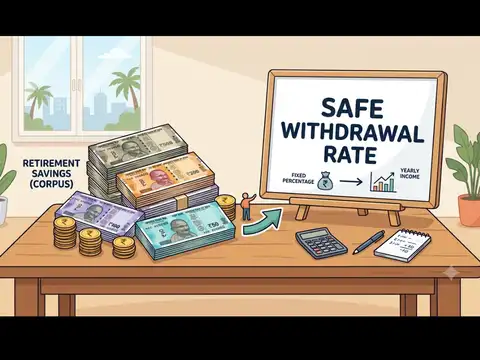
The key to understanding how much you can safely withdraw every month or year is SWR, short for Safe Withdrawal Rate.
It provides a framework for deciding how much you can withdraw from your retirement corpus each year without worrying about depleting your savings too soon.
It provides a framework for deciding how much you can withdraw from your retirement corpus each year without worrying about depleting your savings too soon.
3/7
What is SWR in retirement planning?
As explained above, it provides a guide to the ideal amount you may withdraw from your retirement corpus. To put it simply, the SWR is the percentage of your retirement corpus you withdraw in the first year of retirement.
In subsequent years, the withdrawal amount is adjusted for inflation.
For example, assume that you have retired with a Rs 1 crore retirement fund and following an SWR of 4%, you’d withdraw Rs 4 lakh the first year. The next year, assuming 5% inflation, you’d take out Rs 4.2 lakh, and so on.
In subsequent years, the withdrawal amount is adjusted for inflation.
For example, assume that you have retired with a Rs 1 crore retirement fund and following an SWR of 4%, you’d withdraw Rs 4 lakh the first year. The next year, assuming 5% inflation, you’d take out Rs 4.2 lakh, and so on.

4/7
SWR calculation: How much can you safely withdraw?
The SWR calculation formula is simple:
SWR = First-year withdrawal/Retirement corpus X 100
Here’s an illustration to understand this better:
Suppose you retire with a Rs 2 crore retirement corpus and need Rs 8 lakh a year to meet your expenses. Using the formula, the initial safe withdrawal rate for you will be 4%.
Therefore, you can withdraw Rs 8 lakh in the first year, which means around Rs 66,667 a month.
SWR = First-year withdrawal/Retirement corpus X 100
Here’s an illustration to understand this better:
Suppose you retire with a Rs 2 crore retirement corpus and need Rs 8 lakh a year to meet your expenses. Using the formula, the initial safe withdrawal rate for you will be 4%.
Therefore, you can withdraw Rs 8 lakh in the first year, which means around Rs 66,667 a month.

5/7
Is 4% the ideal SWR?
The 4% withdrawal rule is based on US market history and assumptions, so it should not be treated as a universal guarantee.
Every retiree’s lifestyle and asset allocation differs which would eventually determine their SWR.
For instance, a longer retirement, high inflation, healthcare uncertainties, investment costs etc. may require a lower starting rate.
Every retiree’s lifestyle and asset allocation differs which would eventually determine their SWR.
For instance, a longer retirement, high inflation, healthcare uncertainties, investment costs etc. may require a lower starting rate.

6/7
Is a lower SWR always better?
A lower SWR benefits by offering a larger cushion against market volatility and a longer lifespan, but needs a bigger initial corpus.
Let’s say someone is planning for a 30-year retirement with inflation-adjusted withdrawals. As per local financial studies, a safe withdrawal rate of 3-3.5% might prove better than 4%.
Let’s say someone is planning for a 30-year retirement with inflation-adjusted withdrawals. As per local financial studies, a safe withdrawal rate of 3-3.5% might prove better than 4%.

7/7
Can SWR help in calculating retirement corpus?
Yes! You may reverse the SWR calculation formula to arrive at the retirement corpus you would require. If you already know how much you would need every year to sustain your current lifestyle, you can use the following formula to decide how big a retirement fund you would need:
Retirement corpus = Annual retirement expenses/SWR X 100
For example, if you need Rs 12 lakh annually, you will have to create a retirement corpus of Rs 3 crore at a withdrawal rate of 4% while a fund of Rs 4 crore at a SWR of 3%.
Retirement corpus = Annual retirement expenses/SWR X 100
For example, if you need Rs 12 lakh annually, you will have to create a retirement corpus of Rs 3 crore at a withdrawal rate of 4% while a fund of Rs 4 crore at a SWR of 3%.