
Gift Deed vs Will in India: Which is better for passing your house to your children? Should you transfer it now?

1/9
Gift Deed or Will: Why wait to give your children their home?
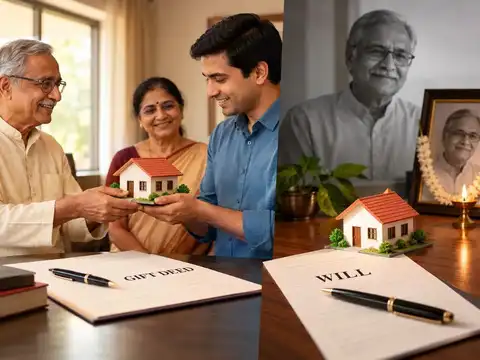
Many senior citizens ask the same question the moment a Will is drafted: if the family home is meant for the children anyway, why wait? A Will changes nothing until you are gone, while a gift deed passes the home to your child today. The two answer different priorities, settling matters early versus keeping control until the end. Cost, tax and your own security should decide which one fits you.
2/9
One moves your house today, the other only after you’re gone
A gift deed transfers ownership the moment it is registered, and your child must accept it while you are alive. The home leaves your name and becomes theirs in full, including the right to sell it without asking you. A registered gift deed is meant to be final, so undoing it is the exception, not the rule. A Will works differently. It takes effect only after your death, so until then the home stays entirely yours. You can rewrite or cancel it whenever you like, moving a property from one child to another, right up to your last day.

3/9
Good news: No income tax on a gift to your child
A gift of property from a parent to a child carries no income tax. A parent counts as a relative under Section 56(2)(x) of the Income Tax Act, and gifts between relatives are exempt whatever their value. You, the giver, also pay no capital gains tax, since the law does not treat a gift as a sale. With no buyer and no price, there is no gain to tax. The real cost of a gift deed lies elsewhere, in stamp duty and in what you give up.

4/9
Tax catch: Your child inherits your old purchase price
If your child sells the gifted home later, the capital gain is measured from the price you originally paid, not its value on the day of the gift. For transfers on or after 23 July 2024, long-term capital gains are generally taxed at 12.5% without indexation. There is a grandfathering relief for resident individuals and HUFs on land or buildings acquired before that date, so if you bought the home earlier, your child may be able to choose indexation at 20% instead. Which option works out cheaper depends on the numbers, so run both before selling.

5/9
Stamp duty: “Small” can still mean lakhs
Stamp duty on a gift to close relatives is often lower than on a sale deed, but rates differ sharply from state to state, and registration charges apply separately. Maharashtra charges as little as ₹200 on a gift to lineal ascendants or descendants. Delhi charges roughly 2% of the stamp duty value for blood relatives, which on a ₹1.2 crore flat works out to ₹2.4 lakh, plus a registration fee of about ₹1.2 lakh. Check your own state’s current rates before you plan the transfer.

6/9
The real price of gifting: Losing control
Once the deed is registered, the home legally belongs to your child. You cannot easily sell, mortgage or rent it out without their consent. A gifted house can also be exposed to your child’s creditors, lawsuits or divorce settlements, which could force a sale. Gifting also fixes the division among your children, while a Will lets you revisit it as their circumstances change. And a home signed over cannot later be sold to fund your own medical care, so make sure you keep enough set aside for yourself first.

7/9
Neglected after gifting? The law lets you take it back
Section 23 of the Maintenance and Welfare of Parents and Senior Citizens Act, 2007 allows a gift to be cancelled if your children fail to care for you. The claim goes before a Maintenance Tribunal, a quicker forum than a civil court, which can declare the gift deed void and restore the property to you. In January 2025, the Supreme Court reinforced this in Urmila Dixit v. Sunil Sharan Dixit. A mother had gifted her property to her son, who then neglected her, and the Court restored it to her. It held that the expectation of care is read into such a gift even if the deed does not spell it out. Still, relying on this means taking your own child to a tribunal, so prevention is better.

8/9
Two clauses that protect you after you gift
Add two safeguards to the gift deed. First, state plainly that your child will maintain and care for you, so the condition is on record rather than argued over later. Second, reserve your right to live in the home for the rest of your life, so ownership passes to your child while you keep a life interest. Together they let you hand over the home without handing over your own security and a place to live as you age. Note that a right of residence keeps a roof over your head but puts no cash in your hands.

9/9
Gift Deed, Will, or neither? Choose before the law chooses for you
A registered gift deed with a maintenance clause suits a parent who wants property settled within their own lifetime. A Will suits a parent who wants full control and every decision open until the end, and it costs nothing to make. Make neither, and the home passes under the ordinary law of succession. Your children will usually need a legal heir or succession certificate and then a mutation of the land records, which is the route that asks the most of them. A gift deed removes that step, and a registered Will gives them a clear basis to claim. Before deciding, weigh your future living costs, healthcare needs and the fairness among your children, and speak to an estate planning lawyer or qualified advisor who can weigh your property against your income, health and wider estate.
This is general information, not personalized legal or tax advice. Stamp duty, tax and succession rules vary by state and can change. Consult a qualified estate planning lawyer or advisor before gifting or willing a property.
This is general information, not personalized legal or tax advice. Stamp duty, tax and succession rules vary by state and can change. Consult a qualified estate planning lawyer or advisor before gifting or willing a property.