
Gift deed or relinquishment deed? The best way to transfer your land and avoid costly mistakes

1/9
Gift deed vs relinquishment deed: Which one actually saves you money?
If you want to transfer your share of inherited land to your sisters, picking the wrong deed can cost you thousands in unnecessary stamp duty. Here's exactly what you need to know.
Both documents are legal. But they are not interchangeable.
Both documents are legal. But they are not interchangeable.

2/9
One deed is for what you own. The other is for what you inherited
This single distinction determines everything — your tax liability, the cost, and whether the deed is even legally valid for your situation.
Gift deed
Use when you are the sole, absolute owner of a property — not a co-heir of jointly inherited land.
Relinquishment deed
Use when you are one of several legal heirs giving up your share of inherited family property.
Gift deed
Use when you are the sole, absolute owner of a property — not a co-heir of jointly inherited land.
Relinquishment deed
Use when you are one of several legal heirs giving up your share of inherited family property.

3/9
For inherited property, relinquishment deed wins
If the land you're transferring came to you through inheritance — from parents or grandparents — a relinquishment deed is almost always the right instrument. It is designed precisely for co-heirs surrendering their share to other co-heirs.
- Lower stamp duty
- Simpler process
- Legally cleaner for joint heirs
- Tax-exempt among blood relatives
Amazon Top Deals
POWERED BY

Crompton Ozone 75 Litres Desert Air Cooler for home | Large & Easy Clean Ice Chamber | 4-Way Air Deflection | High Density Honeycomb Pads | Everlast Pump | Auto Fill| 3 Year Brand Warranty
₹9,798Buy Now43%
OFF

atomberg Studio Smart+ 1200mm BLDC Ceiling Fan with IoT & Remote | BEE 5 star Rated Energy Efficient Ceiling Fan | High Air Delivery with LED Indicators | 3 Year Warranty (Earth Brown)
₹5,903Buy Now36%
OFF

LG 32 L Convection Microwave Oven (MC3286BRUM, Black, 360° Motorised Rotisserie for Bar-be-queing, 301 Auto Cook Menu, Stainless steel cavity, Indian Cuisine, Tandoor Se, Steam Clean & Diet Fry)
₹19,340Buy Now19%
OFF
4/9
Gift deeds can attract higher stamp duty — even within the family
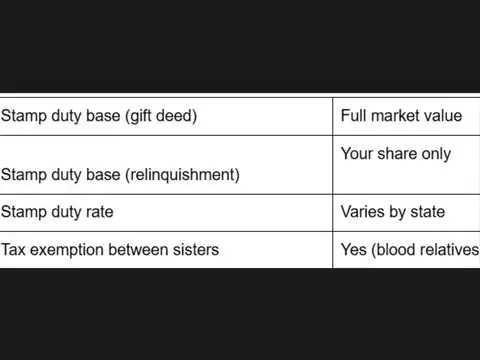
Stamp duty is calculated on the market value of the entire property in a gift deed. A relinquishment deed is typically calculated only on the value of the share being relinquished — a significant difference on high-value land.
Rates vary significantly by state. Some states offer concessions when the recipient is a female family member. Check your local sub-registrar office before drafting.
Rates vary significantly by state. Some states offer concessions when the recipient is a female family member. Check your local sub-registrar office before drafting.

5/9
Both deeds are irrevocable once registered — there is no taking it back
Unlike a Will — which can be changed anytime during the testator's lifetime — both a gift deed and a relinquishment deed become permanent and binding the moment they are registered and accepted by the recipient. Make sure you are certain before signing.
Will
Revocable anytime. Takes effect only after death. Does not override a registered deed made while alive.
Gift / Relinquishment
Irrevocable once executed and registered. Immediate transfer. Overrides any prior Will covering the same property.
Will
Revocable anytime. Takes effect only after death. Does not override a registered deed made while alive.
Gift / Relinquishment
Irrevocable once executed and registered. Immediate transfer. Overrides any prior Will covering the same property.

6/9
Don't walk into the sub-registrar's office without these
Missing even one document can delay registration by weeks. Gather everything before you book your appointment.
1.Original deed draft — executed on proper stamp paper of the correct value
2.Proof of identity — Aadhaar, PAN, or passport for all parties involved
3.Property ownership documents — original sale deed, inheritance documents, or mutation records
4.NOC if applicable — No Objection Certificate from relevant authorities, e.g. housing societies
5.Two witnesses — present in person on the day of registration
1.Original deed draft — executed on proper stamp paper of the correct value
2.Proof of identity — Aadhaar, PAN, or passport for all parties involved
3.Property ownership documents — original sale deed, inheritance documents, or mutation records
4.NOC if applicable — No Objection Certificate from relevant authorities, e.g. housing societies
5.Two witnesses — present in person on the day of registration

7/9
A valid relinquishment deed has 6 non-negotiable elements
Get your lawyer to verify each of these is present before the deed is submitted for registration. An incomplete deed can be challenged in court later.
- Names and details of all parties
- Full property description
- Consideration clause (usually nil)
- Relinquishment clause
- Date of execution
- Witness signatures

8/9
Once registered, your name comes off the property records permanently
After the deed is registered at the local sub-registrar's office, your sister's name is added to — and your name removed from — the official property records. The mutation must then be updated at the local revenue office (tehsildar/patwari) to reflect the change in ownership.
1.Registration at sub-registrar's office — makes the transfer legally valid
2.Mutation at revenue office — updates government land records
3.Update Encumbrance Certificate — confirms the property is now free of prior claims
1.Registration at sub-registrar's office — makes the transfer legally valid
2.Mutation at revenue office — updates government land records
3.Update Encumbrance Certificate — confirms the property is now free of prior claims

9/9
Inherited land going to sisters? Use a relinquishment deed. Full stop.
Unless you are the sole, absolute owner of the land (not a co-heir), a relinquishment deed is simpler, cheaper, and legally cleaner than a gift deed. Both require registration. Both are irrevocable. Both are tax-exempt among blood relatives. The difference is cost — and in most Indian states, that cost difference is substantial.
READ MORE:
gift deed vs relinquishment deed |relinquishment deed India meaning |gift deed property transfer India |property transfer to siblings India |stamp duty gift deed vs relinquishment deed |relinquishment deed stamp duty India |inherited property transfer India |transfer property to sister India |family property transfer India |property registration India rules