
SIP vs RD: Which turns ₹10,000 monthly investment into a bigger corpus in 10, 15 & 20 years?

1/8
SIP vs RD: Which monthly investment can create more wealth?
Many investors begin with a simple question: should they choose a Systematic Investment Plan (SIP) or a Recurring Deposit (RD)? An RD offers fixed and predictable returns with low risk, making it suitable for conservative investors. SIPs, on the other hand, invest in mutual funds and can generate higher returns over time, though market fluctuations can affect performance. Here’s how a Rs 10,000 monthly investment performs over 10, 15, and 20 years in SIPs and RDs. Note: Calculations based on 6.05% RD/FD returns and estimated SIP returns ranging from 6%-13%.
2/8
RD returns: How much can Rs 10,000 monthly become in 10 years?
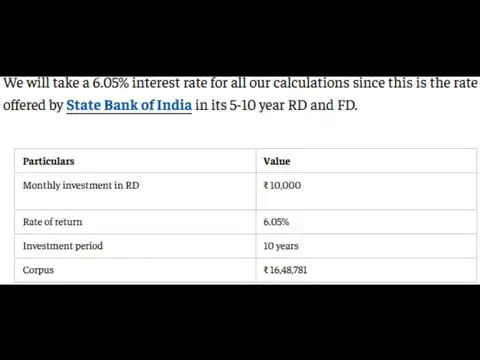
If you invest Rs 10,000 every month in an RD earning 6.05% annual interest, the total corpus after 10 years can grow to around Rs 16.48 lakh. RDs provide stable growth because the interest rate remains fixed throughout the tenure. They are ideal for investors who want capital protection and predictable maturity amounts without taking market risk.
3/8
RD in 15 years: How Rs 10,000 monthly can grow steadily
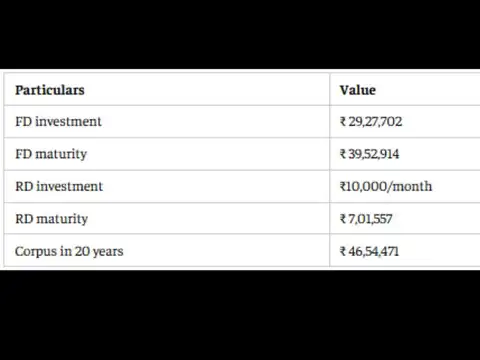
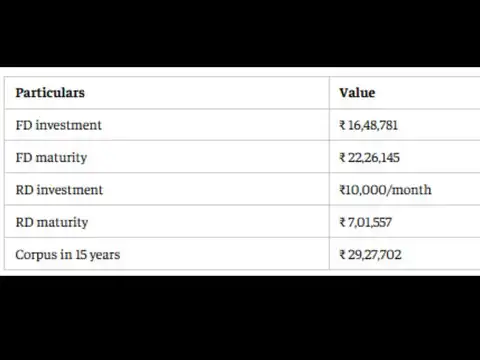
Since most RDs have a maximum tenure of 10 years, investors need a rollover strategy for longer goals. After the first RD matures, the amount can be shifted into an FD while a new RD continues for the remaining years. At a 6.05% return rate, a Rs 10,000 monthly RD investment may grow to nearly Rs 29.27 lakh in 15 years.
Amazon Top Deals
POWERED BY

atomberg Studio Smart+ 1200mm BLDC Ceiling Fan with IoT & Remote | BEE 5 star Rated Energy Efficient Ceiling Fan | High Air Delivery with LED Indicators | 3 Year Warranty (Earth Brown)
₹5,882Buy Now36%
OFF

LG 32 L Convection Microwave Oven (MC3286BRUM, Black, 360° Motorised Rotisserie for Bar-be-queing, 301 Auto Cook Menu, Stainless steel cavity, Indian Cuisine, Tandoor Se, Steam Clean & Diet Fry)
₹19,340Buy Now19%
OFF
4/8
RD in 20 years: Can fixed-income investing build a large corpus?
For a 20-year investment period, the RD maturity amount after 10 years can be reinvested into an FD for another decade, while a fresh RD runs simultaneously. Using this approach at a 6.05% annual return, a Rs 10,000 monthly investment may grow to approximately Rs 46.54 lakh over 20 years, offering stable but moderate wealth creation.
5/8
Rs 10,000 SIP in 10 years: Equity funds may beat RD returns
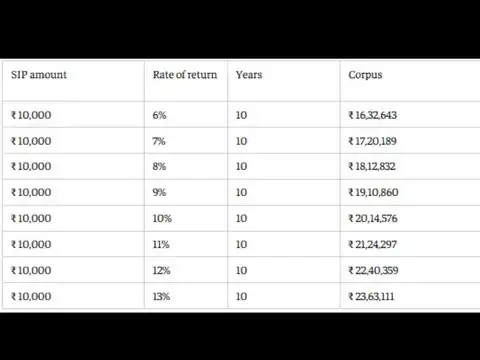
A Rs 10,000 monthly SIP can create significantly different outcomes depending on returns. At 6% annual growth, in 10 years, the corpus may grow to about Rs 16.32 lakh. At 10% returns, it can rise to Rs 20.14 lakh, while 13% annualised returns may generate nearly Rs 23.63 lakh. Long-term equity investing can outperform fixed- income products over time.
6/8
SIP in 15 years: How compounding boosts long-term wealth
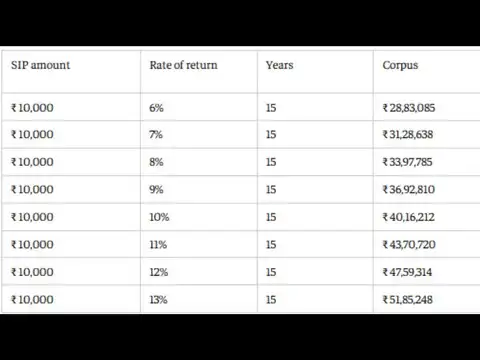
Longer investment periods can significantly increase SIP returns because of compounding. A Rs 10,000 monthly SIP earning 10% annualised returns may grow to nearly Rs 40.16 lakh in 15 years. At 12%-13% annual returns, the corpus may rise to around Rs 47.59 lakh to Rs 51.85 lakh, making SIPs attractive for long-term financial goals.
7/8
SIP in 20 years: Can Rs 10,000 monthly become Rs 1 crore?
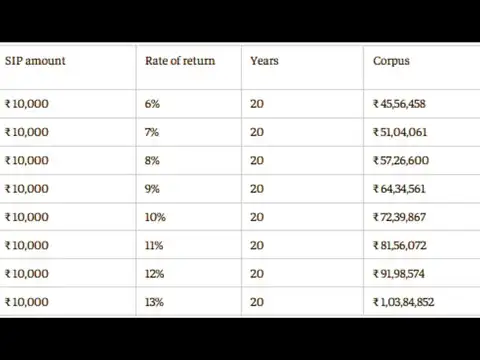
The biggest advantage of SIP investing can be seen over very long periods. At 10% annual returns, a Rs 10,000 monthly SIP may grow to around Rs 72.39 lakh in 20 years. If annualised returns reach 13%, the investment can potentially cross Rs 1.03 crore, showing the power of disciplined investing and long-term compounding.

8/8
Who should choose SIP and who should prefer RD?
SIPs are better suited for young earners, long-term investors, and people investing for goals like retirement or children’s education. They can help beat inflation and create larger wealth over decades. RDs are more suitable for conservative investors who want guaranteed returns, lower risk, and fixed maturity values. The right choice depends on your financial goals and risk tolerance.