Avoid getting into trap of FOMO vs FOLO when investing in equities, what to do to earn better returns
The kind of optimism prevailing in the stocks market is linked to a psychological concept of FOMO vs FOLO— the fear of missing out versus fear of losing out. Instead of paying heed to the market noise, investors would do well to just focus on thei...
By ET CONTRIBUTORS | Updated:
iStock
Market cycle makes the multi-asset investing approach suitable for generating better risk-adjusted returns.
Equity markets continue to rally and have now posted a remarkable 17-month upward run after falling sharply early last year on fears that the pandemic would present deep and lasting challenges for the global economy and businesses. The S&P BSE 500 was up 142% since the March 2020 lows as of 7 September 2021. The past 17 months included an abrupt (and unprecedented) shutdown of the global economy due to the coronavirus, followed by the eventual reopening of the economy and record levels of fiscal and monetary stimulus. This clubbed with strong earnings growth expectations, future cash flows discounted at decadal low-interest rates, and investor optimism particularly from the retail segment have resulted in a sharp rebound in the equity markets. Does this resemble a bull market environment? The current investor sentiment signals this with markets scaling new highs every other day.
Investors started to look at equity markets to generate income post-pandemic as it displaced their primary source of income. This is reflected by the number of trading accounts which have almost doubled in the last two years. Also, the share of retail in trading volumes has increased from 39% at the start of 2020 to 45% at present. The kind of optimism prevailing in the market is linked to a psychological concept of FOMO vs FOLO— the fear of missing out versus fear of losing out.
Let me explain this by a simple example; you are offered a gamble on the toss of a coin. If the coin shows tails, you lose Rs 100. If the coin shows heads, you win Rs 150. Is this gamble attractive? Would you accept it? The expected value is derived as probability times gain or loss. In this case, the probability adjusted outcome is positive as you stand to gain more (Rs 75) than you can lose (Rs 50), resulting in a net gain of Rs 25. However, many may still reject this as the fear of losing Rs 100 is more intense than the hope of gaining Rs 150, indicating risk (loss) aversion behaviour. Now, what is the gain that you need to balance an equal chance to lose Rs 100? For most, the answer could be Rs 200 or more. And, anything above Rs 200 would indicate risk seeker behaviour as fear of missing out on gain overpowers the fear of losing Rs 100. In both scenarios, the net probability adjusted outcome is positive for the person accepting the gamble. This is what is happening right now with equity markets.
Markets go through different cycles. In early 2020, fear of losing money and risk-averse behaviour was a lot more prevalent, which led to a market downturn. Post that, a resurgence in investor optimism led to investor behaviour swing towards FOMO. Consider this year’s IPO market. For most of the issues, the retail subscription has been a lot more than anticipated as in an up-trending market one would weigh fear of missing out on potential listing gains more than fear of losing out if the listing price is lower than the issue price.
In an expensive stock market, invest in these 10 value stocks to get returns
1/11
The performances of growth and value styles tend to rotate, in other words, value stocks usually exhibit strong performance after the stock market has peaked. Following the growth-led rally, the value theme seems to be catching up. Experts say these style shifts usually last a few years, and that's why there is still steam left in value stocks. Adding to this is the ongoing structural economic shift. Traditionally, consumption and services stocks were considered growth stocks whereas manufacturing and utilities were value picks. The recent revival in the manufacturing segment, due to government initiatives like the production linked incentive, is changing this.
We list below 10 value stocks that are worth investing in now. These companies are trading at reasonable valuations and could offer decent returns. (Note that this data is based on an article dated Sep 6, 2021 and data as on Sep 2, 2021.)
The performances of growth and value styles tend to rotate, in other words, value stocks usually exhibit strong performance after the stock market has peaked. Following the growth-led rally, the valu..
Read More
With a very low PB ratio and high dividend yield, Power Finance Corp is a typical value stock. Most of its loans are to government entities and, therefore, are as good as risk-free. However, the stock has underperformed the market and NBFC sector in the past one year because of the slower than expected resolution of a few of its stressed private sector assets. The management continues efforts on this front resulting in PFC bringing down its net NPA to 2% as on 30 June from 2.1% as on March 31. Any resolution of these private assets will result in a re-rating. Increasing provision coverage ratio, which was around 65% as on 30 June, is another comforting factor.
With a very low PB ratio and high dividend yield, Power Finance Corp is a typical value stock. Most of its loans are to government entities and, therefore, are as good as risk-free. However, the stoc..
Read More
Execution misses due to the second covid wave and increase in freight costs resulted in subdued numbers for Q1 of 2021-22. Though this caused a correction in August this year, experts continue favoring Kalpataru. Only 60% of its order book of Rs 13,400 crore is from the transmission and distribution business and the remaining 40% is from emerging segments like railways and oil & gas pipelines. As of now, these are the focus areas of the government and therefore, are expected to report healthy growth in the coming years. Kalpataru also holds 68% stake in JMC Projects, a construction company. Management is acting on the market’s concerns about its debt and promoter pledging.
Execution misses due to the second covid wave and increase in freight costs resulted in subdued numbers for Q1 of 2021-22. Though this caused a correction in August this year, experts continue favori..
Read More
National Mineral Development Corporation (NMDC) is one of the players from the metals and mining space that gained from the uptick in metal prices. The first quarter net profit shot up by five times year-on-year. Global iron ore prices have cooled off in the past two months but this will not dampen the prospects of NMDC. With steel prices remaining high, iron ore prices should also stabilise in the coming quarters. More importantly, NMDC is India’s largest merchant iron ore miner and is one of the lowest cost iron ore producer in the world. Therefore, it will be able to manage the price fluctuations smoothly. NMDC’s Nagarnar steel plant is expected to get commissioned during the second half of 2021-22. The company is also targeting its demerger and divestment after commissioning.
National Mineral Development Corporation (NMDC) is one of the players from the metals and mining space that gained from the uptick in metal prices. The first quarter net profit shot up by five times ..
Read More
Gas pipelines account for around 8% of the government's recently announced National Monetisation Pipeline (NMP) worth Rs 6 lakh crore. Gail operates a gas pipeline network of more than 12,000 km and is also participating in city gas distribution business. The gas transmission volume is already above pre-covid levels and the same is expected to pick up further as the economy recovers. Gas trading margin is also expected to improve in the coming quarters due to the prevailing high spot LNG prices.
Gas pipelines account for around 8% of the government's recently announced National Monetisation Pipeline (NMP) worth Rs 6 lakh crore. Gail operates a gas pipeline network of more than 12,000 km and ..
Read More
Though coal-based thermal power generation remains at its core, NTPC is transforming itself into a renewable energy company. Around 3GW of renewable capacities are under construction and may get commissioned over the next two years. NTPC has set an ambitious renewable energy capacity target of 60GW by 2032, compared to its commercial capacity of around 65GW. It is also experimenting with new technologies including green hydrogen and manufacturing methanol. The cash flows from thermal projects are expected to help NTPC achieve its renewable energy ambition.
Though coal-based thermal power generation remains at its core, NTPC is transforming itself into a renewable energy company. Around 3GW of renewable capacities are under construction and may get comm..
Read More
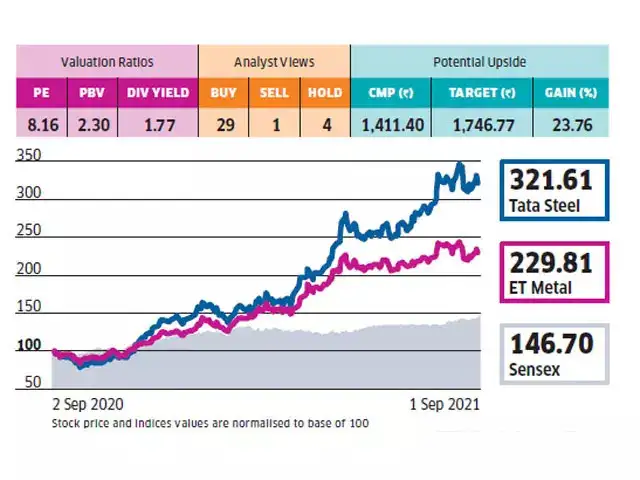
Tata Steel is a global steel company, with operations across the world. The recent uptick in global steel prices has boosted its fortunes. Tata Steel generated a consolidated free cash flow of Rs 3,500 crore during the first quarter of 2021-22. It reduced debt by around Rs 25,000 crore during 2020-21 and may reduce the same amount in 2021-22. Since the Tata Steel share has already reacted to the rise in steel prices, should investors go for it now? Yes, experts say. The covid induced disturbances have slowed down capacity additions and therefore, metal prices across the globe will remain firm once the economy revives. Tata Steel has renegotiated several contracts in July and the positive impact of the same (its realisations are expected to go up by €200/tonne) will be visible from the second quarter.
Tata Steel is a global steel company, with operations across the world. The recent uptick in global steel prices has boosted its fortunes. Tata Steel generated a consolidated free cash flow of Rs 3,5..
Read More
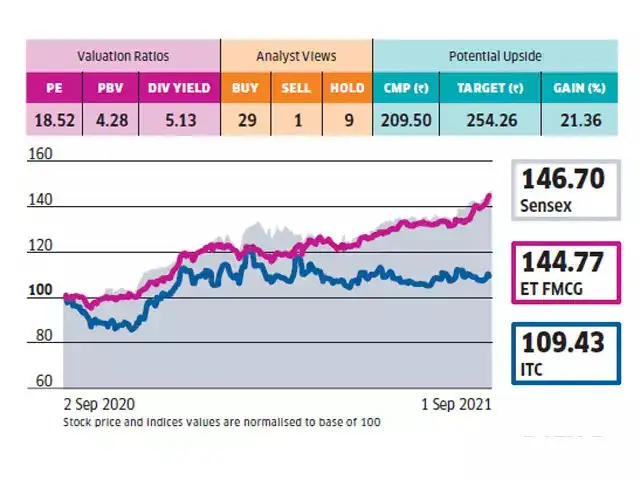
ITC is quoting at reasonable valuations despite several profit-making entities under its belt. With diverse products under its foods and personal care divisions, its FMCG business is doing well and gaining market share across many categories. However, its valuation is not the same as other FMCG companies because most foreign portfolio investors (FPIs) follow the ESG principles and therefore, keep away from ITC due to its cigarettes business. Though its hotels division is under strain due to covid-induced restrictions, the paper and agri divisions are doing well now. Since ITC is a conglomerate, all divisions are not getting their correct valuations.
ITC is quoting at reasonable valuations despite several profit-making entities under its belt. With diverse products under its foods and personal care divisions, its FMCG business is doing well and g..
Read More
Petronet LNG is trading at attractive valuations and offering high dividend yield with prospects of future growth. Petronet, a natural gas importer, is in a sweet spot now because the domestic gas production will not be able to match the demand jump in Indian natural gas, which is expected to double by 2030. The Kochi terminal utilisation improved a bit to 25% in the first quarter of 2021-22, compared to 15% (y-o-y) and 23% (q-o-q). A further ramp up is expected to take it beyond 30% in 2021-22 and reach around 50%-60% in the next five years which will be crucial for its profitability. Its strong parentage (it is promoted by PSU oil majors like ONGC, IOC, Gail and BPCL with a 12.5% stake each) is another highlight for Petronet.
Petronet LNG is trading at attractive valuations and offering high dividend yield with prospects of future growth. Petronet, a natural gas importer, is in a sweet spot now because the domestic gas pr..
Read More
Hero Motocorp, a traditional growth company came into the value segment because of its recent price fall. While most stocks gained in the past one year, Hero declined due to the dull demand from the rural sector. Hero has efficient cost management systems and was able to manage the raw material cost inflation smoothly. To protect its margin, it increased prices in July. With the covid situation improving across the globe, Hero is also seeing traction in exports. Though not a big player now, Hero is in the process of launching several electric vehicles in 2021-22 and is expected to maintain its market share even in the electric vehicles space in the coming years.
Hero Motocorp, a traditional growth company came into the value segment because of its recent price fall. While most stocks gained in the past one year, Hero declined due to the dull demand from the ..
Equities are benefiting from expectations of an economic rebound driven by a massive fiscal stimulus with a focus on providing credit, improving farm income, and export attractiveness. Few other drivers that bode well are thrust on capital expenditure, foreign direct and portfolio inflows, low cost of credit, and expectations of increased consumer spending as vaccines roll out and economies reopen. These growth drivers are expected to help corporates improve their earnings. However, in the near term, few factors still linger – the potential impact of a third wave, high inflation, and concerns around valuation. Investors should be mindful of the drawdown potential coming from extra or higher than normal growth (equity) asset exposure and continue to evaluate these exposures to make sure they balance the risks properly.
How can investors navigate this period? The current market cycle makes the multi-asset investing approach a lot more relevant to generate better risk-adjusted long-term performance. Assessment of adequate equity exposure in a portfolio to meet a certain investment goal is critical as higher allocation could expose an investor to the risk of capital loss if markets are to correct. Investors could also consider diversifying equity exposure by investing in international markets. This helps by providing a hedge against rupee depreciation and an opportunity to take exposure to varied international economic & fundamental growth drivers apart from Indian equities.
One should negate short-term market noise and avoid getting into the trap of FOMO vs FOLO as it can have an undesirable outcome on your investment goal. Rather, investors should stick with their financial plan. Investors entered the market with specific goals in mind, whether that meant retirement many years into the future or focusing on nearer-term aspirations, like buying a home or a second car. Whether the market is at a peak or a trough, your financial plan likely hasn’t changed much, and your original portfolio choice based on your financial plan could still be right for your goals.
(The writer is is Associate Director, capital markets & asset allocation at Morningstar)
(Disclaimer: The opinions expressed in this column are that of the writer. The facts and opinions expressed here do not reflect the views of www.economictimes.com.)






 ETMarkets Smart Talk | AI is real, but AI valuations are not; we are in the FOMO stage of the bubble: Carnelian’s Manoj Bahety2026-06-19T03:30:00Z



