
Rs 4.5 crore retirement fund: Build a monthly income plan with SWP & bucket strategy

1/8
Can you get Rs 4 lakh monthly income without losing your corpus?
A Rs 4.5-crore corpus invested in an FD at 7% can generate around Rs 37.33 lakh in interest per year. But the interest can result in a significant tax outgo. A mutual fund SWP can potentially offer more tax-efficient withdrawals because tax generally applies to the gain component, not the entire amount withdrawn.
2/8
Rs 4.5 crore in FD: How much will you earn after tax?
At a 7% FD interest rate, Rs 4.5 crore can generate around Rs 37.33 lakh a year. Assuming no other income, this could result in around Rs 7 lakh in tax under the new tax regime. Post-tax annual income: Around Rs 30.33 lakh.
3/8
Rs 4.5 crore retirement corpus: How should you allocate the money?
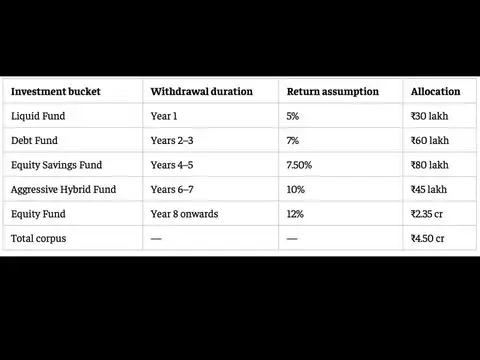
The illustration divides the corpus into five buckets based on when the money will be needed:
Liquid funds: Immediate needs
Debt funds: Years 2–3
Equity savings funds: Years 4–5
Aggressive hybrid funds: Years 6–7
Equity: Long-term growth and the next seven-year cycle
Liquid funds: Immediate needs
Debt funds: Years 2–3
Equity savings funds: Years 4–5
Aggressive hybrid funds: Years 6–7
Equity: Long-term growth and the next seven-year cycle
Amazon Top Deals
POWERED BY

Crompton Ozone 75 Litres Desert Air Cooler for home | Large & Easy Clean Ice Chamber | 4-Way Air Deflection | High Density Honeycomb Pads | Everlast Pump | Auto Fill| 3 Year Brand Warranty
₹9,798Buy Now43%
OFF

LG 32 L Convection Microwave Oven (MC3286BRUM, Black, 360° Motorised Rotisserie for Bar-be-queing, 301 Auto Cook Menu, Stainless steel cavity, Indian Cuisine, Tandoor Se, Steam Clean & Diet Fry)
₹19,090Buy Now20%
OFF
4/8
Rs 4.5 crore bucket strategy: Which assets are used for each period?
For the first year, liquid funds are used for stability and easy withdrawals, with an assumed return of 5%. For years 2–3, debt funds are used, with an assumed annualised return of 7%. For years 4–5, the strategy uses equity savings funds. These must maintain at least 65% in equity/equity-related instruments and 10% in debt. For years 6–7, aggressive hybrid funds are used, with 65%–80% in equity and 20%–35% in debt.

5/8
Rs 4 lakh monthly withdrawal from Rs 4.5 crore: Is it sustainable?
A Rs 4 lakh monthly withdrawal means Rs 48 lakh a year. To sustain this withdrawal without eroding the corpus, the investment would need to generate around 10.66% every year. This is challenging, particularly if markets perform poorly in the initial years.
Experts generally suggest a more conservative 4% withdrawal rate, which translates to around Rs 1.5 lakh a month from a Rs 4.5 crore corpus. The illustration assumes a higher Rs 2.5 lakh monthly withdrawal, suitable only for investors with a higher risk appetite.
Experts generally suggest a more conservative 4% withdrawal rate, which translates to around Rs 1.5 lakh a month from a Rs 4.5 crore corpus. The illustration assumes a higher Rs 2.5 lakh monthly withdrawal, suitable only for investors with a higher risk appetite.

6/8
Rs 2.5 lakh monthly income: How the 7-year withdrawal cycle works
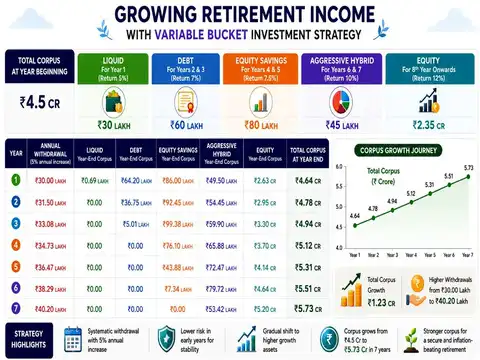
The first-year withdrawal is Rs 2.5 lakh a month, with the withdrawal amount increasing by 5% every year. Money is withdrawn sequentially from the liquid, debt, equity savings and aggressive hybrid buckets as each bucket is exhausted. The equity allocation is left untouched for seven years and is intended to fund the next seven-year withdrawal cycle.
7/8
Rs 4.5 crore corpus: Can the money grow despite withdrawals?
Under the illustration's assumptions, around Rs 2.44 crore is withdrawn over seven years. Despite these withdrawals, the corpus increases from Rs 4.5 crore at the beginning of the first year to Rs 5.73 crore at the end of seven years. The same bucket cycle can then be repeated from the eighth year onwards.

8/8
Rs 4.5 crore retirement plan: How can the bucket strategy reduce tax?
In the first three years, the retiree may have no tax liability under the new tax regime if there is no other income and taxable income remains within the applicable Rs 12 lakh threshold, based on the illustration's assumptions.
From years 4–7, LTCG applies to equity savings and aggressive hybrid funds. The Rs 1.25 lakh annual LTCG exemption can be used, with gains above the exemption taxed at 12.5%. Because each withdrawal includes a substantial principal component, the taxable gain can be much lower than the total amount withdrawn, potentially reducing tax compared with FD interest.
From years 4–7, LTCG applies to equity savings and aggressive hybrid funds. The Rs 1.25 lakh annual LTCG exemption can be used, with gains above the exemption taxed at 12.5%. Because each withdrawal includes a substantial principal component, the taxable gain can be much lower than the total amount withdrawn, potentially reducing tax compared with FD interest.