
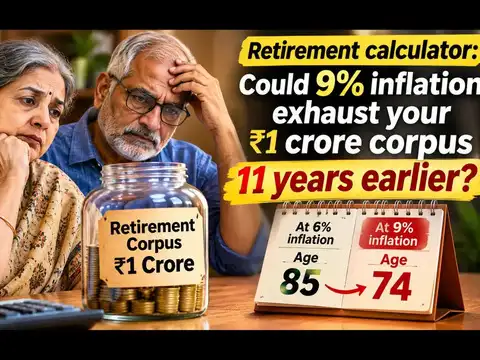
Retirement calculator: Could 9% inflation exhaust your ₹1 crore corpus 11 years earlier?
1/9
Retirement planning: Could 9% inflation exhaust your ₹1 crore corpus early?
A retirement corpus that looks sufficient today may not last as long as you expect. Rising expenses on groceries, fuel, utilities and medicines can erode purchasing power faster than the official inflation rate suggests. For retirees, even a few years of higher personal inflation can significantly shorten the life of their savings.
2/9
Retirement inflation: Why your personal expenses may rise faster than CPI
The Consumer Price Index (CPI) reflects average price changes across a broad basket of goods and services. But retirees may spend a larger share of their income on essentials such as milk, vegetables, cooking gas and medicines. If these expenses rise faster than the overall CPI, their personal inflation rate can be significantly higher than the official figure.

3/9
9% personal inflation: How much more could a retired couple spend?
Consider a retired couple whose monthly essential expenses have increased by 28.2% since February, according to the article's illustration. Their monthly bill has risen by ₹5,128, translating into around ₹61,500 more in annual expenses. At a 4% safe withdrawal rate, they would need an additional corpus of approximately ₹15.4 lakh to fund this expense.

4/9
₹1 crore retirement corpus: Why a 7.5% FD return may not be enough
A senior citizen FD yielding 7.5% earns an effective 5.25% after tax for someone in the 30% tax bracket. Against 9% personal inflation, the real return is approximately -3.44%. This means the money may continue earning interest, but its purchasing power could decline over time.

5/9
₹1 crore retirement corpus: How higher inflation can shorten its life
Consider a retiree who starts with a ₹1 crore corpus and withdraws ₹68,000 every month. The illustration assumes a 6% post-tax return. Under the original 6% inflation assumption, the corpus lasts until age 85. But when inflation rises to 9% for three years, the money runs out by age 75. If 9% inflation persists, it could be exhausted by age 74.

6/9
Retirement planning: Why relying entirely on FDs can be risky
Fixed deposits offer predictable interest, but their returns may not keep pace with rising living costs after tax. Equities, on the other hand, offer the potential for long-term growth as companies can raise prices and earnings over time. However, equity markets can fall 30–40% in a bad year, making them unsuitable for money needed in the near term.

7/9
Retirement portfolio: How to divide your money into three buckets
One approach suggested in the article is to divide retirement savings into three buckets. Keep the first three years of essential expenses in Senior Citizens' Savings Schemes and short-term FDs. Use high-quality debt investments for years four to six to replenish the first bucket. Invest money needed seven years onwards in low-cost, broad-market index funds for long-term growth.

8/9
Retirement calculator: Stress-test your corpus against 9–10% inflation
Don't rely only on an average inflation assumption. Recalculate your retirement plan assuming inflation stays at 9–10% for three years before settling at 7%. Check whether your corpus can still last until at least age 85. If it runs out earlier, you may need to reconsider your withdrawal amount or investment allocation.

9/9
Retirement planning: 4 steps to protect your savings from rising expenses
Track your household expenses year on year to estimate your personal inflation rate. Stress- test your retirement corpus against higher inflation, diversify beyond fixed deposits and keep short-term expenses out of equity investments. Consider consulting a fee-only, SEBI-registered investment adviser rather than relying solely on products promising guaranteed income.