
Nifty 14% below its peak, but Motilal Oswal says profits are set for fastest growth in 17 quarters

1/10
Prices are down, but profits are rising
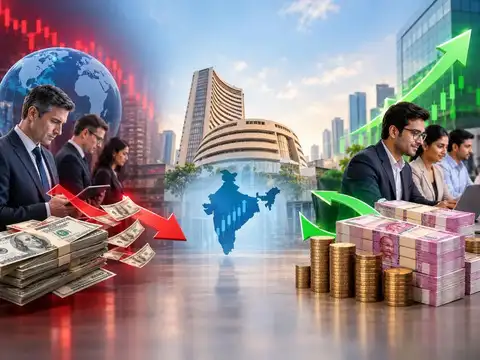
The Nifty 50 is about 14% below its September 2024 peak, according to Motilal Oswal Financial Services (MOFSL) in its India Strategy 2QFY27 Preview. Mid-cap and small-cap indices are down just 2% and 3% from their highs. Yet MOFSL expects the 399 companies it tracks to grow profits 22% year-on-year in the July to September quarter, the fastest pace in 11 quarters. For the Nifty 50 alone it expects 27%, the best in 17 quarters. Share prices have drifted while earnings have kept climbing, and that gap is the central story of the report.

2/10
Why MOFSL calls this a "heavy lift"
MOFSL says Indian equities face a "heavy lift" because many pressures are hitting at once: global uncertainty, geopolitical tension, high energy prices, higher bond yields and steady selling by foreign institutional investors (FIIs). At the same time, the brokerage points to a strong domestic backdrop. It lists GDP growth, industrial production, GST collections, forex reserves, credit growth and auto and cement volumes as signs of busy economic activity. The market, in MOFSL's view, is caught between weak sentiment and a healthy economy.

3/10
Banks and lenders lead the way
MOFSL expects its financial companies to report about 23% profit growth. Private banks are projected at 24% and government-owned banks at 27%. The report cites credit growth of 18.8% and deposit growth of 17%, helped by foreign-currency deposit inflows of $133 billion. Non-bank lenders are expected to grow about 24%, with gold lenders seeing loan books expand around 42%. MOFSL also flags a medium-term worry: a regulatory consultation on insurance commissions that could change how insurance is sold.

4/10
Metals and telecom add momentum
MOFSL expects metal companies to grow profits about 44%, a fifth straight quarter of strong double-digit growth. It warns that non-ferrous metal makers may see lower earnings this quarter and mining profits may stay muted. For telecom, MOFSL projects sector profit of ₹61 billion, up from ₹35 billion a year earlier, with the three private operators seeing about 2.4% growth from the previous quarter. Oil and gas companies excluding oil marketing firms are expected to grow profits around 34%.

5/10
Autos look strong, but one company skews the number
MOFSL says vehicle demand among the makers it covers grew about 19% over last year. Passenger vehicles rose 25%, commercial vehicles 37% and two-wheelers 19%, while tractors fell 4%. Total profit for the group is expected to jump about 65%. But MOFSL notes that excluding TMPV, the growth is only about 4%, because rising costs are squeezing margins even as revenue grows. It is a useful reminder to check whether one big name is lifting an average.

6/10
IT and consumer companies are steady, not spectacular
MOFSL expects technology companies to grow revenue about 12.8% and profit about 13.4% in rupee terms, reflecting what it calls a tepid global environment. Large IT firms may grow between -0.5% and 3% from the previous quarter, while mid-sized ones are expected to do better. In consumer sectors, MOFSL expects higher sales and operating profit across the board: paints and adhesives with sales growth around 16%, and staples excluding ITC around 15%. Solid numbers, but not the kind that grab attention.
7/10
Who is selling and who is buying
MOFSL reports that foreign investors stepped up selling in the regular market, citing global uncertainty, higher interest rates and a rush of capital into AI-related trades. Domestic institutional investors kept buying and absorbed much of the pressure. Over ten years, MOFSL says, FIIs have withdrawn about $3 billion from India's secondary market while putting around $71 billion into the primary market, such as IPOs. In its reading, foreign money has not left India but has moved toward newer growth opportunities.

8/10
Money is rotating into newer themes
According to MOFSL, manufacturing, capital goods, defence, electronics manufacturing, data centres and new-age internet companies have attracted more interest, especially among mid-sized and smaller firms. Heavyweights in banking, autos, consumer goods, IT services, oil and gas and utilities have seen weaker interest and lower valuations. That helps explain why the Nifty 50 has lagged while broader indices held up better. Watching only the headline index can hide where money is actually flowing.
9/10
Valuations have cooled a lot
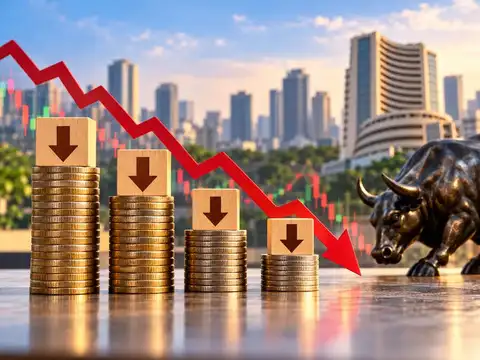
MOFSL says large-cap and mid-cap valuations have fallen 31% and 36% from their peaks, and small-caps 7%, on a 12-month forward price-to-earnings basis. The Nifty 50 now trades 18% below its long-term average and mid-caps 4% below. India's valuation premium over other emerging markets has narrowed to 35% in September 2026, compared with a long-term average of 72% and a peak of 147% in 2022. MOFSL concludes that the risk-reward balance for Indian equities has improved meaningfully, though cheaper does not guarantee the bottom is in.

10/10
What could go wrong, and what to take from it
MOFSL lists the risks: higher global bond yields pulling money into fixed income, high crude oil and input costs squeezing margins, the sustainability of the AI-led global rally, continued FII selling, and a heavy pipeline of IPOs absorbing liquidity. It expects profit growth of 15% in FY27 and 17% in FY28 for its universe, with financials, metals, telecom and autos supplying 78% of the extra earnings. Its overall verdict is that the market will be driven stock by stock rather than by one broad rally. These are one brokerage's forecasts, which can be wrong, and this is general information, not personal financial advice. Consider speaking to a registered adviser before making large decisions.
READ MORE:
Indian stock market outlook 2026 |Nifty 50 earnings growth FY27 |MOFSL India Strategy 2QFY27 Preview |Indian stock market earnings forecast |Indian stock market correction |FII selling in Indian stock market |Indian stock market profit growth |Indian equity market outlook FY27 |Stock market sector analysis India 2026