
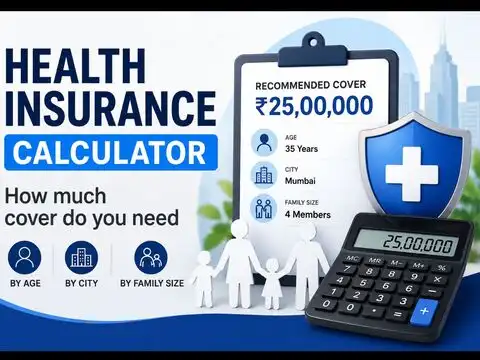
Health insurance calculator: How much cover do you need by age, city and family size?
1/10
Health insurance: Why ₹5-10 lakh may no longer be enough
A ₹5-10 lakh health cover that once seemed adequate may fall short as medical costs rise. Industry estimates put medical inflation at around 12-14% a year. A single cardiac procedure or cancer treatment in a metro hospital can cost ₹15-25 lakh or more. This makes the right sum insured increasingly dependent on your age, location, family and health needs.

2/10
Health insurance calculator: Age is the first factor to consider
Your health insurance requirement should not be based simply on your income. Age is a key factor because medical costs generally rise as you get older. One expert illustration suggests that if ₹5 lakh is adequate for a 30-year-old today, applying 6-8% inflation could mean needing around ₹15 lakh by age 50. A two-adult floater could require roughly ₹30 lakh.

3/10
Health insurance for family: How much cover should you consider?
Family size and health history also affect the amount of cover you need. A family floater shares one sum insured among multiple members, and generally needs to be larger than individual coverage. One expert recommends considering at least three times the individual sum insured for a family floater. Pre-existing conditions and family medical history should also be factored into your decision.
Amazon Top Deals
POWERED BY

Crompton Ozone 75 Litres Desert Air Cooler for home | Large & Easy Clean Ice Chamber | 4-Way Air Deflection | High Density Honeycomb Pads | Everlast Pump | Auto Fill| 3 Year Brand Warranty
₹9,798Buy Now43%
OFF

LG 32 L Convection Microwave Oven (MC3286BRUM, Black, 360° Motorised Rotisserie for Bar-be-queing, 301 Auto Cook Menu, Stainless steel cavity, Indian Cuisine, Tandoor Se, Steam Clean & Diet Fry)
₹19,090Buy Now20%
OFF

4/10
Health insurance in metro cities: Why you may need ₹15-25 lakh
Where you live can significantly affect healthcare costs. One expert suggests individuals in metro cities consider at least ₹15-20 lakh of cover, while another recommends ₹25 lakh. For tier-2 and tier-3 cities, ₹10 lakh is suggested as a minimum by one expert. But remember: you may have to travel to a metro for specialised treatment, so factor those higher costs into your coverage.

5/10
Health insurance for senior citizens: Why parents need separate cover
Experts recommend keeping elderly parents out of your family floater and buying a separate policy for them. Their healthcare expenses can consume the shared sum insured and leave less cover for other family members. Treatment costs also rise sharply after 60. Data cited in the article shows average claims of about ₹1.77 lakh for people over 60, versus ₹65,000 for those under 25.

6/10
₹1-crore health insurance: One policy or base cover plus super top-up?
A large health cover can be structured as one policy or as a smaller base policy combined with a super top-up. For example, with a ₹10 lakh base and ₹20 lakh top-up, a ₹15 lakh hospital bill would first use the base cover and the remaining ₹5 lakh could be covered by the top-up. The more cost-effective option depends on your needs, policy terms and affordability.

7/10
Health insurance top-up vs large cover: Which option is better?
A super top-up can provide additional protection at a lower initial premium, but it may come with restrictions and can become more expensive as claims increase. A sufficiently large single policy can offer simpler cashless claim processing because you do not have to coordinate between multiple insurers. If base and top-up policies are with different insurers, reimbursement may sometimes be required.

8/10
Health insurance review: Why you should increase your cover over time
Buying adequate coverage once is not enough. Experts recommend reviewing your sum insured at least every two years and whenever major life events occur, such as marriage, having children or retirement. Starting early can help because developing an illness later may make it difficult to increase coverage. Your employer's health cover may also end after retirement.

9/10
Health insurance planning: Why you also need a medical emergency fund
Health insurance may not cover every expense. A separate medical corpus can help meet costs such as waiting-period expenses for pre-existing diseases, dental treatment, diagnostics and experimental treatments. It can also provide a buffer if a claim is rejected or premiums become unaffordable. Build this fund separately, because unlike insurance, your savings are depleted when you use them.

10/10
7