
Squeezed in the middle: How tax, EMIs, school fees and health costs are draining India's middle class

1/8
They pay the most tax and work the longest. So why is nothing left?
India's salaried middle class is earning more, spending more and paying more, yet finding less at the end of the month. These are not households in poverty. They are educated professionals whose financial cushion keeps shrinking. Swipe to see where the money goes.

2/8
Earn Rs 2 lakh a month? Only Rs 30,000 is yours
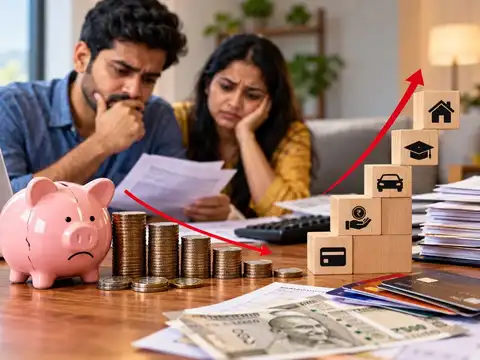
A household earning Rs 2 lakh a month typically spends Rs 50,000 on housing (rent or EMI), Rs 30,000 on education, Rs 20,000 on transport and utilities, Rs 15,000 on insurance and Rs 20,000 on household consumption. Another Rs 20,000 goes to retirement savings and Rs 15,000 to debt repayment. What is left is Rs 30,000, or 15% of gross income before tax. One medical bill or job loss can upset the whole plan.
3/8
Savings are dwindling while debt is climbing
Indian households saw their liabilities increase much faster than their financial wealth in 2025, with borrowing rising at a pace that outstripped the growth in financial assets, according to an Allianz Global Wealth Report 2026. Household liabilities climbed 14.3% during the year, while gross financial assets increased 9%. Much of the new borrowing is personal loans and credit-card dues, not assets like homes.

4/8
School fees and medical bills are rising fastest
School education inflation hit 12.3% in 2024-25, the highest of any major category in the Consumer Price Index. Private school fees in metros run from Rs 1 lakh to over Rs 3 lakh a year, before transport and books. The report also cites healthcare costs rising about 14% a year. Headline inflation looks mild at 4.38% for June, but food inflation was 5.32%. In one month, sugar jumped from Rs 49 to Rs 63 a kilo, a 28% surge.
5/8
The salaried class is now the government's biggest bet
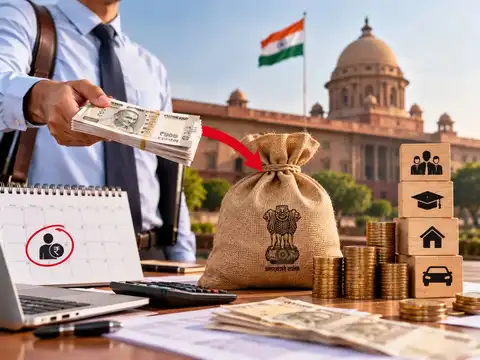
Tax is deducted before the salary even arrives. The Economic Survey 2025-26 shows direct taxes at 58.8% of total tax revenue in fiscal 2025, against a pre-pandemic average of 51.9%. Non-corporate taxes, which include salaried income tax, rose from about 2.4% of GDP to about 3.7%. Personal income tax is estimated at Rs 14.66 lakh crore for 2026-27, ahead of corporate tax at Rs 12.31 lakh crore.
6/8
Education and health costs arrive in waves
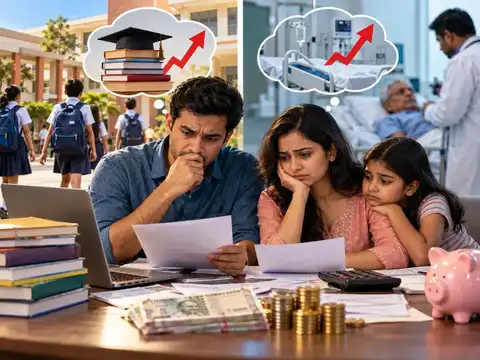
The NSO's 2025 education survey found 95.7% of students in non-government schools pay course fees, against 26.7% in government schools. About 27% of school students pay for private tutors. Parents say they are delaying home purchases to fund fees. On health, 13.1% of Indians reported an illness in the 15 days before the NSO's 2025 survey, up from 7.5% in 2017-18. One 62-year-old Delhi man paid about Rs 70,000 for cataract surgery at a private hospital after failing to get an appointment at AIIMS. Neither poor enough for state help nor rich enough to ignore costs, many families simply pay.

7/8
Easy EMIs, invisible spending, constant pressure
Sociologist Asima Jena of the University of Hyderabad says spending is increasingly driven by status and social pressure, such as lavish weddings, rather than need. UPI and easy credit make spending feel painless until several EMIs pile up. Behavioural scientist Dr Anindo Bhattacharjee calls it the "hamster wheel illusion": always moving, never getting ahead. He warns of "aspirational fatigue", where people still want a home, children and holidays that feel ever less affordable.

8/8
Gen Z isn't waiting for a pension. It's building side hustles.
Young Indians entering work in 2026 grew up around startups, gig platforms and contract jobs. They share flats through WhatsApp groups and treat side income as insurance. Many see freelancing or a YouTube channel as a real alternative to a salary. The report calls this a rational response to an economy where financial risk has shifted from institutions to individuals. Whether this generation keeps faith in education and patience is still an open question. The measure of the middle class may be what is left in the bank on the 30th.
READ MORE:
Indian middle class financial crisis |Indian salaried middle class |Middle class financial struggles in India |Rising cost of living in India |Middle class savings in India |Salary vs expenses in India |Rising household debt in India |Income tax burden on salaried employees |Education and healthcare inflation in India