
 Daily Top 5 Daily Top 5 |
PayU India CEO on MDR; Qcomm’s festive hiring
Want this newsletter delivered to your inbox?
I agree to receive newsletters and marketing communications via e-mail

Thank you for subscribing to Daily Top 5
We'll soon meet in your inbox.
PayU India CEO Anirban Mukherjee has backed a simple pricing model for UPI charges. This and more in today's ETtech Top 5.
Also in the letter:
■ TCS, HCLTech security scare
■ Slice turns profitable
■ AI funding race heats up
 Anirban Mukherjee, CEO, PayU India
Any merchant discount rate (MDR) on Unified Payments Interface (UPI) should be simple and linked to merchant size and industry, PayU India CEO Anirban Mukherjee told us.
More on this: Mukherjee said the fee should be the same for online and physical merchants, as their costs broadly balance out. Physical merchants involve distribution expenses, while online businesses spend more on merchant verification and risk management.
He said MDR could help fund payment infrastructure, cybersecurity and fraud management.
“If UPI MDR happens, I expect banks to come back very strongly into investing more in the digitisation of payments,” he said at PayU India's leadership roundtable.
Tell me more: UPI makes up 52% of PayU India's transaction volume and a third of its payment value. Mukherjee said it was too early to assess the revenue impact of MDR after existing contracts are taken into account.
Background: Parliament on Monday passed legislation allowing the Centre to change the zero-MDR framework. Finance minister Nirmala Sitharaman said consumers and most low-value merchant payments would remain free.
ET has reported extensively on India's plan to restore MDR for large-merchant UPI transactions.

Quick commerce firms are expected to hire 35-40% more temporary workers this festive season as demand for instant delivery grows, according to staffing experts.
What's happening?
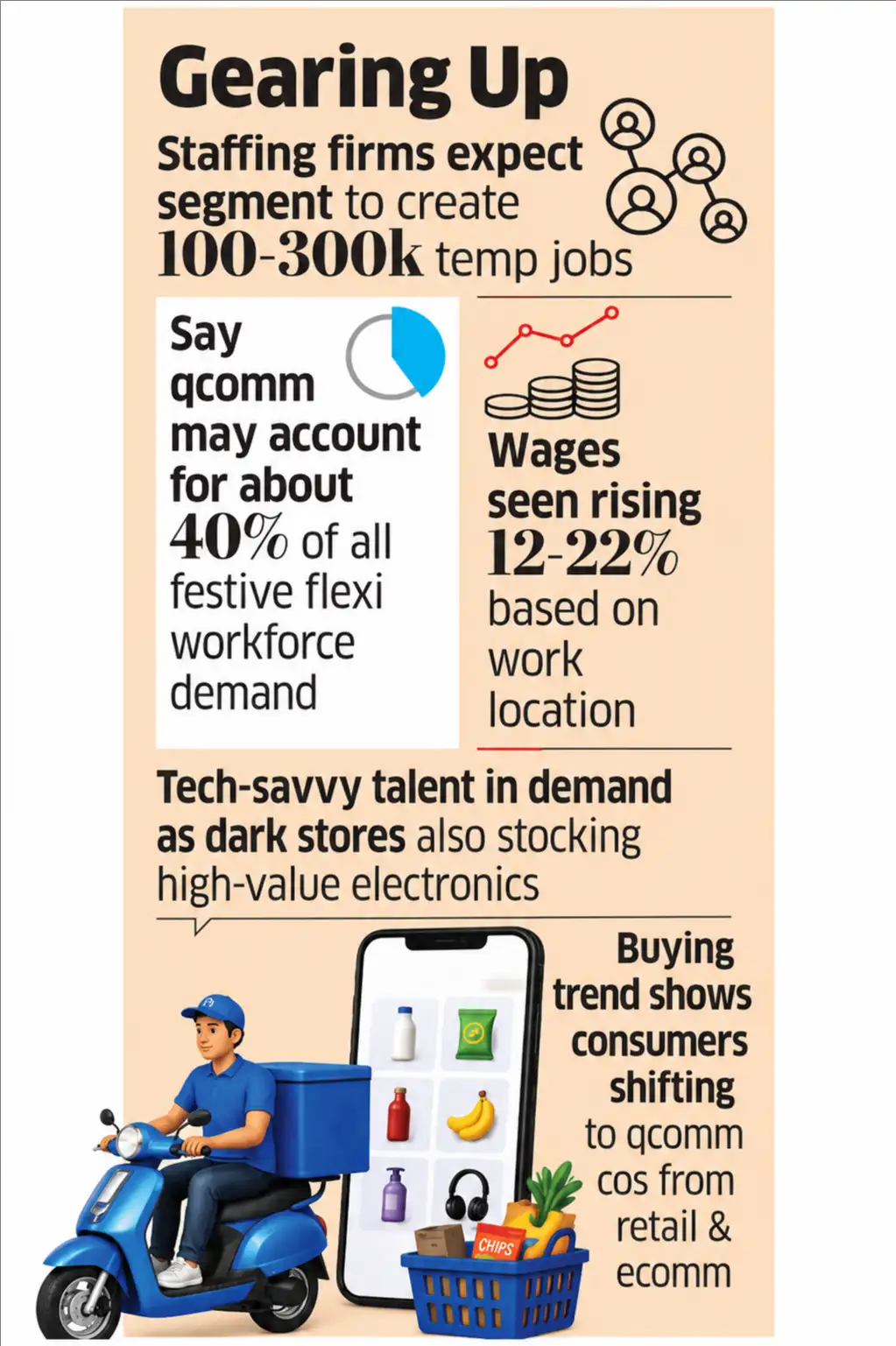
Experts said that quick commerce firms are expanding their product range and delivery areas, increasing demand for workers across warehouse operations and last-mile delivery.
Analyst take: “Last year, quick commerce accounted for roughly 16% to 18% of overall festive flexi hiring. This year, it is around 30% of the total seasonal flexi workforce demand,” said Yeshab Giri, chief commercial officer, Operational Talent Solutions at Randstad India.
“Unlike previous years where hiring was concentrated in last-mile logistics, this year's surge reflects a more strategic, hyper-localised deployment,” Giri added.
Also Read: ETtech Explainer: Can premium beauty, quick commerce drive Nykaa's next phase of growth?

Tata Consultancy Services (TCS) on Monday said some employee data may have been exposed, but there was no evidence of customer data or systems being affected.
More on this: TCS said it received “threat-intelligence alerts” about the possible exposure of employee details.
It said the data appeared to be more than four years old and limited to basic employee information. The alleged breach reportedly involved password spraying and multifactor authentication fatigue.
Meanwhile: The disclosure came as HCL Technologies (HCLTech) responded to media reports that a hacker group had claimed access to its employee data.
In a stock exchange filing, HCLTech said its initial investigation suggested the data “may be limited and dated to a few years back”, adding that there was no evidence of a systems breach or any impact on client engagements.
What else? The rise in cyber breaches is driving companies to hire more talent in cloud security, AI security, and threat intelligence as they strengthen defences against evolving threats, ET reported on Sunday.
Also Read: Aadhaar, banking at risk as India trails in post-quantum security
 Rajan Bajaj, founder, Slice
Slice Small Finance Bank reported a strong June quarter, posting a sharp rise in its net profit as its post-merger turnaround continued to gain momentum.
The fintech became a full-stack lender after merging with North East Small Finance Bank in October 2024, adding savings accounts, deposits, UPI, credit, and merchant banking services to its offerings.
By the numbers:
Recent news: The results come as Slice looks to raise $50-100 million, as ET reported in April. If closed, the round would value the company at $1 billion, below its previous $1.3 billion valuation.

AI startups are raising bigger sums early on, pushing venture capital, especially small and micro funds, to rethink how they invest.
The numbers:
For instance:
Tell me more: Venture capital firms are changing their approach to stay competitive in AI, experts said. Large funds are moving into early-stage deals, while smaller ones are targeting niche sectors and seeking bigger stakes before valuations rise. Some are also considering larger fund sizes.
Also in the letter:
■ TCS, HCLTech security scare
■ Slice turns profitable
■ AI funding race heats up
UPI fee should vary by merchant size and sector: PayU India CEO
Any merchant discount rate (MDR) on Unified Payments Interface (UPI) should be simple and linked to merchant size and industry, PayU India CEO Anirban Mukherjee told us.
More on this: Mukherjee said the fee should be the same for online and physical merchants, as their costs broadly balance out. Physical merchants involve distribution expenses, while online businesses spend more on merchant verification and risk management.
He said MDR could help fund payment infrastructure, cybersecurity and fraud management.
“If UPI MDR happens, I expect banks to come back very strongly into investing more in the digitisation of payments,” he said at PayU India's leadership roundtable.
Tell me more: UPI makes up 52% of PayU India's transaction volume and a third of its payment value. Mukherjee said it was too early to assess the revenue impact of MDR after existing contracts are taken into account.
Background: Parliament on Monday passed legislation allowing the Centre to change the zero-MDR framework. Finance minister Nirmala Sitharaman said consumers and most low-value merchant payments would remain free.
ET has reported extensively on India's plan to restore MDR for large-merchant UPI transactions.
Festive rush: Quick commerce firms to hire 35-40% more temp workers, tech-savvy talent
Quick commerce firms are expected to hire 35-40% more temporary workers this festive season as demand for instant delivery grows, according to staffing experts.
What's happening?
- HR firms expect strong demand for workers skilled in warehouse management systems, automated pick-and-pack operations, inventory reconciliation, RFID/barcode scanning, and artificial intelligence (AI)-based systems.
- Around 100,000 temporary jobs could be created during the festive season, which starts later this month. Some estimates put the requirement as high as 300,000.
- Wages for temporary workers could rise 12-22%, depending on the location.
Experts said that quick commerce firms are expanding their product range and delivery areas, increasing demand for workers across warehouse operations and last-mile delivery.
Analyst take: “Last year, quick commerce accounted for roughly 16% to 18% of overall festive flexi hiring. This year, it is around 30% of the total seasonal flexi workforce demand,” said Yeshab Giri, chief commercial officer, Operational Talent Solutions at Randstad India.
“Unlike previous years where hiring was concentrated in last-mile logistics, this year's surge reflects a more strategic, hyper-localised deployment,” Giri added.
Also Read: ETtech Explainer: Can premium beauty, quick commerce drive Nykaa's next phase of growth?
TCS says it received alerts alleging exposure of some employee data
Tata Consultancy Services (TCS) on Monday said some employee data may have been exposed, but there was no evidence of customer data or systems being affected.
More on this: TCS said it received “threat-intelligence alerts” about the possible exposure of employee details.
It said the data appeared to be more than four years old and limited to basic employee information. The alleged breach reportedly involved password spraying and multifactor authentication fatigue.
Meanwhile: The disclosure came as HCL Technologies (HCLTech) responded to media reports that a hacker group had claimed access to its employee data.
In a stock exchange filing, HCLTech said its initial investigation suggested the data “may be limited and dated to a few years back”, adding that there was no evidence of a systems breach or any impact on client engagements.
What else? The rise in cyber breaches is driving companies to hire more talent in cloud security, AI security, and threat intelligence as they strengthen defences against evolving threats, ET reported on Sunday.
Also Read: Aadhaar, banking at risk as India trails in post-quantum security
Slice posts Q1 profit of Rs 51 crore as banking pivot gathers pace
Slice Small Finance Bank reported a strong June quarter, posting a sharp rise in its net profit as its post-merger turnaround continued to gain momentum.
The fintech became a full-stack lender after merging with North East Small Finance Bank in October 2024, adding savings accounts, deposits, UPI, credit, and merchant banking services to its offerings.
By the numbers:
- Net profit: Rs 50.9 crore, compared with a net loss of Rs 10.1 crore in the year-ago quarter.
- FY26 comparison: June-quarter profit exceeded the Rs 48.4 crore profit, Slice recorded for the entire FY26.
- Total income: Rose 3.5% sequentially; 38.6% year-on-year to Rs 413.8 crore
Recent news: The results come as Slice looks to raise $50-100 million, as ET reported in April. If closed, the round would value the company at $1 billion, below its previous $1.3 billion valuation.
High AI stakes push Indian VCs to rejig funding playbooks
AI startups are raising bigger sums early on, pushing venture capital, especially small and micro funds, to rethink how they invest.
The numbers:
- AI startups now raise an average $3-5 million at the seed stage, compared with $2-4 million for other startups.
- At Series A, AI startups raise upwards of $10 million, against $5-8 million for other startups.
For instance:
- Sarvam raised about $40 million at a valuation above $110 million across its seed and Series A rounds, Tracxn data showed.
- Composio raised $25 million in Series A.
- Simplismart and Rivvun AI each raised close to $8 million in seed rounds.
Tell me more: Venture capital firms are changing their approach to stay competitive in AI, experts said. Large funds are moving into early-stage deals, while smaller ones are targeting niche sectors and seeking bigger stakes before valuations rise. Some are also considering larger fund sizes.
Want this newsletter delivered to your inbox?
I agree to receive newsletters and marketing communications via e-mail