
 Morning Dispatch Morning Dispatch |
Mid-tier VCs scout deeptech deals; ETSA winner Varaha’s India play
Want this newsletter delivered to your inbox?
I agree to receive newsletters and marketing communications via e-mail

Thank you for subscribing to Morning Dispatch
We'll soon meet in your inbox.
Happy Monday! Sector-agnostic mid-tier venture capital investors are recaliberating focus on India's deeptech startups. This and more in today’s ETtech Morning Dispatch.
Also in the letter:
■ Indian spacetech finds new market
■ Explained: New ecommerce rules
■ Zomato introduces new fee

Established mid-tier sector-agnostic venture capital firms are increasing their deeptech exposure in India while building specialised expertise to evaluate startups rooted in complex science and engineering.
Capital follows deals:

Gurugram-based Varaha, which works with smallholder farmers on carbon-removal projects, sees significant opportunity in India’s emerging carbon market even though most of its current demand comes from global companies.
The startup won the Social Enterprise category at The Economic Times Startup Awards 2026 for combining environmental impact with a profitable, measurable business model.
Scale and revenue: Varaha, founded in 2022 by Madhur Jain, Ankita Garg, and Vishal Kuchanur, works with about 2.3 lakh smallholder farmers across India, Nepal, Bangladesh, Bhutan and Côte d’Ivoire.
It has generated more than $15 million in revenue over the last two financial years and has made cumulative payments of over $7 million to communities, Jain, who is also the CEO, told us.
Quote unquote: “Last year alone, around $8 billion worth of carbon removals were contracted globally. So, a sector that is so new saw a huge spurt in growth last year itself. This is because it’s easy to track, monitor, and measure its impact,” Jain said.
Varaha has had more than 700,000 carbon credits issued to date, and total credits sold stand at several million tonnes.
Also Read: ET Startup Awards 2026: Habuild leans on repeat users to expand beyond yoga into strength training, nutrition

Indian spacetech startups have identified Japan as a new market as geopolitical factors push countries to diversify their technology partnerships and supply chains.
What’s the news:
Why the interest: Ankit Bhateja, cofounder of Xovian Aerospace, a startup that builds AI-native radio frequency satellite infrastructure, said geopolitical shifts are a key reason for Japan’s growing interest in space.
“US and Europe used to be a single bloc that’s now decoupling, with Europe trying to develop its own sovereign capabilities. This has got other countries to also start thinking,” he said.
Also Read: ISRO’s ‘Bahubali’ draws big industry interest as L&T, Adani, others eye rocket technology

On September 10, the government announced changes to how ecommerce platforms such as Amazon and Flipkart must display discounts and sponsored listings, aiming to create a more transparent and balanced regulatory framework.
Yes, but: The implementation schedule means the rules will not affect the mega festive sales this year, but will shape future large-scale sales events.
The changes:

Zomato introduces fee for pay-on-delivery orders: Food delivery platform Zomato has started charging customers a fee for cash-on-delivery orders, according to information on its app. The company is levying 2% of the cart value, capped at Rs 30, as a ‘pay-on-delivery’ fee.
Alpaca eyes 10x growth in India assets: US-based brokerage infrastructure company Alpaca expects India-linked assets under custody to expand at least tenfold over the next 12 months as it prepares to take partners live through GIFT City, cofounder and global chief executive Yoshi Yokokawa told ET.
■ AI agents are thirsty for power (Wired)
■ Houthis used Anthropic AI to try to build ballistic missiles (FT)
■ Nvidia’s growing dependence on a few big customers (The Information)
Also in the letter:
■ Indian spacetech finds new market
■ Explained: New ecommerce rules
■ Zomato introduces new fee
Mid-tier VCs rewrite playbooks to chase India's deeptech bets
Established mid-tier sector-agnostic venture capital firms are increasing their deeptech exposure in India while building specialised expertise to evaluate startups rooted in complex science and engineering.
Capital follows deals:
- Antler is now evaluating seven to eight deeptech startups monthly, up from one earlier, while Bertelsmann India Investments plans one or two deals annually across climate tech, defence tech, semiconductors and artificial intelligence.
- Deeptech startups have raised $574 million across 61 deals in calendar 2026, 84% of the $679 million invested across 94 deals during 2025.
- Kalaari Capital is in talks to launch a Rs 500-600 crore deeptech fund, ET reported previously.
- Antler, Kae Capital and Bessemer Venture Partners are building networks of internal experts and external advisers to evaluate complex startups.
- Even tier one VC firms like Peak XV Partners is considering hiring academics such as physicists and biologists as artificial intelligence expands into more sectors.
- Bertelsmann and Bessemer are tapping global networks, while Jungle Ventures sees demand emerging across semiconductors, manufacturing, defence, aerospace and artificial intelligence.
ETSA 2026: Varaha sees India’s growing opportunity in India’s carbon credit market
Gurugram-based Varaha, which works with smallholder farmers on carbon-removal projects, sees significant opportunity in India’s emerging carbon market even though most of its current demand comes from global companies.
The startup won the Social Enterprise category at The Economic Times Startup Awards 2026 for combining environmental impact with a profitable, measurable business model.
Scale and revenue: Varaha, founded in 2022 by Madhur Jain, Ankita Garg, and Vishal Kuchanur, works with about 2.3 lakh smallholder farmers across India, Nepal, Bangladesh, Bhutan and Côte d’Ivoire.
It has generated more than $15 million in revenue over the last two financial years and has made cumulative payments of over $7 million to communities, Jain, who is also the CEO, told us.
Quote unquote: “Last year alone, around $8 billion worth of carbon removals were contracted globally. So, a sector that is so new saw a huge spurt in growth last year itself. This is because it’s easy to track, monitor, and measure its impact,” Jain said.
Varaha has had more than 700,000 carbon credits issued to date, and total credits sold stand at several million tonnes.
Also Read: ET Startup Awards 2026: Habuild leans on repeat users to expand beyond yoga into strength training, nutrition
Japan emerges as a new market for Indian spacetech startups
Indian spacetech startups have identified Japan as a new market as geopolitical factors push countries to diversify their technology partnerships and supply chains.
What’s the news:
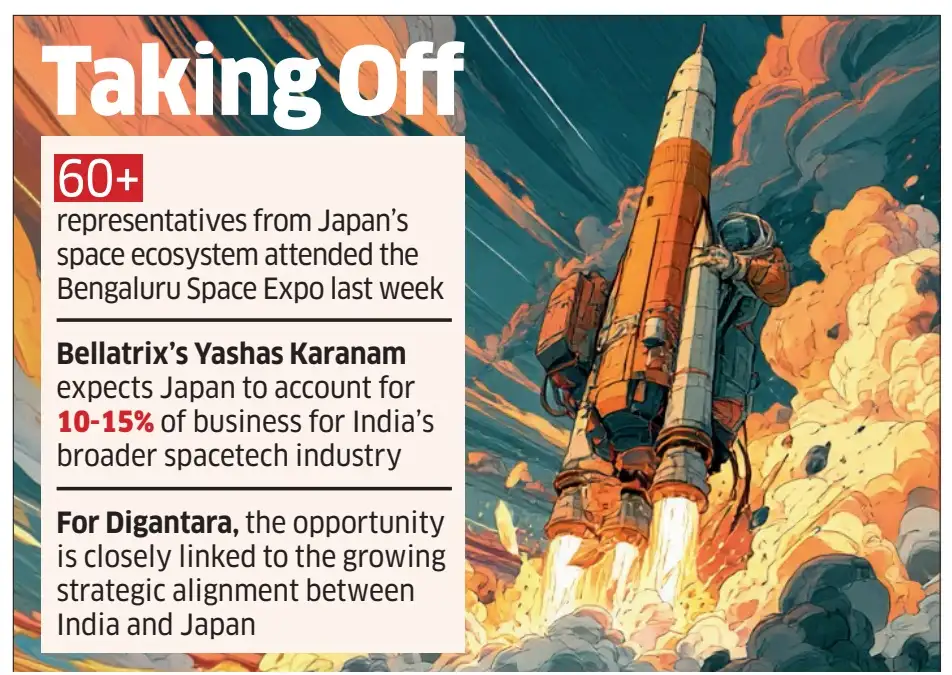
- Startups such as Digantara Industries, Bellatrix Aerospace, Xovian Aerospace, SatNxt, and Manastu Space are seeing growing interest from Japanese companies.
- More than 60 representatives from Japan attended the Bengaluru Space Expo last week, sources said, one of the larger international delegations at the event.
- Japanese companies were scouting Indian startups across launch, propulsion, Earth observation, space situational awareness, and ground infrastructure, several founders told ET.
Why the interest: Ankit Bhateja, cofounder of Xovian Aerospace, a startup that builds AI-native radio frequency satellite infrastructure, said geopolitical shifts are a key reason for Japan’s growing interest in space.
“US and Europe used to be a single bloc that’s now decoupling, with Europe trying to develop its own sovereign capabilities. This has got other countries to also start thinking,” he said.
Also Read: ISRO’s ‘Bahubali’ draws big industry interest as L&T, Adani, others eye rocket technology
ETtech Explainer: What changes for Amazon, Flipkart & consumers with the new ecommerce rules?
On September 10, the government announced changes to how ecommerce platforms such as Amazon and Flipkart must display discounts and sponsored listings, aiming to create a more transparent and balanced regulatory framework.
Yes, but: The implementation schedule means the rules will not affect the mega festive sales this year, but will shape future large-scale sales events.
The changes:
- When a discount is advertised, platforms and sellers must show both the reduced price and the “prior price”.
- The prior price must be the lowest price at which the product was offered in the 30 days before the discount was announced.
- Platforms cannot manipulate search results in ways that mislead users or reduce the relevance of results to a query.
Other Top Stories By Our Reporters
Zomato introduces fee for pay-on-delivery orders: Food delivery platform Zomato has started charging customers a fee for cash-on-delivery orders, according to information on its app. The company is levying 2% of the cart value, capped at Rs 30, as a ‘pay-on-delivery’ fee.
Alpaca eyes 10x growth in India assets: US-based brokerage infrastructure company Alpaca expects India-linked assets under custody to expand at least tenfold over the next 12 months as it prepares to take partners live through GIFT City, cofounder and global chief executive Yoshi Yokokawa told ET.
Global Picks We Are Reading
■ AI agents are thirsty for power (Wired)
■ Houthis used Anthropic AI to try to build ballistic missiles (FT)
■ Nvidia’s growing dependence on a few big customers (The Information)
Want this newsletter delivered to your inbox?
I agree to receive newsletters and marketing communications via e-mail