
 Morning Dispatch Morning Dispatch |
Inside Telegram’s leak economy; Flipkart employees’ latest windfall
Want this newsletter delivered to your inbox?
I agree to receive newsletters and marketing communications via e-mail

Thank you for subscribing to Morning Dispatch
We'll soon meet in your inbox.
Non-consensual image rings are turning small UPI transfers into tickets to abusive, closed Telegram groups. This and more in today’s ETtech Morning Dispatch.
Also in the letter:
■ Govt to draft new AI law
■ H1 venture debt deals stay flat
■ Mumbai rains disrupt online deliveries

A Rs 99 UPI transfer is fast becoming the ticket to private Telegram groups where women’s images are sold, traded, and discussed without consent.
We reviewed multiple such groups and at least 70 posts across Reddit, Instagram, and other platforms that funnel users into closed Telegram channels carrying non-consensual photos, candid shots taken in public, demands for “leaks” and a stream of abusive chatter.
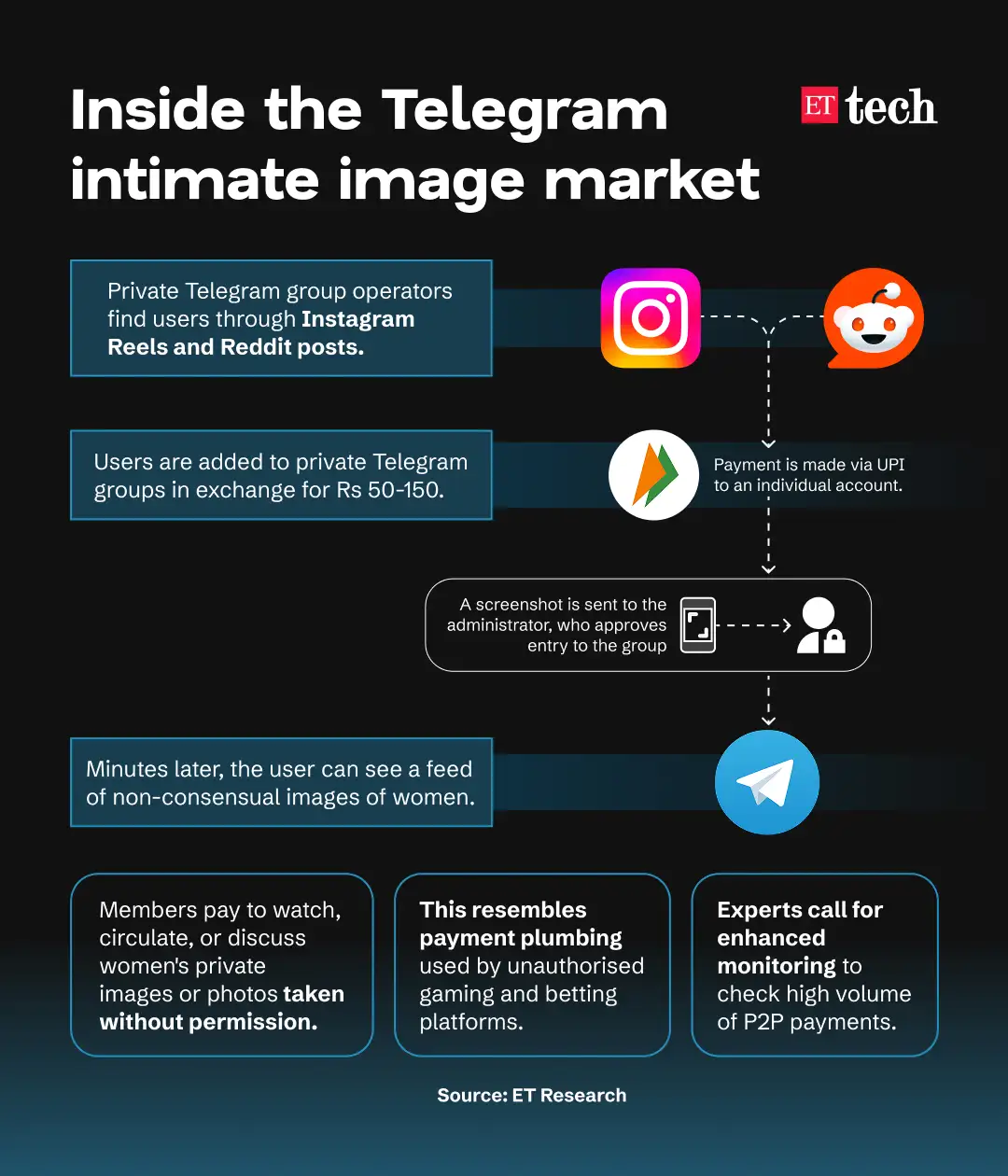
Payments power the model:
Telegram as the distribution layer:
 Kalyan Krishnamurthy, CEO, Flipkart Group
Flipkart has launched another employee stock ownership plan (Esop) liquidity programme, giving eligible staff a fresh chance to cash out a slice of the stock options vested over the past three years.
Driving the news:
In 2023, it enabled a $700 million cash payout to current and former employees after PhonePe’s separation from Flipkart, which remains the largest Esop buyback by an Indian internet company.
Yes, and: The new programme lands as Flipkart enters what Krishnamurthy called its “next chapter as an India‑domiciled company”. The group has been working to shift its holding structure to India, a move widely seen as a precursor to an eventual public listing.
A proposed artificial intelligence (AI) law may sort systems by risk and regulate them accordingly, an official told us.
Driving the news: Low-risk tools like chatbots and recommendation systems may face light-touch requirements, while high-risk uses in sectors like banking, finance, healthcare and critical infrastructure are likely to see see tougher rules.
The law could act as an umbrella framework under which sectoral regulators – including Reserve Bank of India and Securities and Exchange Board of India (Sebi) – issue more specific norms, the official added.
The missing link: The legislation is expected to build on the national AI governance guidelines released by the Centre last November. Those guidelines flagged the IT Act’s broad definition of “intermediary” as outdated and called for clearer classification of modern AI systems.
Setting context: Last week, electronics and information technology secretary S Krishnan said the government is considering a separate AI law to counter evolving threats. Existing rules have so far helped tackle early concerns around deepfakes and online harms, he said, but rising cybersecurity threats now demand a dedicated statue.

Venture debt deployment in India stayed largely flat in the first half of 2026 as fewer late‑stage equity rounds shrank the pool of companies eligible for such loans.
Jargon buster: Venture debt financing is a loan extended to companies that have already raised institutional equity capital and want to fund their next phase of growth. Venture lending typically tracks equity fundraising cycles closely.
Data decoded: Between January and June:
Why deployment stayed flat: Venture debt shadows equity cycles; with fewer growth‑stage rounds, lenders saw fewer immediate opportunities. Most meaningful venture debt becomes available from Series B onwards, while seed and Series A companies remain too early for this kind of capital.

Mumbai rain hits online deliveries: Heavy rainfall across Mumbai has begun to disrupt quick‑commerce operations and ecommerce deliveries, with companies warning customers of service interruptions and longer delivery timelines.
Rentomojo gets IPO greenlight: Furniture and home electronics rental startup Rentomojo has secured approval from the Securities and Exchange Board of India for its proposed initial public offering. The IPO will comprise a fresh issue of shares worth Rs 150 crore and an offer for sale of up to 28.4 million shares by existing shareholders.
Suzuki subsidiary launches Rs 2,000 crore fund: Next Bharat Ventures, a subsidiary of Suzuki Motor Corporation, has launched a Rs 2,000 crore impact‑focused venture fund, among the largest of its kind in India, to back startups building businesses for rural and under‑served communities.
■ Son remakes SoftBank in his own image (FT)
■ China’s web novel platforms embraced AI. Now they are fighting it (Rest of World)
■ How small firms use Claude to quit Salesforce (The Information)
Also in the letter:
■ Govt to draft new AI law
■ H1 venture debt deals stay flat
■ Mumbai rains disrupt online deliveries
ETtech in-depth: Pay Rs 99 via UPI, get access to Telegram’s privacy abuse economy
A Rs 99 UPI transfer is fast becoming the ticket to private Telegram groups where women’s images are sold, traded, and discussed without consent.
We reviewed multiple such groups and at least 70 posts across Reddit, Instagram, and other platforms that funnel users into closed Telegram channels carrying non-consensual photos, candid shots taken in public, demands for “leaks” and a stream of abusive chatter.
Payments power the model:
- Operators typically collect Rs 50-150 via P2P UPI transfers into personal bank accounts, with no website, merchant account or payment gateway in sight.
- Industry insiders say some of these operators juggle multiple UPI IDs, intermediaries and mule or rented accounts to pool and reconcile payments.
- Experts point out that such transfers are difficult to police because payment apps cannot see or infer the underlying purpose of a P2P transaction.
Telegram as the distribution layer:
- Telegram’s large groups, seamless file‑sharing, persistent usernames and easy link rotation make it an efficient distribution stack for operators shifting users off mainstream social platforms.
- AI‑generated and morphed images add another layer of risk, as the same channels can blast synthetic abuse content at scale.
- Legal experts warn that even people who actively seek out or join groups sharing non‑consensual imagery can face prosecution under existing law.
Flipkart rolls out $50 million Esop buyback, second payout in a year
Flipkart has launched another employee stock ownership plan (Esop) liquidity programme, giving eligible staff a fresh chance to cash out a slice of the stock options vested over the past three years.
Driving the news:
- Walmart‑owned Flipkart has set aside a $50 million corpus for the programme.
- Eligible employees can liquidate up to 5% of the stock options vested over the past three years at Rs 713.4 per option, according to an internal email from group chief executive Kalyan Krishnamurthy.
- The payout is scheduled for August 2026.
In 2023, it enabled a $700 million cash payout to current and former employees after PhonePe’s separation from Flipkart, which remains the largest Esop buyback by an Indian internet company.
Yes, and: The new programme lands as Flipkart enters what Krishnamurthy called its “next chapter as an India‑domiciled company”. The group has been working to shift its holding structure to India, a move widely seen as a precursor to an eventual public listing.
New AI law may focus on graded, risk-based regulations: Officials
A proposed artificial intelligence (AI) law may sort systems by risk and regulate them accordingly, an official told us.
Driving the news: Low-risk tools like chatbots and recommendation systems may face light-touch requirements, while high-risk uses in sectors like banking, finance, healthcare and critical infrastructure are likely to see see tougher rules.
The law could act as an umbrella framework under which sectoral regulators – including Reserve Bank of India and Securities and Exchange Board of India (Sebi) – issue more specific norms, the official added.
The missing link: The legislation is expected to build on the national AI governance guidelines released by the Centre last November. Those guidelines flagged the IT Act’s broad definition of “intermediary” as outdated and called for clearer classification of modern AI systems.
Setting context: Last week, electronics and information technology secretary S Krishnan said the government is considering a separate AI law to counter evolving threats. Existing rules have so far helped tackle early concerns around deepfakes and online harms, he said, but rising cybersecurity threats now demand a dedicated statue.
Deep‑tech pipeline offers hope as venture debt deals stay flat in H1
Venture debt deployment in India stayed largely flat in the first half of 2026 as fewer late‑stage equity rounds shrank the pool of companies eligible for such loans.
Jargon buster: Venture debt financing is a loan extended to companies that have already raised institutional equity capital and want to fund their next phase of growth. Venture lending typically tracks equity fundraising cycles closely.
Data decoded: Between January and June:
- Alteria Capital deployed about Rs 680 crore across 48 companies
- Trifecta Capital invested nearly Rs 600 crore in roughly 30 startups
- Innoven Capital India deployed around Rs 400 crore across 16 companies.
Why deployment stayed flat: Venture debt shadows equity cycles; with fewer growth‑stage rounds, lenders saw fewer immediate opportunities. Most meaningful venture debt becomes available from Series B onwards, while seed and Series A companies remain too early for this kind of capital.
Other Top Stories By Our Reporters
Mumbai rain hits online deliveries: Heavy rainfall across Mumbai has begun to disrupt quick‑commerce operations and ecommerce deliveries, with companies warning customers of service interruptions and longer delivery timelines.
Rentomojo gets IPO greenlight: Furniture and home electronics rental startup Rentomojo has secured approval from the Securities and Exchange Board of India for its proposed initial public offering. The IPO will comprise a fresh issue of shares worth Rs 150 crore and an offer for sale of up to 28.4 million shares by existing shareholders.
Suzuki subsidiary launches Rs 2,000 crore fund: Next Bharat Ventures, a subsidiary of Suzuki Motor Corporation, has launched a Rs 2,000 crore impact‑focused venture fund, among the largest of its kind in India, to back startups building businesses for rural and under‑served communities.
Global Picks We Are Reading
■ Son remakes SoftBank in his own image (FT)
■ China’s web novel platforms embraced AI. Now they are fighting it (Rest of World)
■ How small firms use Claude to quit Salesforce (The Information)
Want this newsletter delivered to your inbox?
I agree to receive newsletters and marketing communications via e-mail