US proposes plan to scrap additional security checks for Indians at transit points
US and India collaborate to enhance aviation safety through streamlined security processes, improved passenger flow, and ongoing information exchange. The one-stop security concept offers benefits like enhanced safety, reduced costs, and shorter c...
By ET Online | Updated:

iStock
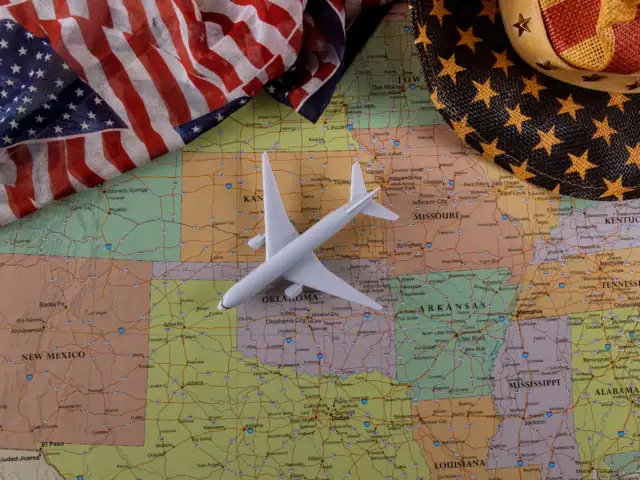
In a move to streamline international air travel, the US Transportation Security Administration (TSA) has proposed a "one-stop agreement" with India to eliminate the need for rescreening passengers and luggage at transfer points.
Addressing the India-US Aviation Summit in Washington, David Pekoske, Administrator of the TSA, highlighted the feasibility and benefits of this concept.
The one-stop security concept simplifies the travel process by ensuring passengers and their checked baggage do not require additional security checks when transferring between flights in different countries. "This concept expedites the flow of passengers and baggage to their destinations by eliminating the duplication of security controls at transfer points," Pekoske explained.
Pekoske emphasized the security advantages, noting that such an agreement would enhance safety for flights inbound to both countries. "It requires the regular exchange of information and improvements to security processes to maintain the agreement," he said, adding that it also reduces security costs, shortens flight connection times, and improves the overall passenger experience.
A memorandum of agreement is necessary to share sensitive security information between the two countries. Pekoske mentioned, "We have a category of classification of information that is not classified in the true sense of classified material, but it is sensitive enough that it needs additional protections."
Reflecting on the origins of the TSA and India's transportation security measures, Pekoske noted both were born from tragic events. For India, it was the Air India 'Kanishka' Flight 182 bombing in 1985, and for the TSA, it was the 9/11 attacks in 2001. "These tragic events were paradigm shifts in how we both thought about transportation security that continues today," he said.
At the summit, US Federal Aviation Administrator Michael Whitaker emphasized the need for India and the US to collaborate on aviation safety issues. "Safety is a team sport," he said, underscoring the importance of data sharing to identify and mitigate risks in the sector.
Whitaker highlighted the interconnected nature of the US and Indian aviation systems, which form a part of a single global network. "We need to work together on issues like safety, we need to share ideas and share innovations, especially in how to safely incorporate some of these new technologies into our airspace," he stated.
The collaboration between the two countries aims to enhance the overall safety of the global aviation system by sharing best practices and learning from each other. Whitaker stressed the importance of proactively analyzing data to prevent accidents. "Our challenge is to bring safety to the next level, and that means we need to proactively analyze data and find those risks of failure and mitigate those risks before they happen," he added.
Addressing the India-US Aviation Summit in Washington, David Pekoske, Administrator of the TSA, highlighted the feasibility and benefits of this concept.
The one-stop security concept simplifies the travel process by ensuring passengers and their checked baggage do not require additional security checks when transferring between flights in different countries. "This concept expedites the flow of passengers and baggage to their destinations by eliminating the duplication of security controls at transfer points," Pekoske explained.
Pekoske emphasized the security advantages, noting that such an agreement would enhance safety for flights inbound to both countries. "It requires the regular exchange of information and improvements to security processes to maintain the agreement," he said, adding that it also reduces security costs, shortens flight connection times, and improves the overall passenger experience.
A memorandum of agreement is necessary to share sensitive security information between the two countries. Pekoske mentioned, "We have a category of classification of information that is not classified in the true sense of classified material, but it is sensitive enough that it needs additional protections."
Reflecting on the origins of the TSA and India's transportation security measures, Pekoske noted both were born from tragic events. For India, it was the Air India 'Kanishka' Flight 182 bombing in 1985, and for the TSA, it was the 9/11 attacks in 2001. "These tragic events were paradigm shifts in how we both thought about transportation security that continues today," he said.
ADVERTISEMENT
At the summit, US Federal Aviation Administrator Michael Whitaker emphasized the need for India and the US to collaborate on aviation safety issues. "Safety is a team sport," he said, underscoring the importance of data sharing to identify and mitigate risks in the sector.
Whitaker highlighted the interconnected nature of the US and Indian aviation systems, which form a part of a single global network. "We need to work together on issues like safety, we need to share ideas and share innovations, especially in how to safely incorporate some of these new technologies into our airspace," he stated.
The collaboration between the two countries aims to enhance the overall safety of the global aviation system by sharing best practices and learning from each other. Whitaker stressed the importance of proactively analyzing data to prevent accidents. "Our challenge is to bring safety to the next level, and that means we need to proactively analyze data and find those risks of failure and mitigate those risks before they happen," he added.
Visiting the United States has become more accessible, but understanding the array of available visas and determining eligibility remains a complex task.
While the H-1B, student, and tourist visas are widely known, lesser-known visas might better suit specific needs.
Here's a breakdown to help you identify the right visa based on your purpose:









ADVERTISEMENT
with PTI inputsDownload
The Economic Times Business News App for the Latest News in Business, Sensex, Stock Market Updates & More.
The Economic Times Business News App for the Latest News in Business, Sensex, Stock Market Updates & More.
ADVERTISEMENT


